For Youth, Losing Access to Social Media Means Losing Access to Power
Tess Vartanian, Aliya Bhatia / Nov 19, 2026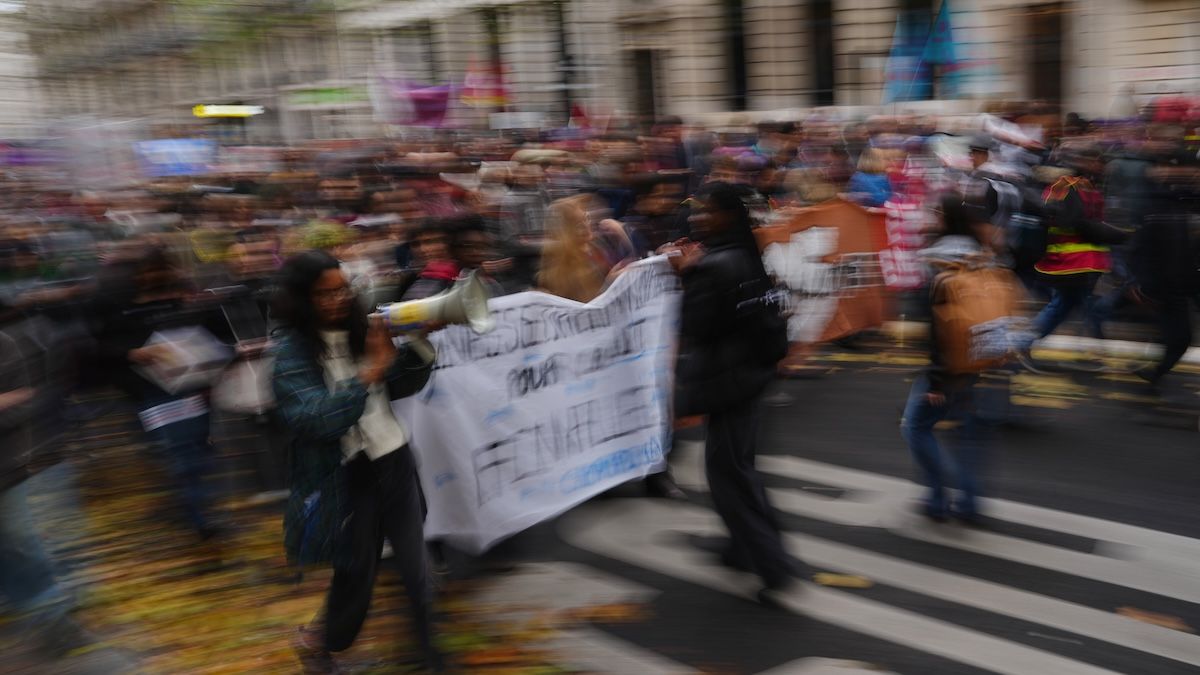
Students marching over public sector wages, cost of living and school conditions in Paris, France. Nov. 17, 2026. (AP Photo/Aurelien Morissard)
Over the last few months, hundreds of thousands of people in France have taken to the streets and joined student-led protests against staff and resource shortages in the country’s public schools. What started as a protest at one school in the suburbs of Paris has erupted into a nationwide movement over spending cuts to education and soaring costs of living.
France is not alone. Youth-led protests have spread across Europe, Asia, and Latin America. In Chile, Greece, and Italy, thousands of students have marched against cuts to education funding. And in India, anger over the country’s examination system has grown into a youth-led movement that has mobilized thousands of students across dozens of demonstrations with enough political force to lead to the education minister’s resignation.
This is one of the largest and most significant surges in youth protests since 1968 — the year student-led movements erupted in Paris, Prague, and the United States to challenge the Vietnam War, totalitarianism, and entrenched social hierarchies.
But today’s protesters have something their 1968 predecessors did not: social media. And authorities around the world have responded with alarming proposals to take away that mobilizing tool.
Young people are making their voices heard on social media platforms like Instagram, TikTok, and X. In France, early protests began as students exchanged messages on Snapchat, complaining how their schools had no teachers and no water and then exchanging plans on where to meet up and when.
The political importance of social media goes beyond organizing and documenting protests. Young people use these platforms to discuss social issues, criticize government policy, circulate petitions, share firsthand accounts, and find others who care about the same causes. For some, online participation is the only realistic option. Many young people need permission from their parents to attend protests or live in regions where public transportation is unavailable or unsafe, particularly for young girls.
While social media is important for everyone’s political involvement, it plays a particularly important role for young people who have not yet reached adulthood and therefore have limited political outlets. Minors cannot vote, and they generally have less money, less mobility, and less access to elected officials than adults. They cannot run for office. But a teenager with a phone can publish a video, organize demonstrations, and help a political message reach millions.
International human rights law recognizes that children do not lack rights to expression, assembly, and association just because they are under 18. National constitutions, including France’s, likewise protect the expressive rights of all people — including children. The United Nations’ Convention on the Rights of the Child has made clear that those rights extend online.
Yet democratic governments around the world are considering or adopting age restrictions on social media. France, Australia, the United Kingdom, Malaysia, and Greece are among the countries that have pursued or adopted social media bans for children under 16 or 15. Various states in the United States have sought to enact similar measures. India and Chile too have expressed interest in restricting children from accessing online services. But not all are surviving legal challenges. Over the summer, France’s high court ruled that the country’s attempt to block social media for children under 15 was unconstitutional, finding that it disproportionately infringed their freedom of expression and communication.
The concerns underlying these bans are real. Young people can face serious harms online, including sexual exploitation, privacy violations, and negative mental health effects. Governments have a legitimate interest in reducing those harms. But governments must also account for young people’s ability to speak, assemble, and organize, especially at a moment like this. Cutting an entire age group off from some of the world’s most important communications platforms is not a narrowly tailored safety measure. It is a substantial burden on young people’s participation in politics. Enacting a ban now would silence them during monumental political change.
The current demonstrations show that social media bans can be used to silence young people rather than protect them. In France, officials see the enormous role social media has played and seem to be looking for ways to cut these channels off, including by influencing companies directly, renewing calls to block minors from social media to break up the protests, and considering a “social media blackout” to disrupt demonstrations. This trend is observable beyond France: Indian authorities for example are cutting internet services, ordering mass takedowns of posts that criticize the government, and considering age-based restrictions on social media.
In this context, social media bans function as a tool for censorship and a barrier to entry for political participation. When governments restrict young people’s access to social media, they are not just limiting access to memes. They are cutting them off from one of the most powerful tools they have for political organizing.
In 1968, governments used military invasions, police brutality, and mass arrests to crush the protests. As protests today are increasingly met with state-backed force in Paris, Delhi, Santiago, and beyond, social media bans might look harmless by comparison. But their political consequences can be even more profound. By cutting young people off from the communications networks they use to find one another, organize, and share ideas, a government can effectively stop a political movement before it ever reaches the streets. And in suppressing the political rights of one generation, it erodes the fundamental rights of all.
Authors