For Students, the Process of 'Becoming' is the Challenge No Chatbot Can Solve
Hannah Kim / Jun 25, 2026This post is part of a series of student essays produced in collaboration with the Berkman Klein Center for Internet & Society at Harvard University. Read more in the series here.
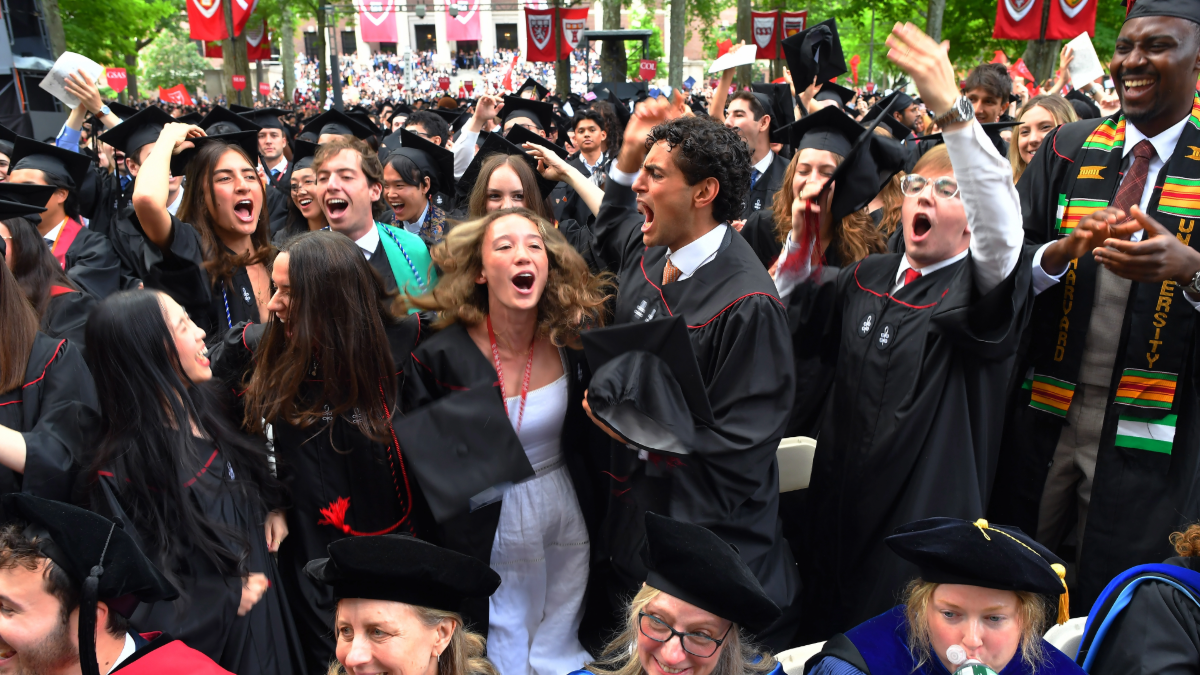
Harvard University graduates, top, celebrate during commencement exercises on the school's campus, Thursday, May 28, 2026, in Cambridge, Mass. (AP Photo/Steven Senne)
I started college in the aftermath of a global pandemic and graduated in the aftermath of ChatGPT. The first is behind us, but the second is here to stay.
I remember the firehose of freshman year. There were back-to-back discoveries of ‘what ifs’ hidden in the new locations and faces, excluding the unfortunate few in quarantine, and I was pressed for time to do it all. The academics demanded no less. Readings were relentless, and problem sets had a way of collapsing an entire afternoon into a single unanswered question. There was no shortcut through any of it, except for the slow, unglamorous process of processing intentionally and hoping for the reward of a lightbulb moment. This was what college felt like. Tiring, directionless, and sometimes isolating, but I cherished it.
When I entered sophomore year and OpenAI announced ChatGPT, I was not surprised. Artificial intelligence was always looming, and the question was never if, but when and how capable it would be. What truly surprised me was the enticement it would bring. ChatGPT and its counterparts were not tempting students to cut corners; rather, they were selling them a more achievable, impressive version of themselves. It promised instant, personalized support, so that even if office hours were unavailable, you could still get your question answered. It also promised some level of peace. If early versions of ChatGPT-generated essays could earn a 3.57 cumulative GPA in one semester, true academic failure was impossible. How, then, could engaging with generative AI possibly regress the student? Perhaps it was raising the floor, then granting the key to manifesting their greatest potential.
It has been 4 years since generative AI arrived on campus, but greater student potential has not noticeably manifested, at least to my knowledge. In the most recent academic term, Spring 2026, Computer Science Professor James Mickens posted his thoughts on a message board regarding the midterm scores for CS1610, a course on Operating Systems. He wrote, “In the ten years that I've been at Harvard, this midterm average was the lowest midterm average that I've seen for one of my classes, being roughly 13 points lower than the historical one.”
Variance in test scores is to be expected, but this case feels like an outlier. The distribution of the scores is bimodal. The larger left peak, representing students who struggled on the exam, is clearly separated from the smaller right peak, representing students who performed well. What is causing this divide? It could be circumstantial, but it would be naive to fully discount the role of AI usage, especially since the midterm was composed using the same methodology as in the past. Professor Mickens holds similar suspicions. He hypothesizes that many students relied too heavily on AI tools, which caused “a shallow understanding of the underlying concepts,” and that it was “not the result of me trying to write a harder midterm.”
CS1610 is a non-required, yet non-trivial class for Computer Science undergraduates, meaning students who enroll are electing to take on a challenge. They have dedication, foundational knowledge, and a higher likelihood of familiarity with AI than the average non-Computer Science concentrator. When that background is leveraged effectively, as Professor Mickens acknowledges, “AI tools can be great force multipliers…” However, this incident demonstrates that technical background or expertise alone does not protect you from risks of AI usage. No one is safe, and regardless of whether the students under the right peak of the grade distribution also used AI heavily, that truth remains.
The Computer Science department is not alone. The Harvard Crimson found that nearly 80% of respondents to the annual survey of the Faculty of Arts and Sciences in Spring 2025 had “seen coursework they knew or believed to be made using AI.” From the same survey, 69% agreed that students did not prioritize their coursework enough, and 82% voted that generative AI be completely prohibited or permitted with restrictions. At least from the standpoint of faculty, it seems that the student body’s embrace of AI is leading to a deprioritization rather than an advancement of academics.
Harvard has not taken a firm stance on the use of generative AI and instead gives faculty the discretion to determine their individual course policies. Official guidelines offer faculty examples of policies ranging from fully encouraging to maximally restrictive. While this approach offers faculty flexibility, it creates a climate of mixed messaging that intensifies the already heavy burden students carry.
For example, I interpret a classroom policy discouraging AI use as a well-intentioned attempt to recenter academics, but one that overlooks the pressures of the job market. While the economy is impossible to predict, the message is clear to employers and employees: knowing how to leverage generative AI tools effectively is crucial to stay competitive. On the other hand, policies encouraging AI are also well-intentioned attempts to cultivate AI fluency, but they come with an implicit assumption and thus an expectation that students will perform at a higher academic level on an already tilted playing field. A 2024 survey found that Harvard students who do not receive financial aid are twice as likely to pay for premium AI products than students who do. Those who spent money on AI reported beneficial effects, suggesting that AI access is a consequential privilege. While Harvard is trying to address this inequality through initiatives like ChatGPT Edu, the University simply cannot keep up with the pace of the market.
It is understandable then why undergraduates rely on AI for academic support regardless of stated course policies. They are not choosing between learning and slacking off, but between learning with long-term stability. Suddenly, their academic choices become a series of demanding micro-decisions that need to be made in an already high-stakes, high-achieving environment. Decisions like how to improve a thesis statement become decisions about whether to edit it, at the cost of losing time building a personal “AI workflow” that will impress an employer. Choosing unilateral disarmament, too, is tricky, as it might disadvantage a student who wants to maintain a competitive GPA relative to others who do use AI. To top it all off, even if students aggressively embrace the technology, access is fundamentally inequitable and they are left in a perpetual tug-of-war where nothing they choose feels adequate to themselves or to the world. Simply put, students are enduring an explosion of expectations.
One might argue that generative AI’s impact on academics will eventually be good, and the solution is to reframe it all as building a robust training ground for some future steady state. I am sympathetic to this claim, but not entirely convinced. Yes, the classroom experience is supposed to throw obstacles precisely because true struggle is necessary for growth. There is, however, a difference between struggling productively and conditioning neglect. What I notice now are the intentional and accidental slips of choosing instant convenience that willingly hides under the guise of mob mentality. These slippages outscore moments of courage, admitting defeat in intellectual battles and earnestly seeking instruction once, twice, or however many times it takes. I am also unable to ignore the gradual erosion of trust and respect as lecture halls visibly vacate when professors are not looking, or worse, when they give up. As it currently stands, this new “training ground” is not building adaptability in good faith. How could it be when the commitment to holding ourselves and each other to timeless norms, not just obsolete written rules, is wavering?
To say this commitment is wavering is not to say it cannot be restored, nor that students are without a role in restoring it. Just as students can still choose to wrestle with a problem before asking for the solution, they can choose to wrestle with a blank page before prompting a large language model primed with an “academic tone” and “no em dashes.” Epiphanies are available. Students can still choose to knock on a professor’s door with a question, just as they can ask a chatbot for a small hint without revealing the solution. Depth, too, is also there for the taking. Students can choose to confide in an actual friend over large language model platitudes. Human relationships are also waiting to be developed. The choice has always been there, before and after generative AI’s arrival on campus.
Yet that choice does not exist in a vacuum. It is surrounded by an industry, an access gap, and conflicting messages, none of which is within a student’s control. What remains within their control is narrower, but crucial. It is how to think, today, about what is in front of them, rather than what to think. This choice is not about winning a race against a machine built to finish faster, but about doing what a machine cannot do on behalf of a student: becoming. There is a particular feeling that comes with becoming. It comes when a wrong idea finally gives way to a right one, or when a conversation with a roommate runs later than either of you intended, and is better for it. The joy that follows is not a reward waiting at the end of the hard work, but it is what becoming feels like while it is still happening: a tired mind producing an imperfect idea that is unmistakably one’s own. This choice is small and ever-present, but it is more than enough.
Read other aticles in this series
Authors