For Meta’s Smart Glasses, Access Is An Afterthought
Ariana Aboulafia / Aug 12, 2026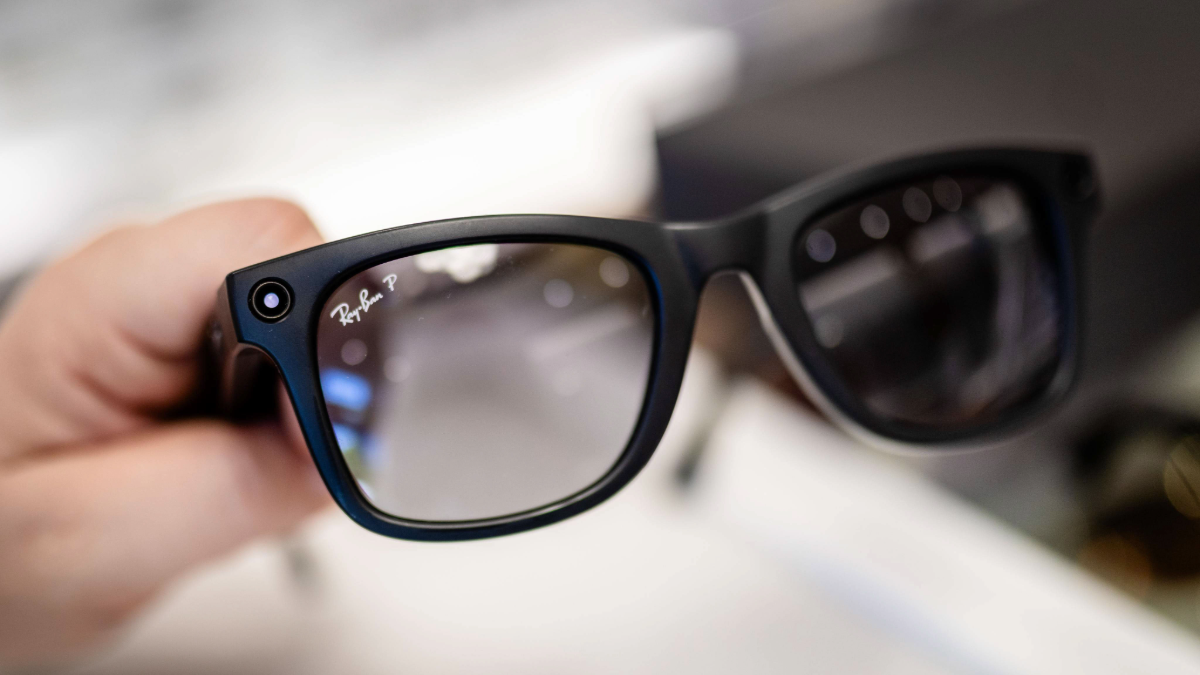
Baden-Württemberg, Stuttgart: A woman is holding a pair of smart glasses from Ray-Ban Meta in her hand at an eyewear store. (Christoph Schmidt/picture-alliance/dpa/AP Images)
AI-enabled smart glasses may very well be tech’s hottest, and creepiest, accessory.
Google recently announced that it is releasing its first smart glasses since Google Glass. Snap launched its smart glasses earlier this summer, and Meta—the company behind the nearly infamous Meta Ray-Bans—continues to expand its influence on the market, with the consistent launch of new models and collaborations with celebrities. Indeed, Q4 2025 filings tell us that sales of the Meta AI glasses rose from a combined 2 million in 2023 and 2024 to 7 million in 2025. Despite the momentum, the features that these glasses may contain—as well as their impact on marginalized people, and how they are marketed—should all give us pause.
An internal memo from Meta, published earlier this year, suggested that the company planned at some point to integrate facial recognition technology into the glasses, and recent reporting from Wired found that Meta rolled out and subsequently deleted code that would allow facial recognition capabilities for its smart glasses through the companion Meta AI app. This means that at some point in the near future, any person you encounter wearing the relatively normal-looking glasses could not only be nonconsensually recording you—including in sensitive places, like medical offices—but also scanning your face and identifying you. The New York Times reported that the memo also mentioned that Meta initially planned to first introduce the feature to "attendees of a conference for the blind,” and roll it out more widely “during a dynamic political environment where many civil society groups that we would expect to attack us would have their resources focused on other concerns.”
Many in civil society, of course, have already called for Meta to abandon the plan to add facial recognition to the glasses, with the Electronic Frontier Foundation calling it “a bad idea that… would violate the privacy rights of millions of people.” But it’s also worth noting that here, Meta aimed to use accessibility and disability rights as a Trojan horse for a tool that poses significant privacy and security threats to people with and without disabilities.
Earlier this year, a Super Bowl ad for Ring presented the product as a solution for finding lost puppies. While the use case seemed convenient and unobjectionable, it was a shield against criticism of a tool that raises concerns for people’s civil rights and liberties—and Meta’s attempt to brand its glasses as an accessibility aid is no different.
Some people with disabilities, including blind and low-vision people, do use the glasses and find them to be useful tools. Some blind and low-vision people even use other facial recognition-enabled tools (including apps) as accessibility aids, some of which work by providing a tech-enabled visual description for folks to recognize faces or read expressions (though there have long been concerns about how accurate these tools even are). Apparently, Meta’s proposed facial recognition feature would instead aim to use the tech to identify people, either limited to those that a user is connected to on Meta platforms, or including anyone who has a public account on a Meta platform, like Instagram. This is a much broader and more privacy-impacting way of using facial recognition—whether the user has a disability or not.
This method of integrating facial recognition technology, combined with the memo’s framing, suggests that “helping” disabled people is not the primary driver of the facial recognition feature. The disability community has recognized this: the American Foundation for the Blind called the glasses “an accessibility tool only by coincidence.” Notwithstanding this, the outright exploitation of the disability community as a means of normalizing intrusive technologies has not often been named. This is likely, in part, because many people with disabilities have accepted that they must give up some privacy in order to enhance their access—but an accessible tool does not have to be an intrusive one.
While privacy and accessibility trade-offs exist, particularly within certain assistive technologies, companies should be minimizing them rather than taking advantage of disabled people’s possible willingness to give up privacy for access. Developers are capable of incorporating privacy into the principles of inclusive design and using inclusive design to build their tools—particularly those they are going to market to the disability community—limiting the need for trade-offs.
With its smart glasses, Meta has done neither, and it’s evident in other features and the overarching impact of the product. For example, the only signifier that the glasses are recording is a small, dim blinking light, which is difficult even for a sighted person to perceive from more than a couple feet away. Many blind and low-vision passersby, who are not able to perceive the indicator, then have no way of knowing when they are being recorded—meaning that this feature is more likely to limit the privacy of a population Meta alleges it is building these tools to benefit. Furthermore, disabled people are disproportionately likely to experience intimate partner violence and stalking, which according to some advocates, could be further facilitated by the incorporation of facial recognition into smart glasses.
Meta is not the only tech company to use accessibility—and people with disabilities, more generally—as a means of justifying the existence and proliferation of its privacy-invasive products. Manufacturers of autonomous vehicles have also argued that they are particularly helpful for disabled users, though they also pose significant privacy risks for everyone. When users generally have concerns about privacy, they may hesitate or be less likely to use or trust a particular tool. Tech companies likely know this, and are comfortable using disabled people as a smoke screen to obfuscate the risks. But this means that, when an “accessible” product’s harms become reality, disabled people will be used as scapegoats. Access needs, though, are not the true reason so many tech-enabled harms exist: we can look to the companies, and how they build their products, for those answers.
Authors