February 2026 US Tech Policy Roundup
Rachel Lau, Shirley Frame / Mar 4, 2026Rachel Lau and Shirley Frame work with leading public interest foundations and nonprofits on technology policy issues at Freedman Consulting, LLC.
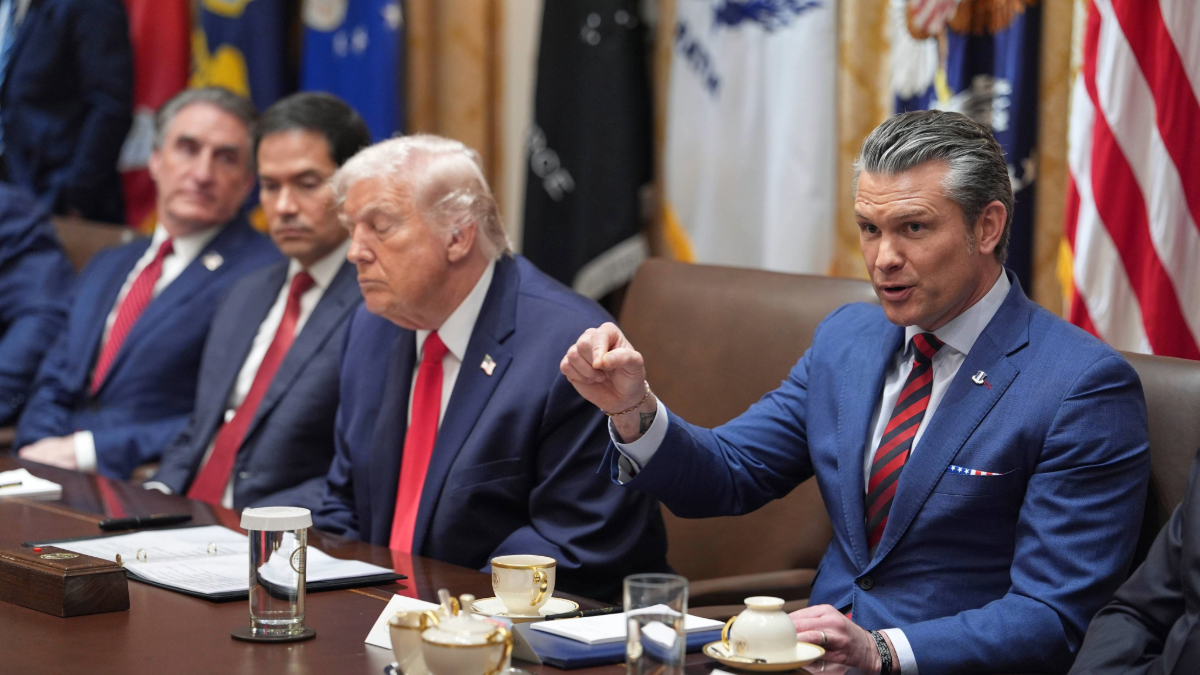
Defense Secretary Pete Hegseth speaks during a cabinet meeting at the White House, Thursday, Jan. 29, 2026, in Washington. (AP Photo/Evan Vucci)
February’s US tech policy was marked by a dramatic confrontation between the Trump administration and Anthropic over military use of AI. After months of negotiations over whether the Pentagon could use Anthropic’s Claude model “free from usage policy constraints that may limit lawful military applications,” President Trump ordered all federal agencies to cease using Anthropic’s technology and Defense Secretary Pete Hegseth designated Anthropic a “supply-chain risk to national security”– a label never previously applied to an American company. The dispute, which raised fundamental questions about the relationship between the government and private tech companies, drew responses from across the tech industry and civil society.
The federal government’s expanding use of AI tools for surveillance and immigration was a theme in February, as the Trump administration pushed for an extension of Section 702 of the Foreign Intelligence Surveillance Act, set to expire in April, while a bipartisan group of senators reintroduced legislation seeking warrant protections. A newly released AI inventory also revealed a nearly 40 percent increase in AI use cases at the Department of Homeland Security, many tied to immigration enforcement. In the courts, a federal judge found that the IRS illegally shared taxpayer data with ICE more than 42,000 times.
Meanwhile, two landmark child safety trials against Meta began in New Mexico and Los Angeles. Finally, AI and tech companies dramatically grew political spending ahead of the 2026 midterms, with Meta, Anthropic, and others putting tens of millions of dollars into competing political spending vehicles.
Read on to learn more about February developments in US tech policy.
Trump administration bans Anthropic following dispute over military use of its AI tools
Summary
On February 27, President Trump ordered all federal agencies to "immediately cease" using Anthropic technology after a monthslong dispute over military use of the company's AI tools. Meanwhile, Defense Secretary Pete Hegseth labeled Anthropic a "supply-chain risk to national security"—a classification never before publicly applied to an American company, effectively barring defense contractors and suppliers from working with the company. Both directives included a six-month phase-out, since Claude had been the only frontier AI model on the Pentagon's classified networks before this month’s events. Despite the ban, the Wall Street Journal reported that the military used Claude when conducting strikes on Iran.
The consequences of the orders remained uncertain as of the month’s end: legal experts questioned the basis for Hegseth's designation, noting it requires a formal legal process and has never been applied to a domestic company. Anthropic contended that the ban can only restrict use of Claude within DoD contracts and argued that the supply-chain designation was "legally unsound,” saying it would challenge the decision in court and urging customers to maintain their contracts. The Pentagon contract represented a small fraction of Anthropic's $14 billion in annualized revenue, and most industry partners had not publicly responded to the directive as of the end of the month.
The conflict began in January after what Semafor reported as a contentious exchange between Anthropic and Palantir officials over Claude's role in the capture of Venezuelan President Nicolas Maduro—an account Anthropic has disputed. Tensions escalated as the Pentagon insisted that companies' usage policies must not constrain lawful military applications. Anthropic, however, maintained its policy prohibiting the deployment of Claude for mass domestic surveillance or fully autonomous weapons. CEO Dario Amodei refused to acquiesce to the Pentagon’s demands, writing that the company “cannot in good conscience accede to their request.” In response, Hegseth threatened to invoke the Defense Production Act—a Korean War-era law allowing the government to require private companies to support national defense—but ultimately did not do so.
Amid the feud, other AI companies also took action on classified government deployment. In the week before the ban, xAI became the second company to reach a classified deployment agreement with the Pentagon. Additionally, hours after Trump's directive, OpenAI CEO Sam Altman announced a deal to deploy OpenAI's models on the Pentagon's classified networks. Following significant backlash, Altman acknowledged days after the initial statement that the deal’s details were still in development and that the rushed announcement “looked opportunistic and sloppy.” In early March, OpenAI announced new provisions preventing the use of its AI tools for mass surveillance of Americans in the contract under negotiation with the Pentagon.
The dispute drew a significant response from civil society and industry. Before the ban announcement, a coalition of labor organizations and unions representing over 700,000 workers at Amazon, Google, and Microsoft urged their employers to refuse the Pentagon's demands, while more than 300 Google and over 60 OpenAI employees signed a separate open letter calling on industry leaders to support Anthropic. Following the announcement, hundreds of tech workers signed another open letter calling on the DOD to rescind the designation and asking Congress to “examine whether the use of these extraordinary authorities against an American technology company is appropriate.” Samir Jain, vice president of policy at the Center for Democracy and Technology, warned that under current law, AI-enabled mass surveillance could persist regardless of contractual restrictions and Anthropic’s position on the government’s AI use. Anthropic appeared to gain public support from the dispute, with Claude becoming the top free download on Google and Apple app stores following the ban announcement.
What We’re Reading
- Justin Hendrix, “How to Think About the Anthropic-Pentagon Dispute,” Tech Policy Press.
- Elke Schwarz, “Tech, Venture Capital and the Hype of War,” Tech Policy Press.
- Justin Hendrix, “A Timeline of the Anthropic-Pentagon Dispute,” Tech Policy Press.
- Jordan Ascher, “Trump Administration Official Says Quiet Part Out Loud on AI-in-Government Plans,” Tech Policy Press.
Tech TidBits & Bytes
Tech TidBits & Bytes aims to provide short updates on tech policy happenings across the executive branch and agencies, Congress, civil society, industry, and courts.
In the executive branch and agencies:
- With Section 702 of the Foreign Intelligence Surveillance Act set to expire in April, the Trump administration pushed for an 18-month extension of the warrantless surveillance authority without reform amendments, while a bipartisan group of senators led by Sens. Dick Durbin (D-IL) and Mike Lee (R-UT) re-introduced the SAFE Act (S. 3893), which would require a warrant before intelligence agencies can access Americans' communications swept up in the program. Durbin noted that the FBI still conducts over 200,000 warrantless searches of Americans' data annually under the current framework.
- At the conclusion of the fourth global AI summit in New Delhi, the US and 87 other countries and organizations signed the India-led summit agreement. The agreement shifted focus from AI safety toward broader adoption and access. While the summit secured more than $250 billion in pledges for building AI infrastructure, critics argued that it failed to advance concrete global safety standards.
- At the State of the Union, President Trump outlined a “Ratepayer Protection Pledge” intended to reduce electricity bills for American households by requiring the tech industry to cover its own energy costs for data centers by building their own power plants or paying for dedicated energy sources. Trump announced that major tech firms, including Amazon, Google, Meta, OpenAI, xAI, and others, will attend an event at the White House in early March to sign the pledge.
- The Federal Trade Commission (FTC) issued a policy statement stating that it will not penalize operators of general and mixed audience sites under the Children’s Online Privacy Protection Act (COPPA) for gathering personal data strictly to confirm a user’s age, provided they delete the data promptly after verification and do not use it for marketing or other secondary purposes.
- The Department of Homeland Security (DHS) awarded Palantir Technologies a five-year blanket purchase agreement (BPA) valued at up to $1 billion to allow agencies including Customs and Border Protection (CBP), Immigration and Customs Enforcement (ICE), the Federal Emergency Management Agency (FEMA), and the Cybersecurity and Infrastructure Security Agency (CISA) to bypass individual competitive bidding processes to deploy Palantir’s Gotham and Foundry platforms. These platforms will serve as the department’s technical backbone to integrate data such as financial records, travel history, and biometrics into automated risk assessments. The contract raised concerns from internal and industry critics about Palantir’s central role in immigration enforcement and the civil liberties implications of increasing biometrics usage.
- A ProPublica investigation reported that the Trump administration loosened long-standing restrictions on intelligence agencies’ access to domestic law enforcement data. The new policy could give the agencies access to the Compass database, a repository of some 770 million records, including FBI case files, banking records, suspicious-transaction reports and visa records. Sen. Ron Wyden (D-OR) and other critics warned about the new system’s potential for abuse and civil liberties violations.
- The FTC sent letters to 13 companies urging them to ensure they comply with the Protecting Americans’ Data from Foreign Adversaries Act, which forbids companies from selling data to countries like China, Russia, and North Korea. The letter reported instances of Americans’ sensitive data being offered to foreign adversaries and pushed the companies to reevaluate their practices to ensure compliance with federal law.
- Over 41 federal agencies published 2025 AI use inventories. The Department of Justice disclosed 315 use cases, a 31 percent increase over 2024, with the FBI more than doubling its inventory to 50 use cases—including nine high-impact facial recognition and biometric deployments. The Treasury Department more than doubled its use cases from 54 to 129, with a high-impact agentic AI tool for the IRS in predeployment. Meanwhile, the Department of Health and Human Services classified fewer than one percent of its nearly 450 AI deployments as high-impact and downgraded all four use cases previously deemed rights- or safety-impacting, raising concerns from policy analysts about oversight of tools affecting marginalized populations.
- DHS's latest AI inventory, released at the end of January, disclosed more than 200 AI use cases–a nearly 40 percent increase since July 2025. Many of these new AI uses were adopted by ICE, which logged 25 new applications, including Palantir's ELITE tool, which uses generative AI to extract addresses from records and map potential deportation targets. In the field, agents deployed Mobile Fortify, a facial recognition tool drawing on more than 1.2 billion face images, more than 100,000 times since May 2025—without completing legally required privacy impact assessments. NBC News documented agents using facial recognition tools on both enforcement targets and bystanders, including protesters and journalists.
- The FTC sent a letter to Apple warning that the Apple News platform may have violated Section 5 of the FTC Act by allegedly omitting conservative outlets. Chairman Andrew Ferguson argued that misleading curation practices could constitute deceptive practices.
- The Department of Homeland Security faced scrutiny after a ProPublica/Texas Tribune investigation found that the department’s SAVE tool–expanded at Trump's direction to mass-verify voter citizenship–made persistent errors flagging naturalized citizens as noncitizens, with DHS having to correct information sent to at least five states.
- Assistant Attorney General Gail Slater departed as head of the Department of Justice’s antitrust division after 11 months marked by both high-profile cases and internal conflict. Omeed Assefi, who served as acting head of the division before Slater’s confirmation, stepped in as acting head.
In Congress:
- Sen. Ted Cruz (R-TX) sent a letter to Federal Communications Commission (FCC) Chairman Brendan Carr requesting an immediate audit of the FCC’s E-Rate, Emergency Connectivity Fund, and Lifeline programs for fraud.
- Sen. Ron Wyden (D-OR) blocked efforts to fast-track the confirmation of Lt. Gen. Joshua Rudd to lead the National Security Agency and United States Cyber Command. Wyden argued Rudd lacked sufficient cybersecurity expertise and failed to demonstrate a clear understanding of NSA authorities, forcing the Senate to hold a formal confirmation vote rather than approve him by unanimous consent.
In civil society:
- The Public Service Alliance released a report assessing whether existing state consumer privacy laws adequately protect public servants from data-related harms, including doxxing and the sale of personal information. Examining 19 state comprehensive privacy laws, the report found that none give public servants the right to compel agencies to redact their personal data from public records, prevent data brokers from selling data obtained from public sources, or provide a private right of action allowing individuals to sue over violations. The report called for legislation explicitly addressing privacy concerns for all public servants, including public school educators and local officials.
- 30 organizations led by Americans for Responsible Innovation and the Institute for Family Studies sent a letter to the Senate urging lawmakers to reject proposals that would federally preempt state AI laws. The groups argued that broad preemption would undermine state protections addressing surveillance, deepfake abuse, and consumer safety, and could shield AI companies from accountability in ways similar to Section 230's effect on social media platforms.
In industry:
- OpenAI and Common Sense Media announced they would pause their "Parents and Kids Safe AI Act" California ballot measure and pursue legislation instead—a pivot that followed mounting pressure from child safety advocates. Eight leaders of tech accountability and children's safety organizations also sent a letter to California lawmakers warning that the initiative would shield AI companies from liability by narrowly defining protections to "severe harms."
- AI and tech companies dramatically escalated political spending in February 2026. Meta launched a $65 million campaign to back AI-friendly state candidates through new super PACs Forge the Future Project (supporting Republicans) and Making Our Tomorrow (supporting Democrats), with initial spending in Texas and Illinois. Anthropic donated $20 million to Public First Action, a 501(c)(4) backing super PACs that support candidates favoring stronger AI regulation—countering the $125 million Leading the Future network backed by OpenAI co-founder Greg Brockman and Andreessen Horowitz. Public First Action launched a $300,000 ad campaign in New Jersey supporting Rep. Josh Gottheimer (D-NJ) and opposing federal preemption of state AI laws. Separately, crypto billionaires Chris Larsen and Tim Draper launched Grow California, a new effort with $40 million in commitments to elect moderate legislators and oppose a proposed 5% wealth tax on billionaires.
- A coalition of nine industry associations, including the Business Software Alliance and Consumer Technology Association, sent a letter to Secretary of Commerce Howard Lutnick urging the department to preserve the core structure of NIST's AI Risk Management Framework as it considers updates to align with the administration's AI agenda. The groups stated that their members have invested billions integrating the framework into their operations and argued that the framework’s voluntary, flexible, and risk-based approach is essential for global interoperability and US AI competitiveness.
- Anthropic accused three Chinese AI companies—DeepSeek, Moonshot AI, and MiniMax—of opening over 24,000 fake Claude accounts to use a technique known as “distillation” to train their models on Claude’s most advanced features. Anthropic argued that distillation could allow Chinese AI firms to create similarly powerful models to Claude without Anthropic’s built-in safety guardrails against bioweapon development and offensive cyber operations—potentially threatening US national security. Anthropic cited the extraction campaign as evidence supporting the need for strict export controls on advanced AI chips to China, which would limit the ability of Chinese labs to engage in distillation and other similar activities.
- Anthropic launched Claude Opus 4.6, its newest AI model with more advanced coding, research, reasoning, and analysis capabilities. With potential implications for cybersecurity, Opus 4.6 autonomously discovered more than 500 previously unknown high-severity security vulnerabilities in open-source libraries, including GhostScript, OpenSC, and CGIF, during pre-release security testing.
- SpaceX acquired xAI in a deal valuing the combined company at more than $1.25 trillion, consolidating Musk's rocket satellite internet company with his AI and social media operations. Musk announced the merger on SpaceX’s website, citing the need to build “orbital data centers” to meet growing AI computing demands. Privacy advocates warned that the arrangement could enable expanded surveillance, as Starlink collects user location, financial information, and communication content (including audio and visual information and shared files) from over nine million global users.
- Amazon-owned Ring announced the cancellation of its planned integration with Flock Safety, citing capacity constraints. The cancellation came amid scrutiny of its “Familiar Faces” facial recognition tool from lawmakers, industry employees, and civil society organizations.
- The New York Times published an internal Meta memo describing plans to add facial recognition software features to its Ray-Ban smart glasses, allowing users to identify people and retrieve information about them through an AI assistant. The company considered adding facial recognition to the first version of its smart glasses but abandoned the feature over ethical concerns and technical challenges.
- Block, parent company of financial technology products Square, Cash App, and Afterpay, announced the layoff of over 4,000 employees, approximately 40 percent of its total staff. CEO Jack Dorsey cited recent improvements in "intelligence tools" that have allowed for “smaller and flatter teams," calling it a structural shift he expects other companies to make within a year. The mass layoff—one of the largest single AI-attributed workforce cuts to date—came the same week that Federal Reserve Board of Governors member Lisa Cook warned that AI could cause disruptions to the labor market, resulting in "hardship for many workers and their families.”
- David Cohen, CEO of the Interactive Advertising Bureau (IAB), unveiled draft model legislation to establish greater transparency around AI training data and require consent from publishers to use their published materials for AI training, AI generation of content that substitutes for the original work, or other use.
In the courts:
- A federal judge ruled that the IRS violated taxpayer privacy law by disclosing confidential taxpayer information to ICE tens of thousands of times under a data-sharing agreement signed last April by Treasury Secretary Scott Bessent and Homeland Security Secretary Kristi Noem. The ruling came after a DC Circuit panel declined to block the arrangement. Earlier in February, senators led by Ron Wyden (D-OR) demanded answers from Bessent on the data-sharing arrangement, citing former senior IRS officials who described "internal objections, unresolved legal concerns, and pressure to proceed."
- California Attorney General Rob Bonta filed a motion for a preliminary injunction to halt Amazon’s alleged anticompetitive pricing practices. Bonta accused Amazon of pressuring vendors and rival companies to fix prices so that Amazon was never undercut by competitors. If granted, the injunction would install a third-party monitor to oversee Amazon’s pricing compliance ahead of the scheduled January 2027 trial.
- Two landmark online child safety trials against Meta began in New Mexico and the Los Angeles Superior Court. In New Mexico, the state argued that Instagram and Facebook features facilitated child sexual exploitation in violation of state consumer protection law—the first state-led case making such claims to reach trial. Separately, a Los Angeles Superior Court bellwether case opened the same day against Meta and YouTube, with plaintiff's attorneys arguing the platforms were designed as addictive "digital casinos" that harmed children's mental health. Mark Zuckerberg testified in the case, calling the argument a mischaracterization of Meta’s platforms. TikTok and Snap, originally also named in the lawsuit, settled with the plaintiff before trial.
- The Department of Justice and 35 state attorneys general filed a cross-appeal in the Google search monopoly case, challenging Judge Amit Mehta's September 2025 remedies ruling that declined to require Chrome divestiture. Mehta had prohibited Google from paying for exclusive default search placement and ordered the company to share search data with competitors for five years, but rejected the breakup that the government sought. Google filed its own appeal in January, contesting the restrictions imposed by the court.
- A federal judge blocked the state of Virginia from enforcing a law (SB 854) that required age verification for all social media users and set a default one-hour daily time limit for users under 16. The judge issued a preliminary injunction, finding the law was both overinclusive and underinclusive—burdening adults with universal age verification while exempting other potentially addictive platforms—and treated equivalent speech differently depending on where it was accessed. The law, signed last May by then-Gov. Glenn Youngkin had taken effect January 1. NetChoice, which brought the challenge on behalf of members including Google, Meta, and Reddit, has filed similar suits against children's online safety laws in California and other states.
Legislation Updates
The following bills made progress across the Senate and House in February:
- Small Business Artificial Intelligence Advancement Act — H.R. 3679. Introduced by Rep. Mike Collins (R-GA), the bill passed the House and was referred to the Senate Committee on Commerce, Science, and Transportation.
- Protecting Privacy in Purchases Act — H.R. 1181. Introduced by Rep. Riley Moore (R-WV). The bill was reported out of the House Committee on Financial Services.
- Digital Commodity Intermediaries Act – S. 3755. Introduced by Sen. John Boozman (R-AR). The bill was reported out of the Senate Committee on Agriculture, Nutrition, and Forestry.
- National STEM Week Act – S. 1070. Introduced by Sen. Joni Ernst (R-IA). The bill passed the Senate with unanimous consent.
- Mathematical and Statistical Modeling Education Act – S. 1602. Introduced by Sen. Margaret Hassan (D-NH). The bill was reported out of the Senate Committee on Health, Education, Labor, and Pensions.
The following bills were introduced in both the Senate and House in February:
- ICE Out of Our Faces Act – S.3779 / H.R. 7363. Introduced by Sen. Edward Markey (D-MA) in the Senate and Rep. Pramila Jayapal (D-WA) in the House, the bill would “limit the Department of Homeland Security's use of facial recognition.”
- AI Grand Challenges Act of 2026 – S.3809 / H.R. 7434. Introduced by Sen. Cory Booker (D-NJ) in the Senate and Rep. Ted Lieu (D-CA) in the House, the bill would “authorize the Director of the National Science Foundation to identify grand challenges and award competitive prizes for artificial intelligence research and development.”
- Direct File Act – S.3948 / H.R. #. Introduced by Sen. Elizabeth Warren (D-MA) in the Senate and Rep. Brad Sherman (D-CA) in the House, the bill would “amend the Internal Revenue Code of 1986 to codify the Direct File program.”
The following bills were introduced in the Senate in February:
- Future of AI Innovation Act – S. 3952. Introduced by Sens. Todd Young (R-IN) and Maria Cantwell (D-WA), the bill would “establish artificial intelligence standards, metrics, and evaluation tools, to support artificial intelligence research, development, and capacity building activities, to promote innovation in the artificial intelligence industry by ensuring companies of all sizes can succeed and thrive, and for other purposes.”
- Small Business Artificial Intelligence Training Act of 2026 – S.3888. Introduced by Sens. Jerry Moran (R-KS) and Maria Cantwell (D-WA), the bill would “require the Secretary of Commerce to develop artificial intelligence training resources and toolkits for United States small businesses, and for other purposes.”
- CLEAR Act – S. 3813. Introduced by Sens. Adam Schiff (D-CA) and John Curtis (R-UT), the bill would “require a notice be submitted to the Register of Copyrights with respect to copyrighted works used in building generative artificial intelligence models, and for other purposes.”
- Investing in Tomorrow’s Workforce Act – S. 3877. Introduced by Sen. Richard Durbin (D-IL), the bill would “address the needs of workers in industries likely to be impacted by rapidly evolving technologies.”
- Guaranteeing Rate Insulation from Data Centers (GRID) Act – S. 3852. Introduced by Sens. Josh Hawley (R-MO) and Richard Blumenthal (D-CT), the bill would “impose certain requirements on data centers to ensure the prioritization of residential ratepayers, and for other purposes.”
- Stop Price Gouging in Grocery Stores Act – S. 3892. Introduced by Sen. Ben Ray Luján (D-NM), the bill would “prohibit retail food stores from price gouging and engaging in surveillance-based price setting practices, and for other purposes.”
- Safeguarding Consumers from Advertising Misconduct (SCAM) Act – S. 3774. Introduced by Sens. Ruben Gallego (D-AZ) and Bernie Moreno (R-OH), the bill would "prohibit online platforms from displaying fraudulent or deceptive commercial advertisements, and for other purposes.”
The following bills were introduced in the House in February:
- Kids Off Social Media Act (KOSMA) – H.R. 7433. Introduced by Rep. Anna Paulina Luna (R-FL), the bill would “prohibit users who are under age 13 from accessing social media platforms, to prohibit the use of personalized recommendation systems on individuals under age 17, and limit the use of social media in schools.” The Senate companion bill (S.278) was previously introduced by Sens. Brian Schatz (D-HI) and Ted Cruz (R-TX).
- AI Workforce Training Act – H.R. 7576. Introduced by Reps. Josh Gottheimer (D-NJ) and Mike Lawler (R-NY), the bill would “amend the Internal Revenue Code of 1986 to establish a credit for workforce artificial intelligence training, and for other purposes.”
- Community Health Profiles Act – H.R. 7717. Introduced by Rep. Ritchie Torres (D-NY), the bill would “establish a pilot program at the Centers for Disease Control and Prevention to support local jurisdictions in developing neighborhood-level, publicly accessible health data platforms, to establish a National Neighborhood Health Data Repository, and for other purposes.”
- To establish a grant program to provide awards to National Laboratories… – H.R. 7696. Introduced by Resident Commissioner Pablo José Hernández (D-PR), the bill would “establish a grant program to provide awards to National Laboratories and institutions of higher education to develop secure artificial intelligence (AI) cyber-physical testbeds to simulate grid-scale cyberattacks, and for other purposes.”
We welcome feedback on how this roundup could be most helpful in your work – please contact contributions@techpolicy.press with your thoughts.
Authors