EU Child Safety Panel Tests Von der Leyen's Ban Resolve
Mark Scott / Jul 9, 2026Mark Scott is a contributing editor at Tech Policy Press.
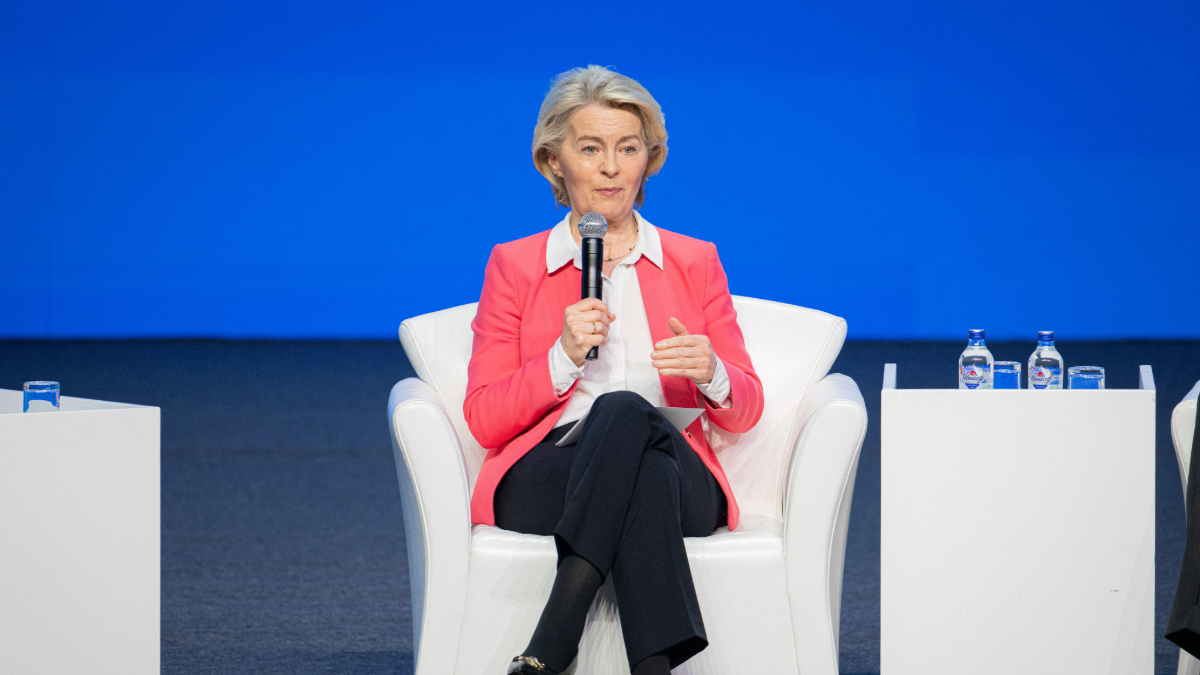
European Commission President Ursula von der Leyen speaks during the Defence Industry Forum at the 36th NATO (OTAN) Heads of State and Government Summit in Ankara, Turkiye on July 7, 2026. (Photo by Alexis Jumeau/Sipa via AP Images)
When the European Commission’s special panel on child safety online publishes its recommendations next week, one question will be on everyone’s minds: to ban or not to ban?
The expert group was created by Ursula von der Leyen, the European Commission president, amid growing political pushback about how children can access digital services, especially social media. Several European countries are pushing ahead with social media bans for children, while the likes of Australia and the United Kingdom have either instituted such proposals or are on the brink of doing so.
“When a quarter of our young people are confronted with problematic content online – from hate speech, to body pressure, to unexpected violence – it is a clear signal that it is time for change,” von der Leyen said when the special panel held its final meeting on June 16.
The group, which is co-chaired by a French and a German academic, will present its recommendations on July 13. It will then be down to von der Leyen and other EU leaders to decide whether the 27-country bloc should move ahead with an Australia-style ban or find another way to keep children safe in the increasingly digital world.
Brussels has already made child online safety one of its priority areas under the bloc’s Digital Services Act, and EU enforcers have already taken action against the likes of TikTok for how it designs its services toward keeping children engaged on its social network. The other area that has been earmarked for attention under the EU’s online safety rules is online marketplaces, where counterfeit goods may also prove harmful to kids.
The European Commission is also slated to publish its long-awaited Digital Fairness Act by the end of the year, which similarly targets how social media platforms are designed to keep people engaged.
Yet the pressure to pull the policy lever for an outright ban continues to mount.
A recent YouGov poll for Reset.tech, an advocacy group, across the European Union’s five most populous countries showed that adults were significantly in favor of blocking those under 16 years of age from accessing the likes of TikTok, YouTube and Instagram if these platforms did not meet the legal requirements to protect such children on their platforms.
Across France, Germany, Italy, Poland and Spain, at least 69 percent of those surveyed by YouGov would support a social media ban under those circumstances, according to the results shared with Tech Policy Press.
Separate research, led by Laura Edelson, a computer scientist at Northeastern University, also discovered that roughly 60 percent of child online safety features implemented by Snapchat, Instagram, YouTube and TikTok failed. That included the ability for children to search for self-harm and eating disorder content, as well as for strangers to directly communicate with minors on some of these platforms despite clear safeguards against such behavior.
In response, social media giants say their child-focused online safety protections remove the vast majority of harmful content from their platforms, and that parents are given ample opportunity to control how their kids operate on these platforms.
While the drumbeat for a blanket social media ban becomes deafening, it’s still not clear Brussels will follow the likes of Paris, Madrid and Athens in pushing for such a one-size-fit-all approach. Under EU rules, national social media bans may also run afoul of the bloc’s Digital Services Act.
A separate expert panel in Germany published their own recommendations last month that did not go as far as to call for an Australia-style moratorium for children under the age of 16.
Instead, that child online safety group urged that protections should be designed for specific platforms that were often significantly different from each other. A complete moratorium would also shift the focus onto users versus holding platforms accountable for their existing child-safety obligations under Article 28 of the EU’s Digital Services Act.
The German experts outlined multiple alternatives. That included a minimal legal age of 13 for accessing social media, followed by graduated protections as users became older, or tweaks to Europe’s existing online safety rules to restrict parts of social media for particular age groups when specific harms were present.
Both options would require strict age verification that has raised hackles within the privacy community over how such practices could potentially gather sensitive data on all social media users.
Within the European Commission, many officials would prefer this nuanced approach that imposes restrictions on how minors access parts of social media without banning them completely from these platforms.
That is particularly important as the EU’s Charter of Fundamental Rights includes the right to access information — and both children and adults now rely heavily on social media to understand the world around them. Any potential social media ban for children could possibly be appealed for infringing on this basic right within the 27-country bloc.
The outstanding question, however, is whether such nuance is politically palatable for von der Leyen, who has pinned much of her reputation within digital policymaking circles about protecting children online.
Many national leaders, including France’s Emmanuel Macron and Spain’s Pedro Sánchez, are adamant about pushing forward with a ban and may push back on any attempts by Brussels to water down such plans. Von der Leyen understands those priorities — and wants to make sure whatever recommendations she takes on board on July 13 can be scaled across the 27-country bloc.
“We must protect our children in the online world,” said the German politician in April. “And for that, we need a harmonized European approach.”
Editor's note: Tech Policy Press has received grant funding from Reset.tech.
Authors