EU Border Agency Frontex Tests the Limits of Europe's Trusted Flagger Rules
Ramsha Jahangir / Nov 18, 2026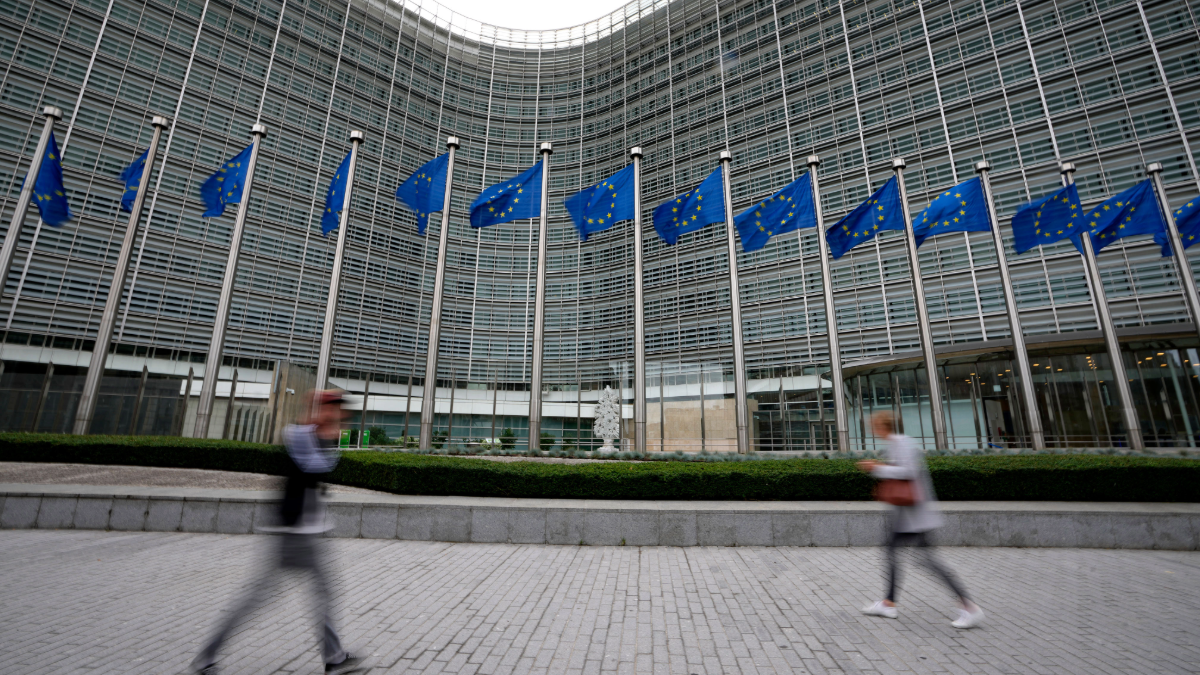
European Union flags flap in the wind as pedestrians walk by EU headquarters in Brussels. (AP Photo/Virginia Mayo, File)
A European Commission proposal to give the EU border agency Frontex a role in identifying and reporting illegal online content is testing the safeguards of the bloc’s Digital Services Act (DSA).
The proposal, published on Oct. 27 as part of a wider reform of the European Border and Coast Guard Agency, would establish an Online Monitoring and Response Center within Frontex, which the Commission says is needed to counter smuggling networks that use social media to coordinate unauthorized border crossings. The monitoring center would monitor publicly available social media content, notify platforms of illegal material and seek designation as a “trusted flagger” under the DSA.
A coalition of 28 rights organizations from across Europe is calling on the Commission to withdraw the proposed powers, arguing that they risk undermining the DSA’s safeguards against government overreach.
Trusted flaggers are organizations recognized for their expertise in identifying specific types of illegal online content under the DSA. As of Nov. 6, national coordinators had designated 90 trusted flaggers across 22 member states, according to the European Commission. They include child protection hotlines, anti-discrimination groups, fact-checkers, consumer organizations, copyright holders and private anti-piracy firms. A handful are public bodies, among them financial supervisors in Austria, Belgium, Ireland and Portugal that flag scams and fraud. None is an EU agency or a law enforcement body.
Under Article 22 of the DSA, platforms must give notices from trusted flaggers priority and process them without undue delay. The status does not give power to order content removal. Platforms remain responsible for assessing the notices and deciding how to take action.
The Commission says its proposal respects this distinction. But the proposal would also let Frontex ask national authorities to issue orders requiring platforms to remove illegal content (Article 9) or to ask platforms to hand over information about individual users (Article 10). The combination of these roles is at the center of the dispute.
Commission guidance exposes a potential conflict
The proposal comes as the Commission is developing guidance on how the trusted flagger system should operate across the EU.
In May, it published draft guidelines covering the designation of trusted flaggers, their independence and reporting obligations, and the procedures for suspending or revoking their status. The guidelines are intended to help national Digital Services Coordinators (DSCs), which oversee the DSA in each member state, apply the rules consistently. The Commission consulted on the draft until July 10 and has said it plans to adopt final guidelines in the second half of 2026.
Paragraph 31 of the guidelines recommends that there should be no overlap between trusted flaggers and public authorities with powers to issue orders against illegal content.
Specifically, the Commission calls on DSCs to consider that national authorities empowered to issue orders to act against illegal content under Article 9 “should not commingle such powers with the trusted flagger status.” Only authorities without such powers, or departments of those authorities with “sufficient management and operational autonomy” and no power to issue such orders “whatsoever,” should be eligible, it says.
The guidelines illustrate the point with two examples. In one, presented as good practice, a coordinator refuses trusted flagger status to a market surveillance authority that can issue removal orders, “to avoid situations in which the providers of online platforms are unable to distinguish the capacity in which such an authority is acting.”
In the other, presented as poor practice, a platform treats notices from an autonomous department of a public authority as removal orders, even though the department has no power to issue them. The Commission says this creates “confusion between notices and orders, thereby undermining the clear separation” intended by the DSA.
Civil society groups argue that the proposed arrangement for Frontex risks creating exactly this conflict of interest.
“The commingled role proposed for Frontex will logically and inevitably result in its notices to the platforms being treated as proxy takedown orders,” the signatories wrote in a letter to Commissioners Henna Virkkunen and Magnus Brunner published this week.
The concern is that Frontex would combine priority reporting as a trusted flagger, a status open to certain public bodies under the DSA, with the ability to ask national authorities to initiate formal enforcement action.
The organizations also question whether national authorities would retain sufficient independence when considering requests from an EU agency, and whether users would have meaningful transparency and avenues for redress if action were taken against their content.
Asha Allen, secretary general of the Centre for Democracy and Technology Europe (CDT Europe), said the DSA itself does not provide explicit safeguards against government overreach through trusted flaggers.
“The draft Guidelines provide some clarity on this, particularly point 31 which expressly recommends that government authorities who can issue Article 9 and 10 orders should not commingle their role by also being trusted flaggers,” Allen told Tech Policy Press. “This proposal therefore goes against the Commission's own draft guidelines.”
The comparison is significant, although the guidelines are not binding. They set out the Commission’s interpretation of Article 22 and are intended to guide national regulators and platforms. Their final status and the way national authorities apply them will matter.
Disinformation and illegal content
The scope of Frontex’s proposed monitoring activities raises another concern.
The proposed regulation would establish an Online Monitoring and Response Centre to monitor publicly accessible user-generated content relevant to the management of the EU’s external borders and migration. Its activities would focus on content related to unauthorized border crossings, migrant smuggling, cross-border crime, violence at borders and the disruption of border infrastructure. The list also includes content related to disinformation, the instrumentalization of migration and other threats the proposal describes as hybrid.
The proposal would also allow Frontex to cooperate with authorities in non-EU countries on “the response to the online content identified” by the center, and would require the Commission to draw up a DSA crisis protocol for situations at the EU’s external borders.
Criminal smuggling networks are “growing increasingly professional, adapting rapidly and utilizing new technologies and social media to coordinate unauthorized crossings,” Commission Executive Vice-President Henna Virkkunen said in a speech presenting the proposal in October.
At a subsequent press conference, Virkkunen said Frontex would have to apply for trusted flagger status through a national Digital Services Coordinator. She argued that the agency had the specialist expertise needed for the designation and said platforms would be expected to prioritize its notifications.
Asked about the trusted flagger role, Virkkunen said that if Frontex flags content that is “clearly disinformation,” online platforms “should prioritize that.”
But the distinction between disinformation and illegal content is important under the DSA. Article 22 concerns notices about illegal content, not misleading information in general. The DSA does not itself define what constitutes illegal content. That is determined by applicable EU and national law. False or politically sensitive information is not automatically illegal.
This could become particularly relevant when monitoring content about migration, asylum and border security. Information about migration routes, asylum procedures or the conduct of border authorities may be sensitive or politically contentious without breaking the law.
The civil society organizations argue that the proposed monitoring categories are too broadly defined and could capture lawful expression. They warn that combining monitoring with trusted flagger status and the ability to request enforcement orders could encourage excessive reporting and increase the risk of restricting legitimate content.
They also point to the risk of consequences for migrant and asylum-seeking communities, which rely on social media to share information about border crossings, routes and access to support.
Allen said there is a history of law enforcement agencies using national security arguments to pressure companies into removing online content, with disproportionate consequences for marginalized groups.
Previous cases illustrate the risks of giving public authorities privileged channels to flag content to platforms. In 2022, the Oversight Board, an independent body established by Meta to review difficult content moderation decisions, overturned Meta’s removal of a UK drill music clip from Instagram following a request from London’s Metropolitan Police. The board called Meta’s channels for government requests “haphazard and opaque” and urged it to publish data on such requests.
Commission says DSA respected
In her Oct. 27 remarks, Virkkunen said “the DSA enforcement framework remains fully respected,” with Frontex able to “act within its mandate on detection and signaling and directly engage with and alert platforms of its findings.” Frontex could also ask national authorities to issue orders requiring a platform “to provide information or to act against illegal content,” she said.
Under Article 22 of the DSA, trusted flagger applicants must demonstrate particular expertise and competence in identifying illegal content, independence from online platforms, and the ability to submit notices diligently, accurately and objectively.
The Commission's draft guidelines provide further detail on how national coordinators should assess those criteria. They say authorities should examine an applicant's expertise in the relevant areas of law, its methods for identifying illegal content, its track record and the safeguards it has in place to prevent political or other influence over its decisions.
The guidelines also call for particular scrutiny of an applicant's independence and objectivity, including whether its management, funding or other support could influence its decisions.
Allen said the draft guidelines were detailed and reflected many recommendations from civil society, including examples of how public authority notices could be treated as proxy takedown orders.
“However, like all guidelines, these are not binding rules and these specific guidelines are yet to be adopted,” she said. “Which leads us to our present situation in which a proposal has been put on the table that not only undermines the text of the DSA, but the supplementary guidance aimed at helping member states implement these rules in line with fundamental rights.”
The Commission's position rests on a formal separation between Frontex identifying and reporting content, platforms assessing notices, and national authorities issuing legally binding orders. Civil society groups argue that the practical effect could be that platforms give greater weight to notices from an EU agency that also has power to ask national authorities to initiate enforcement action.
The proposed regulation must still be negotiated by the European Parliament and the Council, and no public timeline for adoption has been announced. Even if adopted, Frontex would need to be designated by a national DSC, most likely in Poland, where it is headquartered. Incidentally, Poland’s DSA implementation has thus far been marred by unrelated delays over free speech concerns.
The European Commission did not respond to a request for comment.
Authors