Don’t Trust Trump? Don’t Trust Big Tech
Rick Claypool / Apr 23, 2026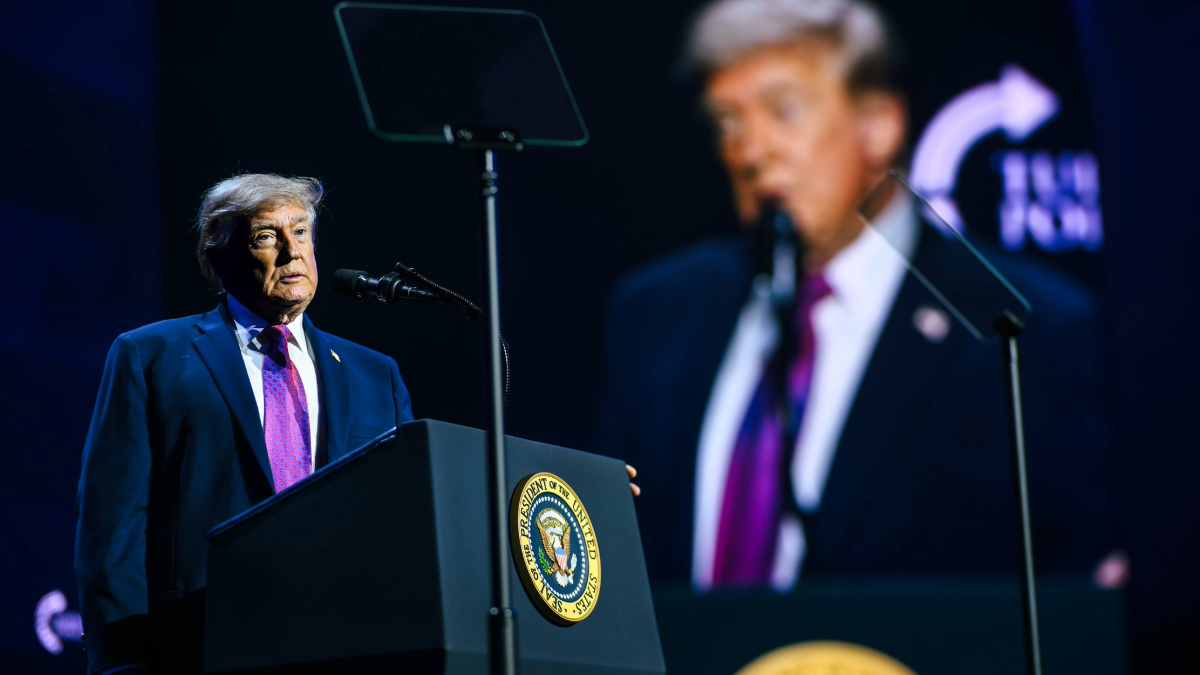
President Donald J. Trump delivers remarks at a Turning Point USA event at Dream City Church in Phoenix, Arizona on Friday, April 17, 2026. (Official White House photo by Daniel Torok)
“President Trump will lead our country into the age of AI, and I am eager to support his efforts to ensure America stays ahead,” OpenAI CEO Sam Altman announced in December 2024 when giving a $1 million donation to Trump’s inaugural fund.
The statement marked a dramatic shift in tone from 2016, when Altman blogged that then-candidate Trump “is irresponsible in the way dictators are,” criticized Trump’s “casual racism, misogyny, and conspiracy theories,” compared Trump to Hitler, and noted “Demagogic hate-mongers lead down terrible paths.”
Self-serving flip-flops are nothing new for Altman—nor are they particularly unique among Silicon Valley corporations and their billionaire executives. My new Public Citizen report, “Big Tech Embraces Trump,” documents how corporations—including Amazon, Apple, Google, Meta, Microsoft, Nvidia, OpenAI, Oracle, and Palantir—have engaged in deliberate campaigns to ingratiate themselves with the Trump administration, heaping excessive praise on Trump while going along with his unpopular and authoritarian policies.
The New Yorker’s blockbuster story on Altman is based on over 100 interviews and is only the latest in a series of revelatory reports on Altman’s untrustworthiness. He’s accused of being possibly a “Bernie Madoff- or Sam Bankman-Fried-level scammer” by an unnamed Microsoft executive, while OpenAI’s then-chief scientist Ilya Sutskever compiled a memo asserting Altman exhibits a “consistent pattern” of lying. It’s apparently this kind of shady behavior that led to Altman’s short-lived firing from his post as CEO of OpenAI for not being “consistently candid in his communications with the board,” as the company euphemistically announced.
The story adds further evidence of OpenAI’s leadership prioritizing profits and expanding market share over safety and reveals an openness to cozying up with autocrats, including considering instigating a bidding war between Russia and China over sales of its AI technology.
In this context, OpenAI’s leap to replace Anthropic as a contractor for Trump’s “Department of War” puts on full display the nihilistic opportunism at the core of how OpenAI pursues its business interests.
That opportunism is on full display in OpenAI’s orientation to politics as well.
The growing likelihood of Democrats re-taking at least one chamber of Congress has coincided with OpenAI suddenly releasing a new “New Deal”-style “people-first” policy document—a document Kate Aronoff astutely notes in The New Republic, “mostly reads like a convenient artifact for OpenAI to point to in the event that [the Democratic party] sweeps the midterms this fall.” Eryk Salvaggio accurately describes it in Tech Policy Press as a “policymercial” – marketing copy in the form of a policy proposal.
The document heralds the imminent development of an AI “superintelligence” and calls for a range of policy responses, including the creation of a “public wealth fund” for distributing the economic benefits of AI to “every citizen” and strengthening social safety net programs like Medicare, SNAP, unemployment insurance, and childcare benefits.
Particularly provocative for anyone following AI policy in the US is the document stating that policymakers have been focused on “upstream safeguards” including “US state-based regulation,” an effort that “should continue.”
OpenAI lobbied the White House to pre-empt state legislative efforts to protect the public from AI harms. Altman apparently supported provisions of Trump’s “Big Beautiful Bill” to pre-empt state AI legislation, telling Sen. Ted Cruz (R-Texas) at a hearing, “it is very difficult to imagine us figuring out how to comply with 50 different sets of regulation.”
Vox’s Eric Levitz wrote about the contradictions between OpenAI’s leadership and the oddly progressive-sounding policy paper, noting the AI company is “advertising its support for radical new social policies that have no actual chance of becoming law in the near-term, while ignoring—if not abetting—attacks on actual welfare programs in the here and now.”
What Altman most likely does not want Democrats to remember if they regain control and congressional oversight authority is how he and OpenAI went out of their way to ingratiate themselves to Trump.
Days before the inauguration, Tools for Humanity Corporation—which operates Altman’s eyeball-scanning orb startup—made a $5 million donation to MAGA Inc, a Trump-backing super PAC. It was one of the largest corporate donations the super PAC received after the election and before the inauguration, matched at the time only by United Healthcare. It would later be dwarfed by the whopping $25 million the super PAC received from another OpenAI executive, Greg Brockman, and his wife Anna.
Recent filings show Trump’s super PAC has raised an unprecedented $300 million, largely from corporations and billionaires, and concentrates an alarming and highly unusual amount of political financial power under a sitting president who is constitutionally barred from seeking a third term. The funds, Politico reports, empower Trump to play the role of “political kingmaker” in the 2026 midterm elections. The material consequence of the donations is the Democratic Party approaching the election with a financial disadvantage—and a major financial advantage for Republican candidates who remain MAGA loyalists despite Trump’s shrinking popularity even among his base.
The money, in other words, supports the anti-democratic advantage in US elections that further advantages the narrow interests of MAGA authoritarianism and billionaire corporate oligarchs over the broader and more diverse interests of the American people.
OpenAI is not alone. Big Tech corporations and executives, including Amazon, Apple CEO Tim Cook, Google, Meta, Microsoft, and Palantir CEO Alex Karp each made million-dollar donations toward Trump’s inauguration. Many have pledged to sponsor the destruction of the East Wing of the White House and its replacement with Trump’s “Golden Ballroom.” Super PAC donors from Big Tech have already given Trump and Republican-backing super PACs $134 million to spend on the midterms. More than half of that sum – $70 million – is attributable to Elon Musk.
The new Public Citizen report conservatively estimates the total combined spending by Big Tech to back Trump and Republicans in 2024 and in 2026 so far to be at least $653 million.
President Trump himself has acknowledged Big Tech’s MAGA-friendly shift, remarking in characteristically crass fashion during his University of Alabama commencement speech last year, “If you look at some of these internet people, [...] they all hated me in my first term, and now they’re kissing my ass. It’s true. All of them. It’s true.”
Now lobbying firm Holland & Knight is warning corporations that cozied up to Trump that Democratic oversight priorities could include “communications and activities between the Trump Administration and private companies, including financial contributions to the construction of President Trump's White House ballroom, settlement funds earmarked for the Trump Presidential Library and awarding of federal contracts to companies with ties to the administration” as well as data centers, algorithmic pricing schemes, environmental rollbacks, and the federal government’s use of AI systems.
Candidates across the political spectrum should not be cowed by Big Tech corporations and opportunistic billionaires shifting policies to pander to power, nor should offers of super PAC cash throttle the momentum for real accountability and reform. Americans oppose the cozy connections between the Trump administration and Big Tech by a two-to-one margin, while voters strongly favor tough regulations to protect the public from AI technology.
The dangerous synergies of an authoritarian White House supported and supercharged by Big Tech titans puts on full display the risk of concentrated and excessive corporate and oligarchic power.
Whatever the outcome in November, those who are elected must govern to show they are accountable to the American people—not Big Tech corporations and not their billionaire executives.
Authors