Contemplating 'Muskism' and the Age of Trillionaires
Justin Hendrix / Jun 7, 2026Audio of this conversation is available via your favorite podcast service.
On June 12, SpaceX will reportedly offer 555,555,555 shares at $135 apiece in an initial public offering. The IPO is expected to give SpaceX a market value of $1.77 trillion, instantly making it one of the most valuable companies in the world. When combined with his holdings in Tesla, the IPO may also make SpaceX founder Elon Musk—already the world’s richest man—the world’s first trillionaire.
Today’s guests are Quinn Slobodian and Ben Tarnoff, authors of Muskism: A Guide for the Perplexed. The book considers its subject as a specimen of the current geopolitical moment, promising an “examination of Elon Musk as a symptom and avatar of our postliberal age.”
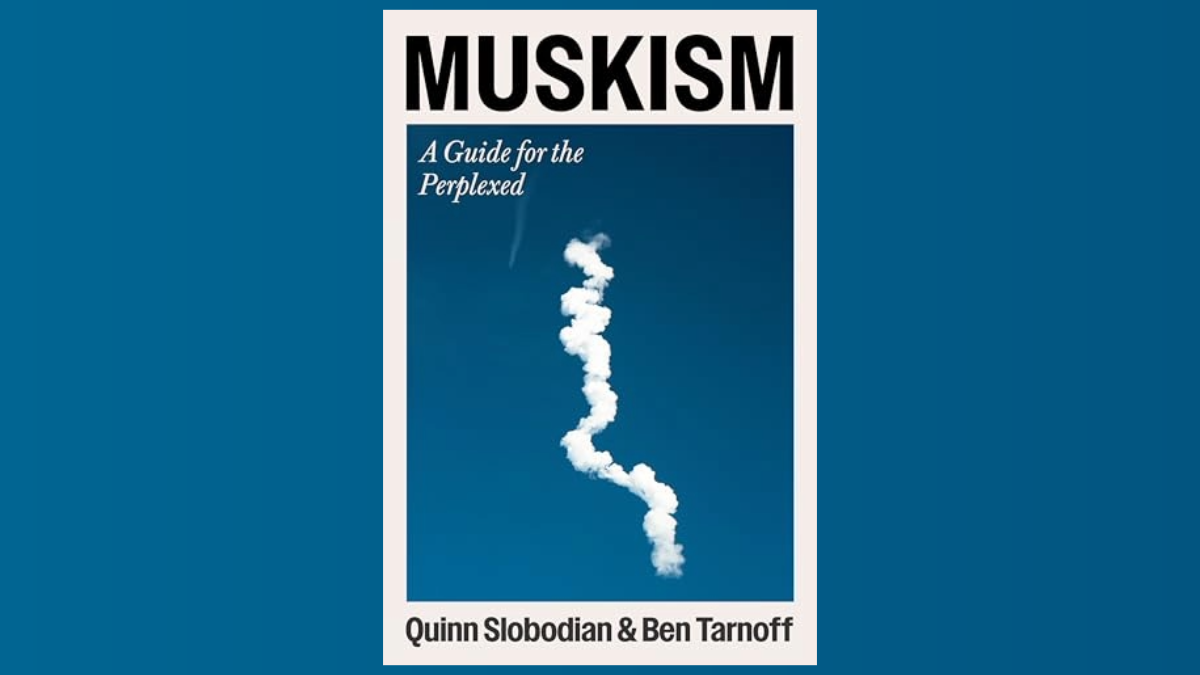
Muskism: A Guide for the Perplexed by Quinn Slobodian and Ben Tarnoff, 2026. HarperCollins
What follows is a lightly edited transcript of the discussion.
Justin Hendrix:
Today's guests are the authors of a book that look at Musk as the kind of specimen of the current geopolitical moment, promising a "examination of Elon Musk as a symptom, an avatar of our post-liberal age." Let's jump right in.
Ben Tarnoff:
Hi, I'm Ben Tarnoff. I'm a writer from Massachusetts and I am the co-author of Muskism, A Guide for the Perplexed.
Quinn Slobodian:
I'm Quinn Slobodian. I teach history at Boston University and also the other half of the co-author with Ben for Muskism, Guide for the Perplexed.
Justin Hendrix:
I'm pleased to speak to the two of you and by your count, what number podcast is this for the book? How many have you done so far?
Ben Tarnoff:
It feels like 3,000, but it's got to be fewer than that, right, Quinn?
Quinn Slobodian:
We're going to be pushing 20. It might be-
Ben Tarnoff:
It's more than 20.
Quinn Slobodian:
Yeah.
Ben Tarnoff:
Total, total?
Quinn Slobodian:
Yeah, if you include Europe, then yeah, we're pushing 50.
Ben Tarnoff:
I was going to say a hundred, but you're better with numbers.
Justin Hendrix:
So given that volume, there's a strong possibility that Tech Policy Press listeners have already heard the two of you talk about this book in some other context. They've certainly probably run into a review, whether in the New York Times or The Guardian. They probably heard you on NPR, maybe on another one of the podcasts that's in their queue. I assume to some extent you said almost everything you have to say about the themes and the topics of this book, so I'm hoping we can find some new ground, potentially give our listeners some peculiar value in this particular interview. But I do want to give you an opportunity to at least state a couple of the basics and make sure that any listener who has not yet gone out to their local bookstore and bought this book will know why they should do so. But maybe I'll just start with this idea that Musk represents more than the man himself.
We spend a lot of time talking about him and his predilections. We spend a lot of time talking about him, his predilections, his apparent interests and substances and politics and all the various things that he gets up to, but you're asking us to think about him differently. You're asking us to think about him as a phenomenon, as a symptom, as a harbinger of our times. You're asking us to think about him as a phenomenon, as a symptom, as a harbinger of our times.
Quinn Slobodian:
Yeah, I think the starting point for us was really to think about Muskism in relationship to Fordism. So just as people in the 20th century made that comparison, not necessarily by just reading everything Ford wrote and saying like, "Ah, yes, here is the book of Ford, the philosophy of Ford," but by looking what he did as a capitalist and then the kind of social worlds that were required beyond the factory to make his products and his profit possible. So in the 1970s especially, sociologists started talking about Fordism and then later post Fordism, and they were interested in the things that the capitalist himself did not say in many cases. So how do gender relations, how do international relations, how do relationships to extractive industries and everyday practices of consumption all get bundled into this one big thing called Fordism. So that was our gambit too, was if we look at Musk not just as a personality or a pathology or even the person at the head of many companies, but someone who's trying his best to roll out in a pretty comprehensive way, a transformation of social reality, then where does that take us?
I don't think we started with the assumption that we would be able to come up with something internally coherent and sort of mutually complimentary in such a way that his genius becomes undisclosed to us, but it was more of an analytic, how can you ask the questions of Musk that don't usually get asked, questions about the social contract being offered, the ideology being delivered? So this was our approach that kicked off the book and really carried us through it.
Ben Tarnoff:
We feel that Musk presents a uniquely interesting prism through which to understand the last 40 or 50 years of global capitalism and in particular understand how certain historical currents have converged to produce the very strange and crisis-ridden moment that we're living through today. I think at the end of the day, the question that really motivated this project as Quinn and I took it on, was less, how did Musk become Musk or what's going on inside Musk's head, but more broadly, how did we get here? How did we get to this moment of geopolitical strife, deglobalization, investment in renewables, mass digitization under the banner of generative AI, these kind of convergence of these different threads. And when you pull back and look at each of those threads, you come to the conclusion that Musk is actually the perfect avatar through which to understand how that kind of ensemble of historical forces becomes possible.
So that's kind of how we try to use Musk as a figure who's obviously very powerful in his own respect, richest man in the world, has a foothold in a number of extremely consequential sectors, but more broadly is also a very clarifying teaching tool for helping us see what capitalism looks like in 2026.
Justin Hendrix:
So recently that avatar flew to Beijing on Air Force One as part of President Trump's delegation to go meet with Xi Jinping. He took that trip despite a federal judge ordering him to remain on recall as a witness in the lawsuit against OpenAI. You would argue, I suppose this is not any kind of contradiction. This is the system. This is how things work. Musk is generally above the law and at the heart of the most important political entanglements on the planet at the moment.
Quinn Slobodian:
Yeah, I mean, I would probably stop short of the idea that our point is that he's above the law. I think that one of the things we did want to do with the book is to switch up the conversation a bit away from what we think are kind of distracting and maybe unhelpful categories like techno-feudalism or certainly net by now cyber libertarianism as being supposedly the magic keys that would unlock of the understanding of Silicon Valley leadership class and their motivations. Musk certainly did rename himself techno king of Tesla in 2021, but what we found so interesting, especially in the DOGE experience, which was also so well unpacked in the pieces with the Tech Policy Press, was that it actually showed the limitations of his ability to simply float above the law and act unfettered. In fact, when Musk tried to become the sovereign and become the government, he kind of face-planted by one way of looking at it.
He actually couldn't do the legitimacy work and the consent creation work that governments have spent hundreds of years figuring out how to do in the period of Republican nationalism. So in that sense, we don't see him as someone who just exists above the law and above the state. Rather, we are understanding him as someone who's motivated by what we call state symbiosis, that actually there's a very important fusion of private power and public power that you get in the Musk-Trump relationship, for example, that can't really be messed with too much. As with symbiotic organisms in an ecological sense, if the balance tips too much, it turns into parasitism. And arguably part of what was happening in DOGE was it was turning into a parasitic relationship and one that was not actually expanding state capacity while also expanding the bottom line for the other counterparties.
So this, I think the fact that Musk is on the plane to Beijing is more of a sign that he continues to see his best interests in grafting himself as closely as possible onto the existing representative government rather than trying to go it alone. He could defy a federal judge in Oakland, but he wouldn't probably deny the White House in the same way. He understands where real power still sits.
Ben Tarnoff:
Yeah, Musk and China, it's a very interesting relationship and one that I think is useful for elucidating many of the themes in our book. Of course, as probably many listeners know, Musk has important business in China with Tesla. He builds a gigafactory in Shanghai in 2019. Historically, the Chinese market has been quite an important one for Tesla EVs. And if you pull back, think about it more broadly, what Tesla has sold from the beginning is a promise of what we call electric autonomy, that both individuals and nation states can fortify their self-reliance in an unstable world by investing in renewable technologies. And if you think about the Chinese state, that in fact has been their motivation for their incredibly extraordinary push into renewables really since the 2000s. So it's after the Iraq war that the Chinese leadership is looking at global energy shocks and saying, "We need to find a way to insulate ourselves from these. We don't have access to oil reserves. What about renewables?"
And this is really the origins of green industrial policy that's now reaping extraordinary dividends globally for the Chinese. It's not really about climate change, it's really about energy independence. And Musk emerges as an important merchant of energy independence, as someone who's selling that to the Chinese, selling that to the Europeans. He builds a gigafactory outside of Berlin and Brandenburg. So to the extent that policymakers are forced to begin thinking about how to insulate themselves from global energy shocks by building up their own energy self-sufficiency through renewables, Musk can be an enabling partner there. So in that sense, he is a beneficiary of if you like a more fragmented, more bordered, more deglobalizing world. He's found a way to profit from that arrangement. On the other hand, that has to be kept in a very specific balance because if it tips over into too much conflict, he can lose those lucrative opportunities.
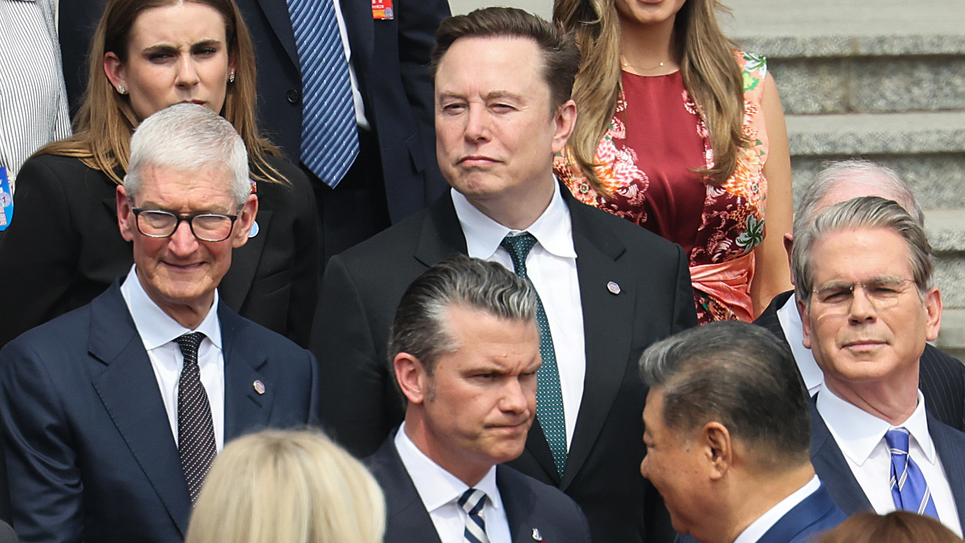
So in the case of his positioning within the MAGA coalition, he's generally been a voice for engaging constructively with the Chinese. He and Jensen Wang and Tim Cook, all of whom went to China with Trump are the folks in Trump's ear telling him to make deals with Xi Jinping. Whereas we know there's another faction of the Silicon Valley MAGA coalition that has more of an investment in defense tech, for instance, that is trying to push in the opposite direction, toward more militarization, toward more saber-rattling. So this is actually a very interesting way to illustrate Musk's on the one hand, the value that he draws from deglobalization as a broad phenomenon, whereas on the other hand, his need to continue to stay engaged with those foreign markets and avoid an escalation into a kind of conflict that could actually really ruin his fortunes.
Justin Hendrix:
Seems like the right place to ask you about the concept of sovereignty generally, which runs through the book. You effectively say that Musk has arrived at a kind of promise or a pitch around sovereignty that's core to what he's selling. I guess if there's too much conflict, then people would have to choose sides and that would be bad for a salesman of sovereignty as a service.
Quinn Slobodian:
It can be if his reputation becomes so wound up with one faction in a geopolitical rivalry that it would seem compromising to contract the services of him because it would be welcoming in the enemy. And that's certainly one of the risks that Musk ran when he bound himself so tightly to Trump in 2024. What's interesting is how well he's actually weathered that decision when you think about it. I mean, even the fall off in Tesla sales in Europe, for example, has recovered a little bit and more importantly, the big money in institutional investment from Europe, for example, the Norwegian Oil Fund, which is a top 10 Tesla shareholder has actually remained allied with him and close to him. So interestingly enough, even his spectacular acts of outrageous behavior and highly polarizing rhetoric around immigrants and white birth rates and white genocide doesn't actually seem to make much of a dent in the confidence of the international investor class.
So in that sense, his calculations that he could play with politics in those ways tactically for his own reasons and yet not harm his bottom line, so far seems to be correct. One of the interesting things though to mention is that makes Musk an interesting person to follow as the kind of figurehead of tech through the last 25 years rather than someone like Zuckerberg or Cook for example, is because he has been so concerned with these problems of actual hard tech throughout and not just asset light consumer facing apps that really drove the Web 2.0 boom. So to take, for example, SpaceX and Tesla, you see a very interesting symmetry, this is further to what Ben was just explaining, that in 2002, SpaceX gets its start as a service provider offering the Department of Defense and the Pentagon an ability to launch tactical satellites more cheaply, launches in 2002 right in the first year of the global war on terror, says, "We're here to help carry out what Donald Rumsfeld calls network-centric warfare that's going to rely on a lot more of these cheap, easily deployed satellites."
And then really only six years later, he's standing there ready to profit from the backlash against the war on terror when Obama says, "We need to move to renewables and electrify the auto sector so we're not so reliant on fossil fuel production in the Middle East constantly sucking us in." So that's already a really interesting prefiguration of some of these geoeconomic dynamics, which we've become so familiar with now that you'd be kind of hard-pressed to tell if you just followed Zuckerberg or something.
So Musk is not because of some preternatural foresight on his part, but through his intuitions as a business person actually able to set himself up for the era of friendshoring and supply chain shortening and vertical integration that we enter around 2017 and then much more so since 2020. And it's indeed, I think, fascinating to see him there mugging for selfies at the banquet in Beijing now because he has this sort of lightness and elation that you can imagine someone would have if they've just danced through this minefield where it looks like all of these decisions might be fatal to your entire business model and yet Tesla's up 25% in the last month.
People want EVs again because of the rising cost of fuel at the pump and people are starting to believe him on space data centers and believe him on humanoid robots, especially because the Chinese now are showing they're commercially viable, so it seems like that old version of Muskism, which was modular and could be dropped down in one country and then another according to the needs of this or that sovereign, seems to be showing its resilience.
Justin Hendrix:
Maybe we could just dig into the space data centers for a second. I feel like this is an idea that in many ways exemplifies exactly the kind of entanglement, the necessary entanglement between the state and private interests. I mean, we're not going to get space-based data centers without government involvement, I assume, that's just not going to be a possibility. And I think that means somebody has to buy this vision of the future where these things are zinging around over our heads and they're necessary somehow for our national interests and national security to build this type of infrastructure. But can we dig into that a little bit? Is there any more to say about space data centers, which seems like a topic that many people are curious about right now?
Ben Tarnoff:
Yeah, I mean, it was of course the main talking point that Musk rolled out when he merged xAI with SpaceX earlier this year and now it's been resurfacing because SpaceX is of course expected to IPO next year for projected $2 trillion valuation. So it's a subject that's been explored in the press quite a bit with debates over the technical feasibility of it. There was just a piece today in Bloomberg of walking through the steps that you would have to take to construct a orbital data center. I think at minimum, you would need to put a lot more satellites into orbit and Musk earlier this year has filed a request with the FCC to launch as many as one million more satellites into low earth orbit. For a point of comparison, he currently controls about 11,000 satellites in low earth orbit for Starlink, his satellite internet service, which is about 70% of all satellites in space, so gives you a sense of just how extensive his control over space has become.
But the state, as you mentioned Justin, becomes an important partner in many respects. I mean, you need regulators to go along with this incredible saturation of space with his satellites, but government is also a very important customer for these technologies. I mean, Starlink notoriously has become integral to modern warfare. There were illustrations of this, of course, in the Ukrainian conflict where at separate moments, Musk restricted service of Starlink, which potentially altered the course of the war because the drones that at this point both sides are using rely on satellite internet for guidance and navigation. So if you don't have that connectivity, you can't actually operate these drones. So Starlink has now really become one of the necessary tools for modern militaries. There's in fact a military version of Starlink called Star Shield that has better encryption and surveillance and reconnaissance capacities.
So as we illustrate in the book, and as Quinn mentioned a moment ago, this isn't new territory for Musk, it's not new territory for SpaceX. SpaceX gets its start as a government contractor during the war on terror, but the extent to which SpaceX by more extensively privatizing space has also enabled its ever deepening militarization, is one of the most important stories of the last few years. And it's a real fulfillment of the Star Wars dream of the Reagan '80s, which of course was much ridiculed and maligned, but interestingly, a number of veterans of the Strategic Defense Initiative are quite important in the early history of SpaceX. So it's a kind of belated fulfillment of this dream that space will become an integral war fighting domain and that the way you will really make progress toward that is by empowering the private sector.
Quinn Slobodian:
I think there's also something interesting there to say about sovereignty, which you asked about a minute ago, because there's really two ways of defining sovereignty and one is the kind of definition from international law, which relies very much on the idea of territory. I mean, this is what's sometimes called the Westphalian idea of sovereignty you learn in your IR class the first semester, which is the idea that states, by recognizing the right of non-interference with one another, effectively produce a horizontal community of sovereign nations. So sovereignty isn't supposed to be something you can have more or less of actually. It's supposed to be a condition you either have or you do not. The second definition though is a kind of synonym for state capacity so sovereignty means not just the formal status of non-intervention as recognized through non-enforceable international law, but your ability to win a war, to do effective industrial policy, to patrol your borders and so on.
What's interesting about space is it does provide a kind of hack for a world that's already divided up into sovereign states. Like the open ocean, it is a kind of domain that remains kind of like a global commons where that second definition of sovereignty becomes pertinent, which is just like who has the capacity to exploit this new site of potential resources, connectivity and so on? So practically speaking, there is no way actually for most of the countries in the world to object to Musk saturating low earth orbit with one million satellites. There's no space police that can be deployed from Geneva or anywhere else that could sanction him and prevent him from doing that. So it's actually the perfect space for someone like Musk because he can both create this partnership with existing territorial sovereign, the United States, that allows him to use it as a launchpad to claim this empty terra nulliuss in space and appropriate it to himself always with the promise, "I'm not just doing this for my own profitability, I'm doing this to enhance your state capacity down on earth."
Justin Hendrix:
I must say that when I'm in a place far from where I live in New York City where there isn't so much light pollution, and I do look up and I see all those tiny dots moving close to the earth at such rapid pace, and to know that in many cases what I'm looking at is Elon Musk's empire literally whizzing above my head, I feel that somehow.
Quinn Slobodian:
We've heard that from several people actually who have hit that line in our book and been like, "Oh, that's where it became real for me." I was like, "I've been in that experience."
Justin Hendrix:
Late in the book, you have this section where you beginning to think about the future for Muskism and you have this kind of reflection on his notion of being techno king. You talk about Thomas Hobbs, his idea of Leviathan and you say, quote, "One can imagine Musk, a raid in a similar fashion, a torso made of a Tesla chassis, a SpaceX rocket in one hand, a Neuralink at the temple logged onto X." And with this vision, you kind of wonder where will this Muskiathan move next? You talk about four futures, Carbon Musk, Contractor Musk, Compound Musk, Cyborg Musk. Can you give my listeners just the brief summary, I suppose, of what each of these futures looks like and what does our life look like inside these futures?
Ben Tarnoff:
Sure. Yeah. So yeah, this is kind of our effort to think about the paths that Musk could take and then more broadly the shapes that Muskism could take. I mean, Carbon Musk is along the lines of what we've been talking about. And I think the prospects for a Carbon Musk I think look better now than they did even a few months ago. And Carbon Musk is basically doubling down on technologies of the energy transition, which of course Tesla has been associated with historically. More recently, Musk has been keen to reposition Tesla as an AI and robotics company, that's kind of his direction of travel for investment. But in a different political environment and in a perverse way, the war on Iran has been producing precisely this environment. You can imagine Musk pivoting back toward being a provisioner of renewable energy technology. Now, the landscape, of course, is very different now than it was when he took over Tesla in 2008.
You now have to contend with the Chinese who are in every category dominant in renewable technologies. I mean, BYD is displacing Tesla globally, CATL is the biggest battery manufacturer in the world. Of course, everyone knows about Chinese solar panels and so forth. So it's a different and more difficult terrain, but it's not impossible to imagine that as soon as a few years from now, maybe there's a Democrat in the White House, maybe you have a Democratic Congress and maybe Musk is trying to do yet another pivot and arrives at decarbonization as the primary accumulation strategy. I think that's related to contractor Musk. I mean, contractor Musk is tapping into this dynamic of state symbiosis that we've identified as always been integral to Musk's business strategies, this effort not to displace the state or try to exit from it, but really to fuse with it in a symbiotic manner.
There are military dimensions to this. We spoke of SpaceX as a military contractor and the importance of Starlink for modern militaries, but there are other ways to think about this. The extent to which Musk could become a renewable energy merchant again may dovetail with a future US government's desire to build up energy security and energy independence through investments and renewables. That was a watchword of Obama's first term, Biden tried to do it. It's possible that the next Democratic president will get back on the horse and try yet again. But you could also see government contracting opportunities residing in AI. So xAI is Musk's AI company, Grok has now been authorized for use on the Pentagon's classified networks. He's very keen to get in the gravy train that Palantir has really perfected of pushing high technology to expand particularly coercive state capacity and arguably that was something that in a quite chaotic way he was doing at Doge. So those are a couple not entirely mutually exclusive future paths that Musk could take.
Quinn Slobodian:
Yeah. So Compound Musk and Cyborg Musk gets us into a couple of the themes that we didn't end up touching on too much, but which are pretty central to the book. One is what makes him different from a Ford is not so much his manufacturing model or his relationship to the government, because a lot of the things that we've said here you could say about the mass-produced automobile with the vehicle, the truck, the bulldozer, similarly existed in a symbiotic relationship with governments and militaries and so on. But what makes Musk a child of the 21st century instead of the 20th is the fact that this is all being run through digital capitalism as the most important sector of profit accumulation and the computational metaphor as the way to understand both the human mind but also society and politics at large. So his solution to the problem that we alluded to at the top, the problem of social consent and legitimacy, is really solved through accelerated cyborgification.
It's really the only way to describe it and it's actually how he describes it too. So he's in court right now, last day I think, or he's not physically in court, but he is part of a trial that he's not present at in Oakland, about the foundation of OpenAI. And the point we make in the book is that OpenAI understood usually as a kind of AI safety and alignment undertaking sits uneasily then with the fact that Musk founds Neuralink shortly afterwards and his public statements about why he's founding Neuralink is, "We need this brain computer interface basically accelerate our fusion with network technologies." So we are becoming man/machine, human symbiotes as he calls them and we need to become evermore part of the cybernetic Collective. So when we talk about Cyborg Musk, we mean partially his ongoing project to displace the conventional public sphere with his own bespoke ecosystem of content creation and automated content production from X.com to Grok to Grokipedia, such that he creates a closed ideological loop in which no one can tell him he's wrong or a fat idiot or anything else insulting.
But also the idea that the frontier for Tesla is really the humanoid robot, which becomes kind of corporeal AI or whatever and the integration of humans and these machines then moves towards a horizon as he sees it where the human part is a smaller and smaller increment of the environment that organizes human life. So that's Cyborg Musk. It seems unlikely he'll stop being interested in that stuff. He will always see the kind of Mac as we propose as the load star really for what he's up to. And the possibilities of that as a commercial sector are certainly there, so that will always be there in the background, whether or not it will consume all of his interest is another question.
The Compound Musk is maybe a way to allude to some of his thinking about race and demographics and gender. So he's known for his amplification of what were until very recently extremely utre and extremist talking points from the European far right, the most important there being the idea of remigration, which as recently as about a year and a half ago, members of the Alternative for Germany Party, the Far Right Party were actually excluded from their own party for talking about the idea of remigration, now must post it regularly. The White House as recently as this week has posted it themselves, the idea that according to some undetermined way of classifying people, those with ethnic origin that does not belong will be forcibly rounded up and expelled. That's often taken to imply that Musk is a far right ethnonationalist and wants to build out ethnostates on the model of his identitarian buddies in Holland and the UK and Germany.
But the reason we say Compound Musk, is that if you look at what he's actually done towards, let's say, raising the white birth rate, which seems to be something he's interested in, the answer is he has had 14 children, that actually the only proactive moves he's made towards even addressing these openly racist mandates for ethnonationalism has been a highly personalized one, and we say compound in the sense of building out a compound of your genetic offspring because this seems like probably the least likely, but certainly one path out of this present crisis of political confidence that he at least has briefly endured, would be to withdraw entirely from political and commercial life and just become a hermit guru overseeing a growing brood of the carriers of his IIQ DNA.
So that's sort of another world that we imagine. But maybe to wind up with the question that you asked in addition to there, what does this mean for us? I think that to bring it up to this current conjuncture, I think me and Ben actually are feeling more optimistic than we did when we started this book in the sense that this kind of kamikaze alliance that Silicon Valley leadership class made with MAGA was a very bold move and it afforded them at least a year of runway in which they could do things in some ways so quickly that people didn't have time to catch up with what they were doing, and that was really openly the goal, right? You put David Sachs in the White House, he tried repeatedly himself to get the 10-year moratorium on regulating AI put into state law and failed more than once.
They had probably a year where everything was aligned. They had cheap energy, lots of cheap credit and a pliable partner in government in which they could try to get generative AI to scale towards this supposedly escape velocity moment of AGI. And of course, the invasion of Iran now has put a giant brick wall in all three of those things, the looming midterms as well. So I don't think that either of us are really presently of the mind that the Muskiathan is somehow moving freely across the landscape. I think that it's more of a Gulliver and the Lilliputians or Gulliver's Travels situation here where the Muskiathan is beginning to creak, I think, and it might actually find more friction than it expected.
Justin Hendrix:
I wonder to some extent if it's also possible to imagine it as a kind of Voltron. I mean, you are seeing huge spending from others right now. Mark Andreessen and his partner, Ben Horowitz are apparently going to outspend Musk in the midterms. Others are doubling down at this point, maybe partly out of concern that the headwinds are great and that whatever investment they've made and progress they've made on their political projects in the last little bit of time could get set back. Do you see others coming in and changing the landscape?
Ben Tarnoff:
It's an interesting moment because I think it illustrates the extent to which Silicon Valley is itself a quite differentiated and fractured sector. When the MAGA Silicon Valley Coalition was being formed, I think it was easier to subsume those divisions, particularly when you have those dramatic photographs of everybody at the Trump inauguration, the kind of inclination to think about figures like Mark Zuckerberg and Musk and Andresen and Jensen Huang and all of these different figures with the same broad brush. And the reality is that there are obviously differences at the individual level, at the ideological level, but I think more pertinently their political economic incentives and constraints are just quite different. It's quite different to be the CEO of a big publicly traded company than it is to be a venture capitalist. The slice of the sector that NVIDIA occupies is actually pretty different than the slice of the sector that Meta occupies or take your pick.
So I think now that more pressure is being placed on MAGA more broadly, you can actually see these fractions and fault lines more clearly. I think it now makes it easier to see how that coalition will come apart, but then also it makes me begin to speculate where the pieces of Silicon Valley will fall under the next administration. If you assume that a Democrat will be in the White House next, what does the relationship between tech and Washington look like? It's a really interesting question because there's no going back to the kind of golden age of the Obama days, the kind of status quo anti that in fact a lot of the Silicon Valley folks quite angry at Biden for not having restored. There was a kind of coolness, a distance, but still a caution, I'd say. Biden was by no means a radical in how he treated tech.
But now that so many prominent figures from the industry have so visibly supported Trump, even if their positioning toward MAGA now is becoming more fraught and complicated, I think that raises just very interesting questions for how the Democratic Party, which historically really since the early '90s, has relied on Silicon Valley as a major donor base, how is it going to now relate to this region which has not just historically funneled a lot of campaign cash to its coffers, but is now overwhelmingly the leading fraction of American capital? And that I think is extremely interesting thing to watch and very hard to predict how that will play out. I mean, how does a President Newsom or President AOC sit down with Silicon Valley? What do they want? What are the demands, what are the concessions? What is the balance of power? I think that's a really interesting thought experiment.
Quinn Slobodian:
Well, it's also interesting to look back now at the last 10 years and say, okay, one of the gambits of Trump 1 was to just change their growth story of America from Silicon Valley digital capitalism to a restoration to manufacturing. That was the headline promise. And of course it was arguably hollow from the outset and is much harder to accomplish than anyone in the Trump administration was willing to even expand effort on. Interesting thing about Biden is that they were trying to deliver on that goal. They were trying to make the American growth story not just about consumer facing apps anymore, but it's going to be green manufacturing, green industrialism. Enter Trump 2, and interestingly enough now we've defaulted back to digital capitalism is the vanguard investment story for American capitalism, which opens the question as Ben is saying of what happens then? Let's just stipulate that the Democrats return.
Do they try to do Bidenomics again harder? Unlikely, but is the digital capitalism story which they've written from Gore through Obama now so negatively coded that it's burnt for them? I mean, it's a real conundrum. What do you sell on the campaign trail? Like, "We're going to do better Silicon Valley now after generative AI is less popular than ICE." I mean, it's a messaging problem. I don't envy people trying to figure that out. And it's really interesting seeing even the Altman and Amade types spinning around in circles trying to figure it out themselves too. I think they also don't know how they want to position themselves for this future, which is not very distant. It's a couple of years, it's three years from now. So that's something like Muskism I think becomes helpful because you then are then led to ask, "Is there such a thing as a centrist Muskism? Is there such thing as Muskism without Musk?"
As you say, "Can you take out the different components of Voltron and add in ones with better haircut like Gavin Newsom and then suddenly the Voltron's acceptable now?" I think that those are big and unanswered questions.
Justin Hendrix:
At the end of the book, you paint this dystopian picture of the life of a Muskian bureaucrat and of his daughter, which is even worse and more grim. I feel like this sort of grim view of the future extends from so many of the ideas that came out of Silicon Valley from Muskism and beyond. A lot of people are aware of that now. It's sort of accepted that what Silicon Valley wants for us is what many people would regard as a dystopia, and I think you see that in people's reaction to AI even as they adopt the technology, they fear it, they complain about it, they don't like it. But I do think that what you say is the harder part, which is an alternative vision. Who will arrive at the political chops to both package and develop that alternative vision, see it through somehow? That seems very unclear to me. That might mean the dystopia has a leg up?
Ben Tarnoff:
Well, I think the way we've been thinking about it is that there's a short-term political opportunity and a long-term political difficulty. The opportunity is that people hate AI, that opposition to data centers is very, very strong, that it will probably be a major issue in the midterm elections and that progressives can harvest and channel these energies for their own purposes. Bernie Sanders has a proposal for a national moratorium on data centers, Maine passed one but was vetoed by the governor, but there's quite a lot of in fact bipartisan outrage because the deal is just very dystopian. It's saying, "We're going to put these data centers in your backyard. They're an environmental hazard, they're an eyesore, they make noise, they cause your electricity bill to go up. And by the way, if this is all successful, we're going to put you and your kids and your grandkids out of work forever." That's not how you build a social compact.
There's no pitch there. So it makes sense why people would hate it. So that's great. And I think if you're thinking as a progressive political operative, there's dividends to be reaped here. However, the harder question is, let's say you get the moratorium, what's next? What are you buying time towards? And there are a lot of proposals out there for how you could, I don't know, democratize AI if that's the right word, or more broadly distribute its benefits. A lot of this is now coming from the companies themselves, they're trying to get out ahead of this around, you've probably seen the kind of proposals from OpenAI and Anthropic around these various issues, however kind of thinly drawn. Again, to my mind, I think there's interesting work to be done there, but the more pressing issue is how you diversify the American economy away from a one-way bet on AI.
That is both risky for obvious reasons, but gives you very little room to maneuver politically because you really only have one counterparty in a capitalist class. You're only sitting down with one very small group of people who have their hands on the controls. So what if we had a more diversified economic base in which biotech, in particular capitalizing on the breakthroughs with mRNA, biotech was a major player. If we could get a green industry, a green renewable EV battery maker, solar panel off the ground, then I think you have a wider set of players that you can kind of actually do a more constructive politics with, that you actually need to be able to set different factions of capitalist against one another to create space for progressive policy. It's what FDR in fact did best. You don't get the New Deal without it, but it's hard to do.
I think Biden essentially tried to bootstrap that in a space of a few years and you'll recall that the Inflation Reduction Act almost didn't get through and the way that it got through was the lobbying of people like Bill Gates telling Joe Manchin, "Hey, we really got to do this." And to me, that's kind of a depressing fact, that you don't actually have a kind of green industry sector that's strong enough to exert pressure on the political system, to what extent can you cultivate that from above with the tools of public policy as relatively weak as they are, relative to say the Chinese? We don't have a political economy where we can coordinate investment and production in such a way that the Chinese can. We have to offer all of these de-risking inducements to private capital. Is that enough to really strengthen a sector to the point that it can provide a counterweight to Silicon Valley?
I'm skeptical, but again, I think that's probably our only best hope for creating a political economic order that's more conducive to progressive policy.
Justin Hendrix:
Well, we've put podcast number 349 in the books for Muskism, a Guide for the Perplexed. Hopefully I think we've broached a little bit of new ground. Ben, Quinn, I'm very grateful to you for joining me. Thanks again.
Ben Tarnoff:
All right.
Quinn Slobodian:
Thanks for having us, Justin.
Authors