Considering the Federal Trade Commission’s Double Standard on Media Bias
Philip M. Napoli / Feb 24, 2026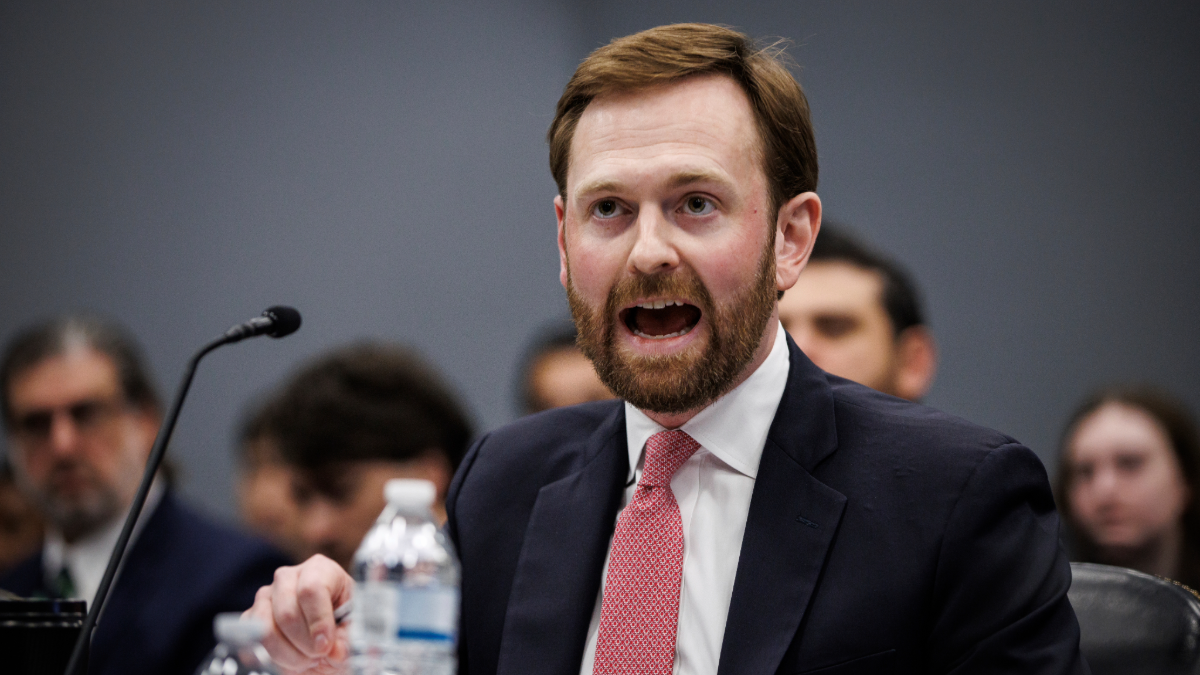
Andrew Ferguson, Chairman of the Federal Trade Commission (FTC), testifies before the House Committee on Appropriations in the Rayburn House Office Building on May 15, 2025 in Washington, D.C. (Photo by Samuel Corum/Sipa USA)(Sipa via AP Images)
It’s an interesting time to be an organization that conducts media bias research in the United States. Depending on the results of your research, you may find the Federal Trade Commission (FTC) using it to justify an inquiry directed at another company; or you may find yourself the target of an FTC investigation.
The first scenario is reflected in events earlier this month, when FTC Chairman Andrew Ferguson sent a letter to Apple CEO Tim Cook. In his letter, Ferguson noted that recent research from self-described conservative media watchdog organization the Media Research Center indicated that Apple News, the company’s news aggregation app, “systematically promoted news articles from left-wing news outlets and suppressed news articles from more conservative publications.”
According to Ferguson, such patterns may put Apple in violation of the FTC Act — if such patterns are inconsistent with Apple’s terms and conditions; are contrary to consumers’ expectations that failure to disclose such ideological favoritism is a “material omission”; or if such practices cause “substantial injury that is neither reasonably avoidable nor outweighed by the countervailing benefits to consumers or competition.” The bottom line, Ferguson contends, is that this pattern in Apple News’ curation may constitute unfair or deceptive practices, and therefore could warrant an FTC investigation.
At the same time the FTC is using media bias research to justify potential regulatory actions against Apple, it is also conducting an inquiry directed at another media watchdog, NewsGuard. NewsGuard is a self-described non-partisan media watchdog organization that rates news outlets based on the reliability of their reporting. Like the Media Research Center, NewsGuard conducts media bias research; although some of its findings are critical of conservative news outlets. Unlike the Media Research Center, NewsGuard is being investigated by the FTC for its work, rather than seeing its work used by the FTC.
In June of 2025, the FTC issued a civil investigative demand to NewsGuard, seeking troves of documentation, including organizational charts; personnel records; product descriptions, methodologies, and associated data sets; client correspondence and records; correspondence with similar watchdog organizations; company financial data, etc. Notably, this demand for information on virtually all aspects of NewGuard’s operations contained no stated justification. As NewsGuard has noted, “Under the FTC Act, the agency was required to state the specific conduct constituting an alleged violation that is the subject of investigation … The FTC did not do that in the NewsGuard CID, leaving the company to guess about what the agency alleged was at issue, or how it could have anything to do with legitimate enforcement of antitrust or competition laws.” (Earlier this month, NewsGuard filed a lawsuit in a US District Court, seeking termination of the agency’s inquiry.)
What we do know is that Ferguson has publicly accused NewsGuard of leading “collusive ad boycotts … to censor the speech of conservative and independent media in the United States.” Essentially, NewsGuard is being accused of undermining the revenue prospects of these outlets, since some media buyers and advertisers use services such as NewsGuard to help them decide where to place their ads.
The FTC is so opposed to media buyers using such tools that it actually made a prohibition on the use of third-party services that assess media outlets’ adherence to journalistic standards or ethics the primary condition of its approval of the 2025 Omnicon/Interpublic Group merger. Of course, there are no such prohibitions keeping the FTC from using such third party findings as the basis for a possible investigation of Apple.
NewsGuard is not the first media watchdog organization to be targeted by the FTC in this way. In 2025, the agency issued a similar civil investigative demand to Media Matters for America, a self-described progressive research center that frequently issues reports critical of the journalistic practices of conservative media. Media Matters is particularly well known for its study showing that ads for prominent brands such as Apple, IBM, and Oracle were appearing on X alongside pro-Nazi posts — findings that discouraged some advertisers from continuing to advertise on Elon Musk’s controversial platform. And so, like NewsGuard, Media Matters was likely targeted for its role in fueling alleged “advertiser boycotts.” Media Matters successfully obtained a preliminary injunction from the US District Court that is currently under appeal by the FTC.
There is, of course, a fundamental hypocrisy baked into the scenarios described here. On the one hand, indications of (left-leaning) media bias presented by media watchdog organizations serve as an impetus for regulatory intervention. On the other hand, media bias organizations whose work offers any kind of critical findings regarding right-leaning news organizations find themselves in the crosshairs of those very same regulators.
What we’re witnessing at the FTC is part of a broader, troubling trend, in which accusations of media bias are serving as the basis for a wide range of policy and regulatory decisions. Bias claims were at the core of Congress’ decision to defund public broadcasting. The inclusion of a “bias monitor” to oversee CBS News was a key condition of the Paramount/Skydance merger. Media bias claims are also central to the Federal Communications Commission’s threatened regulatory actions against broadcasters for the political content of programs such as Jimmy Kimmel Live, the Late Show with Stephen Colbert, and The View. And, of course, the FTC’s ongoing investigation of digital platforms’ content moderation practices is, like its investigations of NewsGuard and Media Matters, premised on claims of anti-conservative bias.
This multi-pronged regulatory and policy assault on media bias is itself clearly rife with bias, as it seeks to consistently tilt the playing field in one direction. But more important — and more concerning — are the ways in which these actions are exploring a range of regulatory rationales in an effort to circumvent the First Amendment. Thus, claims of deceptive practices, or collusion, or monopoly power are at the center of the FTC’s actions directed at media watchdogs and digital platforms. Dramatically reinterpreted notions of public interest obligations provide the basis for the FCC’s regulatory threats against broadcasters.
Finally, it is important to remember that these generally half-baked rationales for trampling on First Amendment rights don’t necessarily need to pass muster with the courts in order to be effective. The “process as punishment” approach to regulation can be enough to achieve compliance from organizations without the financial resources or the ethical fortitude to resist. In this way, media bias is weaponized across a wide range of contexts to construct a news and information ecosystem in which the administration’s preferred bias predominates. And to the extent that these efforts succeed, they establish a dangerous template that future administrations on either side of the political spectrum can follow.
Authors