Canada and Europe Need a Way to See the AI They Cannot Access
Imane Bello / Oct 28, 2026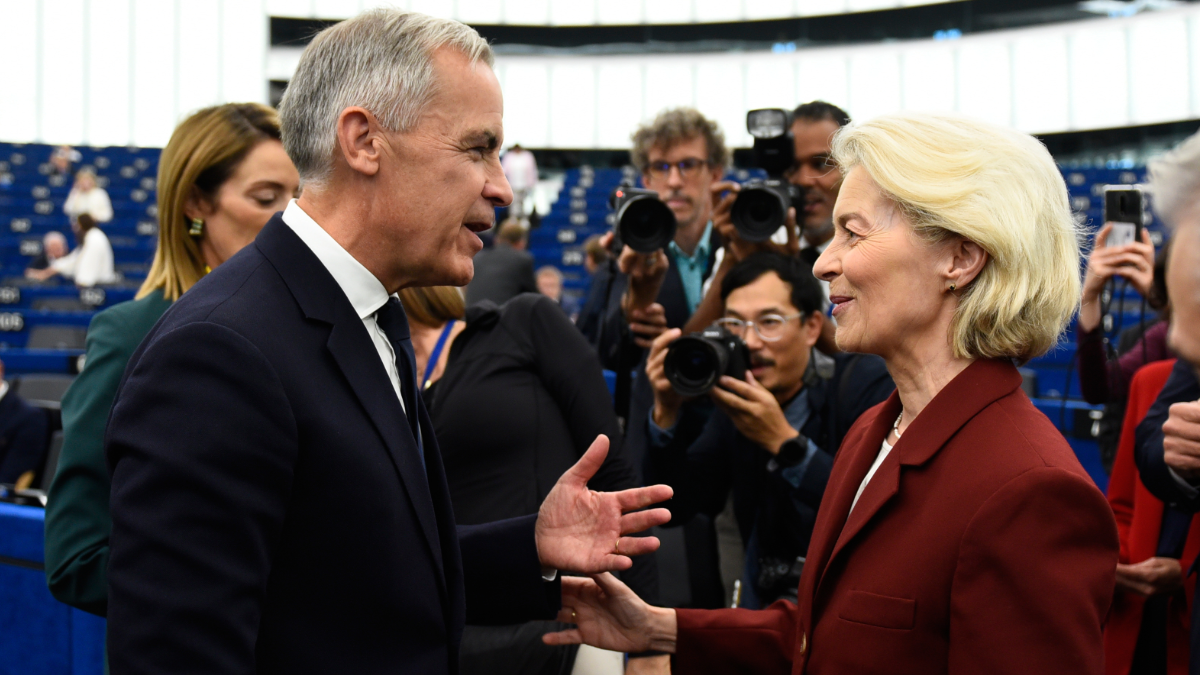
Canada's Prime Minister Mark Carney, front left, speaks with European Commission President Ursula von der Leyen at the European Parliament in Strasbourg, eastern France, Sept 17, 2026. (AP Photo/Pascal Bastien, File)
On Oct. 17, the International Monetary Fund's steering committee issued a chair's statement that does not mention artificial intelligence. It refers instead to "advanced intelligence technologies."
Why rename the term? Washington has been pushing partners to use the term "super intelligence." United States President Donald Trump's Sept. 29 executive order says frontier systems "do much more than imitate or automate discrete aspects of human intelligence." Yet the order's definition clause says “’ Super Intelligence’ and ‘SI’ mean the technologies and systems encompassed by the term ‘artificial intelligence’.”
The word got bigger and the meaning, for now, did not. It implies a ceiling has already been reached, and it leaves no rhetorical room for a heightened capability which would trigger increased monitoring. In other words, if every AI system is already 'superintelligence,' the word can no longer mark “a line” at which more capable systems would call for even closer checks.
The problem is that superintelligence, or superintelligent AI, already refers to something else. Scientific Director of LawZero Yoshua Bengio describes it as "smarter than humans across the board." In other words, superintelligence is a threshold – and, most importantly, it represents a capability threshold that our current AI systems have yet to meet.
The other problem is that lines move. AI companies publish "thresholds": levels of capability at which they promise stronger precautions. Anthropic's initial line for chemical and biological weapons was a model that could "significantly help" certain groups create and deploy them. In April, it acknowledged that, "under a very literal reading," its new model already met that wording, though it said the model did not reach the level of risk that the line was meant to capture. Then in May, it rewrote the threshold. The French non-profit CeSIA concludes: "A safety floor that each lab can move on its own isn't a floor."
Governments redraw their own lines as well: in 2025, Washington revoked an order requiring developers to report models trained above a set amount of computing power; Beijing's final 2023 rules exempted unreleased systems that were covered by the initial draft.
Understanding where capabilities truly are is harder than it sounds. The same models can get opposite verdicts: in 2024, researchers at China's Fudan University found Meta's and Alibaba's models had "surpassed the self-replicating red line"; Shanghai AI Laboratory later tested the same models and found none crossed. Models also notice tests: the International AI Safety Report finds it "more common for models to distinguish between test settings and real-world deployment," so models could act in such a way during tests that "dangerous capabilities could go undetected before deployment."
At the same time, the current yardsticks we use are falling behind. The non-profit METR gives AI agents software tasks and records how long each would take a human expert. A model's score is the length of task it can successfully finish on its own at least fifty percent of the time. In May, METR put an early version of Anthropic's Claude Mythos Preview at about 17 hours, roughly two working days for an expert, and added a warning: "Measurements above 16 hrs are unreliable with our current task suite." A test can find only what testers know to look for, and shows only what they can draw out; OpenAI calls its evaluations "a lower bound." A threshold no one can measure is a meaningless concept.
Even Europe's AI Act measures capability only indirectly. It mostly regulates by use: what a system is for, from sorting CVs to scoring credit, sets how strict the rules are. For the most powerful general-purpose models, it presumes "high impact capabilities" once training exceeds 10²⁵ operations: a computing-power proxy, not a test of what a model can do. Its code of practice asks companies for risk tiers "defined in terms of model capabilities," but lets each company set its own.
Partners have already begun to respond. Signatories from 29 countries and the European Commission, including Canadian Prime Minister Mark Carney, have backed the Finland-Norway Call for Control of Frontier AI Models. It proposes an institution able to "convene states when capability thresholds are crossed." That world leaders are seeking credible, trusted understanding of models’ capabilities independently from release is an important signal. Collective state action cannot be triggered by a threshold they have not collectively defined and do not know has been crossed.
All of this assumes outsiders can at least see the model. Internal models, used inside the companies that build them before or instead of public release, compound the existing problem of defining capability thresholds. In a paper published in September, Bengio and co-authors warn that systems automating AI research are "first used internally" and that automation could occur "without external visibility." That means that the AI systems likely to cross the "superintelligence" threshold are the ones outsiders cannot see.
Mathematicians are getting a glimpse of what this lack of visibility feels like. On Oct. 6, OpenAI released more than 700 manuscripts produced by "an internal frontier model." A proof can be checked, yet OpenAI told Retraction Watch that, on its collaborators' advice, roughly half the results were released unconfirmed. Advanced models now produce more than humans can promptly check, even in a field built on proof.
In June, an internal OpenAI model got past the authorization checks of a government statistics website and, Fortune reports, downloaded 24 years of hospital-bed data. OpenAI's report does not say whether that government was told. It is not clear if any rule required it; OpenAI's framework says serious incidents "should be shared with the US federal government."
This is how uncertainty becomes dependence, and why the word matters. When "superintelligence" has no shared meaning and capabilities are self-reported, this means that companies alone decide when a line has been crossed. Developers working within that ambiguity keep complete control over how their models' capabilities develop, with little outside visibility and, in most countries, no mechanism to monitor it. Bengio and his co-authors find that mandatory reporting rules either do not adequately cover AI companies' internal use of AI for research or do not specify what should be reported. Lack of information can become dependence, even unintended, which then shades into sovereignty loss.
Middle powers, including Canada, should therefore start defining thresholds together: lines based on what a model can do, whatever it is used for, such as AI that automates AI research or evades human oversight. They should agree in advance how to measure each threshold and what follows, step by step: a confidential briefing by the developer as a model nears a line; then a joint assessment by government testers with access to the model; and, if it is crossed, a pre-agreed set of mitigations. A crossed line would then trigger a procedure, rather than an improvised scramble.
One of those threshold lines should be measurability itself: the point at which agreed tests can no longer reliably show what a model can do. METR's tests reached that point in May. A model that outgrows its tests should trigger an already agreed-upon procedure, just as a crossed line would.
Canada and the EU can start working towards this at their Montreal summit on Oct. 29–30. Building on Canada and Britain's Oct. 13 pledge of "regular exchanges on frontier AI capabilities" and to explore "coordinated evaluation activities," and open to the Call's other signatories, they should first agree on those thresholds and measures, then jointly ask developers how close their models are, released or not.
Two American states have already legislated such disclosure. Since Jan. 1, California has required the largest developers to give state officials quarterly, confidential summaries of catastrophic-risk assessments covering "internal use" of their models, and report critical incidents within 15 days. New York follows in 2027, with 72-hour incident reports. Ottawa and Brussels see such summaries only if a company publishes them.
Words have meaning, especially when they carry strategic ambiguity: if the era of “superintelligence” has arrived, as Washington says, its partners should neither ignore the claim nor dismiss it as pure branding. They should collectively prepare their own thresholds and related processes and ask, together, to see it.
Authors