Can Europe Build Digital Sovereignty While Safeguarding Its Rights Legacy?
Nicole Manger, Vidisha Mishra / Dec 5, 2025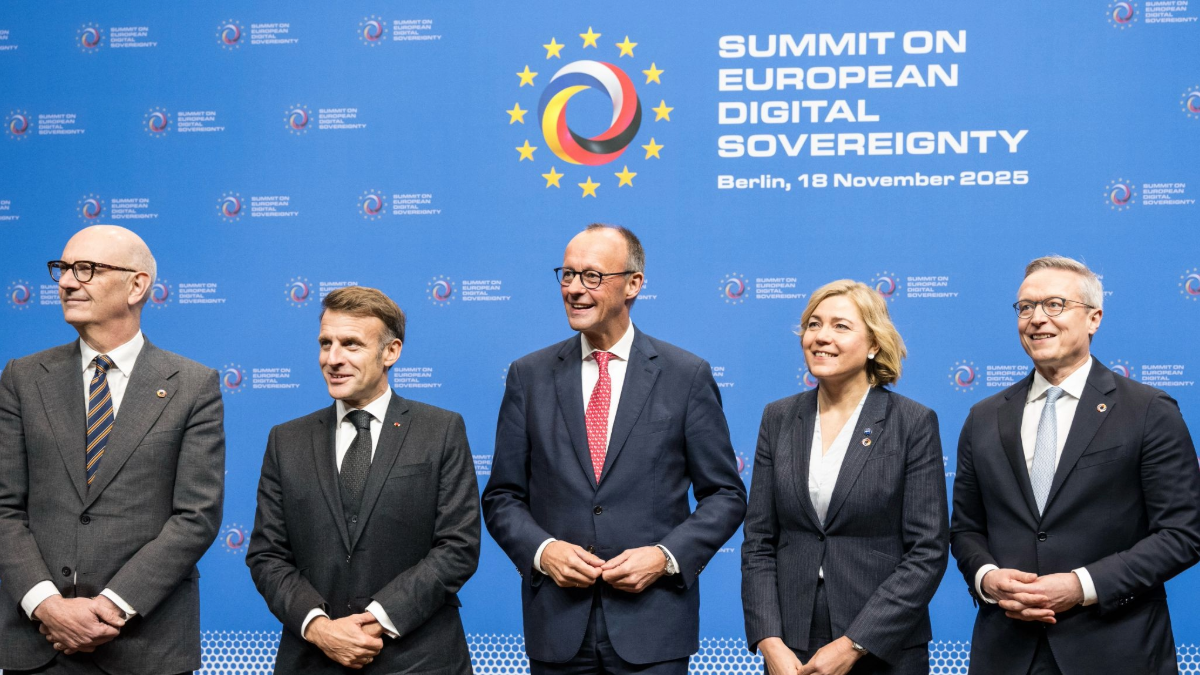
European leaders pose at the Summit on European Digital Sovereignty in Berlin on 18 November. Source
The European Digital Summit in Berlin last month marked a decisive shift in Europe’s approach to digital governance. Convened by Germany and France, the Summit signaled that Europe is moving beyond its decade-long identity as the global benchmark for digital regulation.
The shift is industrial and security-driven: 80 percent of Europe’s digital infrastructure relies on non-European providers, creating a strategic dependence governments can no longer ignore. German Chancellor Merz made the stakes explicit: “Europe’s digital sovereignty is central to Europe and to our common values, but also to the competitiveness of our economy, to our security, and to our defense.”
But urgency comes with consequences. As Europe accelerates its sovereignty agenda, it faces a defining tension: in building autonomy at speed, it risks trading its rights-based governance legacy for a defense-centric model that could undermine the very democratic values it seeks to protect.
From regulator to builder: the EuroStack
The most significant outcome of the Berlin Summit is the explicit pivot toward infrastructure ownership. German Chancellor Merz introduced "EuroStack," a strategic framework designed to reduce reliance on foreign hyperscalers by fostering European alternatives in AI, cloud computing, and cybersecurity. This is not merely about market share. Complementing the AI Invest Initiative and the AI Continent Action Plan, it is an attempt to secure the foundational layers of the digital economy against external geopolitical shocks.
To operationalize this, the European Commission and key member states launched the Digital Commons EDIC (European Digital Infrastructure Consortium). This governance model aims to create open, interoperable alternatives to proprietary US and Chinese platforms, theoretically reducing administrative friction for European SMEs while establishing sustainable financing for digital public goods.
Simultaneously, the European private sector is aligning with these signals. The announcement of an €11 billion investment by Schwarz Digits in a new data center in Brandenburg represents the tangible capital expenditure required to back these political ambitions. Furthermore, the strategic partnership between German enterprise giant SAP and French AI company Mistral signals a push to embed "sovereign AI" directly into public services and enterprise workflows. Adding to resilience, the Bertelsmann Foundation initiated the European Network for Technological Resilience and Sovereignty (ETRS) to create a detailed roadmap for digital sovereignty. This indicates that Europe’s political ambition is beginning to translate into capital deployment and institutional capacity.
The defense pivot and the shrinking civic space
While the infrastructure push is logical, the political narrative driving it exposes a widening fracture in European policy. The Summit’s agenda was heavily dominated by defense-tech and dual-use applications. Given the geopolitical context of the Russian-Ukrainian war, this securitization of digital policy is understandable.
However, this focus is crowding out civil society and public-interest technology voices. Rights organizations report that the sovereignty narrative is increasingly being weaponized to justify rollbacks of the General Data Protection Regulation (GDPR) and the EU AI Act. There is a palpable risk that in its race to compete with American dynamism and Chinese scale, Europe may view its own fundamental rights framework as regulatory baggage rather than a competitive differentiator. The absence of diverse civil society voices at the Summit suggests a drift away from the multi-stakeholder model that characterized the "European way” of digital governance.
This is a strategic error, not just a matter of exclusion. Without public trust and buy-in, the widespread deployment of new sovereign tools (such as EU-Digital Identity Wallet or AI-enabled public services) faces the risk of a domestic backlash that could stall adoption entirely. If sovereignty becomes a synonym for deregulation, Europe risks losing the unique trust-based market position it has spent a decade building.
The energy bottleneck: sovereignty’s hidden cost
The biggest constraint to the EuroStack vision is not technical — it is energy. AI and digital infrastructure demand massive, continuous power, and Europe’s grid is not yet built for it. Data center consumption is expected to surge by 2030, yet industrial energy prices in Europe remain significantly higher than in competing markets.
This creates a strategic paradox: the more Europe pursues technological autonomy, the more its energy costs threaten to erode competitiveness. The gap can no longer be treated as a secondary issue. The upcoming Data Center Energy Efficiency Package and the Strategic Roadmap for Digitalization and AI in the Energy Sector (due Q1 2026) will be defining tests of whether Europe can align its sovereignty ambitions with a viable and secure energy foundation.
Sovereignty vs. market access
The Summit also highlighted the fragile nature of Europe’s autonomy in a transatlantic context. The drive for sovereignty is colliding with realpolitik trade negotiations. Reports indicate US Commerce Secretary Howard Lutnick is urging softer interpretations of the EU’s platform rules—the Digital Services Act and Digital Markets Act—in exchange for lower steel tariffs and higher US investment.
This places the European Commission in a precarious position. The central tension is unresolved: Europe wants to dismantle Big Tech’s market dominance through regulation while simultaneously needing US cooperation on trade and defense. EU parliamentarians and rights groups warn that the recent Digital Omnibus package with major cuts to privacy rules and a freeze on high-risk AI regulations may signal such early regulatory backsliding. If the EU concedes on regulatory enforcement to secure trade deals, it renders the concept of digital sovereignty hollow. True sovereignty requires the political will to enforce market rules regardless of diplomatic pressure from Washington.
Strategic imperatives for Europe’s next phase
The 2025 Berlin Summit set the ambition and urgency. The next phase requires alignment, investment, and strategic alliances to move from intent to implementation.
1. Leverage public procurement as industrial policy
Subsidies are temporary; contracts are market-makers. Governments must aggressively prioritize European, open-source alternatives for public infrastructure. This creates guaranteed demand for "EuroStack" technologies, offering a more sustainable growth path for local innovators than grant funding alone.
2. Reconcile innovation with regulation
The narrative that rights hamper innovation is a false dichotomy that Europe must reject. Regulatory clarity creates market predictability. The EU’s competitive advantage lies in "trustworthy AI" and privacy-preserving tech. Diluting the AI Act or General Data Protection Regulation (GDPR) to mimic the US model creates a "race to the bottom" Europe cannot win. Instead, the EU should double down on compliance and oversight tools that make European tech the gold standard for safety and ethics globally.
3. Fix the financing to scale "Sovereign Tech"
Infrastructure sovereignty is impossible without sovereign capital. Aside from the Schwarz Digits pledge, general financing plans remain insufficient, and the venture financing landscape is fragmented. While the 2026 EU budget allocates €1.0 billion to the Digital Europe Programme, this foundational funding is not sufficient for the scale of EuroStack. The EU needs a unified capital markets union and targeted instruments to fund capital-intensive projects—specifically open-source infrastructure, which was identified as a strategic necessity by the Sovereign Tech Agency.
4. Open-source as the foundation of trust and autonomy
Sovereignty requires control over the digital stack’s core layers, a control proprietary software inherently denies. The EU must view open-source technologies not just as a cheaper alternative for public procurement, but as the only viable path to technical autonomy, transparency, and resilience. This requires dedicated public funding for open-source maintenance and co-development of European open digital public goods, ensuring that the EuroStack is built on shared, auditable foundations rather than merely replacing one form of proprietary dependency with a European one.
5. Projecting the "European Way" Globally
Finally, Europe must abandon the fortress mentality. Sovereignty does not mean isolation; it means strategic interdependence. Inward-looking narratives risk ignoring crucial alliances with emerging economies. Europe must actively position itself as the global bridge-builder, offering an alternative to the US-China binary by advocating for its standards and co-developing interoperable infrastructure with emerging economies.
This includes leveraging its seat in platforms like the Trade and Technology Council (TTC), Group of Seven (G7), and Group of Twenty (G20) to advocate for globally inclusive digital governance. The India AI Impact Summit in February 2026 may open additional fresh channels for cross-regional cooperation.
The way forward
The 2025 European Digital Summit confirmed that Europe understands the scale of its dependence and is ready to act. But sovereignty will only be credible if Europe can pair industrial strength and security capability with the democratic values that built global trust. If Europe maintains that balance of building capability without compromising principle, it will not just secure its technological future - it will help shape the next chapter of the global digital order.
Authors