Cambodia’s Scam Crackdown Has Failed to Stop the Industry’s Global Spread
Lam Le / Nov 10, 2026Lam Le is a Tech Policy Press fellow.
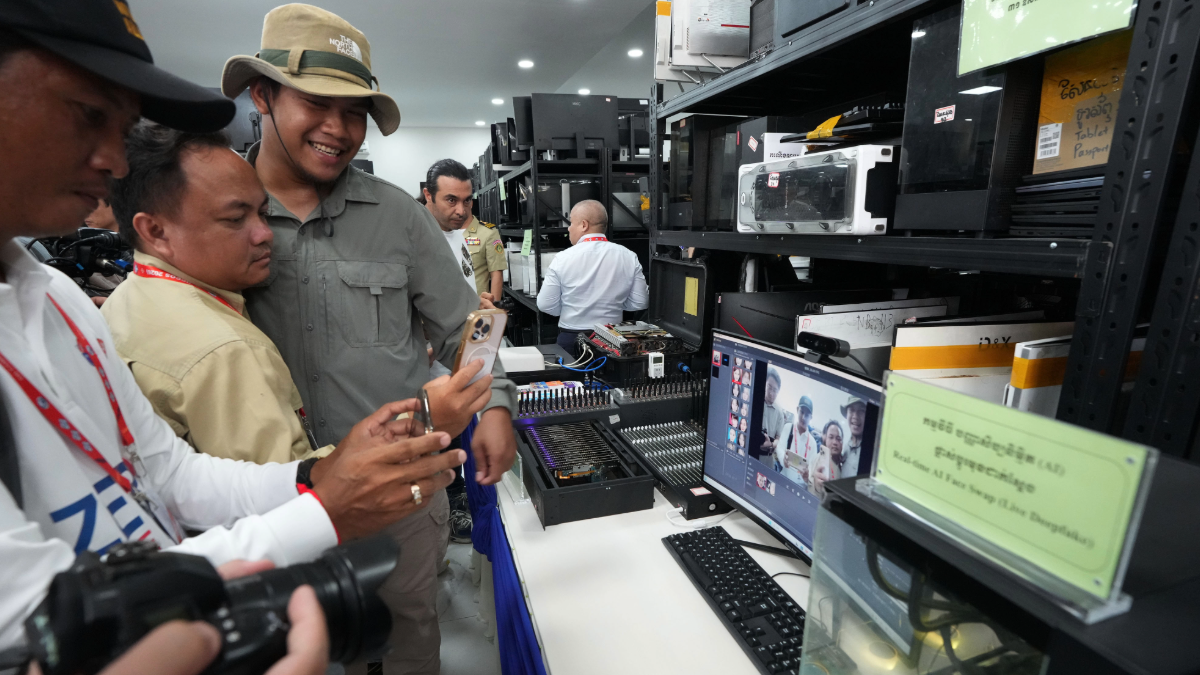
Journalists test AI software used to manipulate images at Phnom Penh Municipal Police headquarters following an operation against scam centers in Phnom Penh, Cambodia, Tuesday, Sept. 22, 2026. (AP Photo/Heng Sinith)
At first glance, it sounds like a normal modeling job. But on closer inspection, the details become peculiar. The job is in Pakistan, the shift lasts from 9 p.m. to 9 a.m., and the pay is $4,000-$5,000 a month, or nearly three times Pakistan’s per capita income.
The recruiter, who has a Chinese username, is also looking for a “real model” of any nationality in Vietnam to target “European love stories,” and another model from South Asia to work in Malaysia.
The ad was posted on Telegram, in a channel advertising jobs in Cambodia.
These are the characteristics of ads recruiting workers, usually attractive women, to participate in video calls for romance scams, according to the analysis by Moses Ngeth, a Cambodian security analyst who has reviewed thousands of scam job ads on Telegram channels over the past three years.
The ad in question was posted in late October, two months after the Cambodian government announced: "there are currently no online scam compounds remaining in the country.”
In July 2025, the Cambodian government launched a year-long crackdown on scam compounds in the country, after years of international pressure and reports exposing the billion-dollar illicit industry that runs on trafficked workers forced to con victims around the world. But beyond the images of emptied buildings, and confiscated phones, computers and Starlink terminals, is an industry that continues to evolve, thrive, and regroup in countries such as Myanmar, Vietnam, Timor-Leste, Pakistan and as far afield as Georgia and Nigeria.
“The scams follow you home,” Ngeth told Tech Policy Press, meaning scam operations often relocate to the home countries of their workers.
Recruitment in Telegram channels for scam jobs in Cambodia continues, and the roles increasingly appear to be filled less by trafficking victims and more by people who apply voluntarily, whether out of desperation or because they are attracted by the pay. Since the crackdown on Chinese-language recruitment Telegram channels, analysts at the UK-based Humanity Research Consultancy (HRC) have seen more individuals posting CVs listing their experience managing scam teams, the languages they speak, the markets they’ve targeted, and even the size of the teams they’ve supervised.
“To me, this is a sign that the scam economy is increasingly resembling a mature illicit labor market,” Mina Chiang, founder and director of HRC, told Tech Policy Press. “Rather than disappearing after a crackdown, experienced managers and workers are actively looking for their next employer, while syndicates continue recruiting for new locations. The knowledge, skills, and management systems move with the people, making the industry highly resilient.”
In fact, the crackdown has produced a humanitarian crisis, as thousands of scam workers became stranded and undocumented overnight, without money and legal support to get home safely.
“The government’s ‘crackdown’ has been done in a highly selective manner – closing physical facilities and arresting the slave laborers who have been forced to engage in online scamming, while avoiding any action against the vast majority of the bosses who own and manage the scam centers,” Mark Taylor, an independent consultant who previously worked for USAID in Cambodia, told Tech Policy Press.
The owners and managers of scam centers “are seeking to recruit stranded workers who already have the skills to conduct scams such as the time-intensive “pig butchering” scam. Facing miserable and precarious conditions, some stranded scam workers consider accepting work again in the scam centers.”
Police reports, experts and scam job ads on Telegram indicate the bosses, most of them Chinese and Taiwanese, quickly moved to hotels, restaurants, apartments in Cambodia and other countries, including Myanmar, Vietnam, Timor-Leste, and as far as Croatia and Nigeria.
Ugandan scam survivors interviewed by HRC said some returnees from scam compounds in Southeast Asia were later recruited by Chinese scam bosses to work in Madagascar after struggling with debt. They were offered substantial joining bonuses known as “red envelopes.”
In May 2026, Sri Lankan police reported that since the start of the year, they had arrested more than 1,000 foreigners, most of them from China, Vietnam and India, for alleged involvement in cybercrime. Authorities and researchers said the increase stemmed from Chinese syndicates relocating from Cambodia and Myanmar, drawn by Sri Lanka’s relaxed visa rules, developed telecommunications infrastructure, and relatively weak cybercrime enforcement.
In October, police in north central Thanh Hoa province in Vietnam charged 88 foreigners and one Vietnamese with using digital means to misappropriate property and facilitating illegal stay in Vietnam. The indictment said the group rented a hotel beginning in June 2026 to conduct romance scams targeting victims in Japan, China, Taiwan, the US, India and South Korea. Their equipment and data had been transported from Cambodia.
Most of the accused are Chinese nationals, besides 28 Indians, nine Cambodians, one Malaysian and one Myanmar national. The majority entered Vietnam on tourist visas, while 22 entered illegally, 21 were without passports and one was on a wanted list. To evade detection and arrest, the group avoided hiring Vietnamese staff and targeting Vietnamese victims. The police estimate the scammers have misappropriated 50 billion dong (nearly US$2 million) from victims.
Scammers who moved to Vietnam are mostly small operations. “They brought what they had learned at the scam centers (in Cambodia) to open one of their own,” Ngo Minh Hieu, prominent Vietnamese anti-scam investigator, told Tech Policy Press. “Cybercrime has become an ecosystem, with every step available as a service.”
Previously, opening a scam operation required operators to be well-versed in money laundering, know how to hack databases to steal large numbers of account credentials, and build a team from the ground up.
Now all it takes is a visit to Telegram, where Chinese businesses offer money laundering services, databases, and scam scripts, while phones and computers can be purchased second-hand. Hieu estimates that starting a 15-person operation in Vietnam would cost less than $4,000.
And if one wants to work in the scam industry, there are diverse jobs, from those requiring zero experience to more technical ones.
Ngeth, the Cambodian analyst, combed through 4,991 ads posted in Telegram channels between 2023 and 2026. According to his report, Cutting the Grass, not the Root, the most common job advertised is “add contact,” which basically means finding people online to talk to, with the intention of eventually scamming them. It reportedly pays up to $750 a month, which is more than triple Cambodia’s minimum wage.
The model job mentioned at the beginning of this article is by far the most lucrative. These jobs typically require good English skills, and some ads specify a preference for Western-looking faces for video calls. Other jobs include “customer service,” “killer,” which means the person tasked with taking the victim’s money, translator, and HR and finance roles.
Then there are ads looking for money mules in Turkey, and an AI model developer based in Vietnam.
This indicates that while Cambodia has been home to the largest scam operations, “this is not only a Cambodian policy issue,” Chiang said.
The lack of protection for survivors of trafficking into scam operations has contributed to a humanitarian crisis, pushing some to return to scamming simply to earn enough money to survive. Meanwhile, the spread of smaller scam operations around the world makes them harder for authorities to detect and dismantle.
“The buildings can be shut down, but the people, the networks, and the experience remain,” Chiang said. “If those are not disrupted, the same business model can quickly reappear in a different form and in a different location.”
Authors