California Leads the Way With New Slate of AI Bills
Danny Tobey, Ashley Carr, Michael Atleson / Sep 15, 2026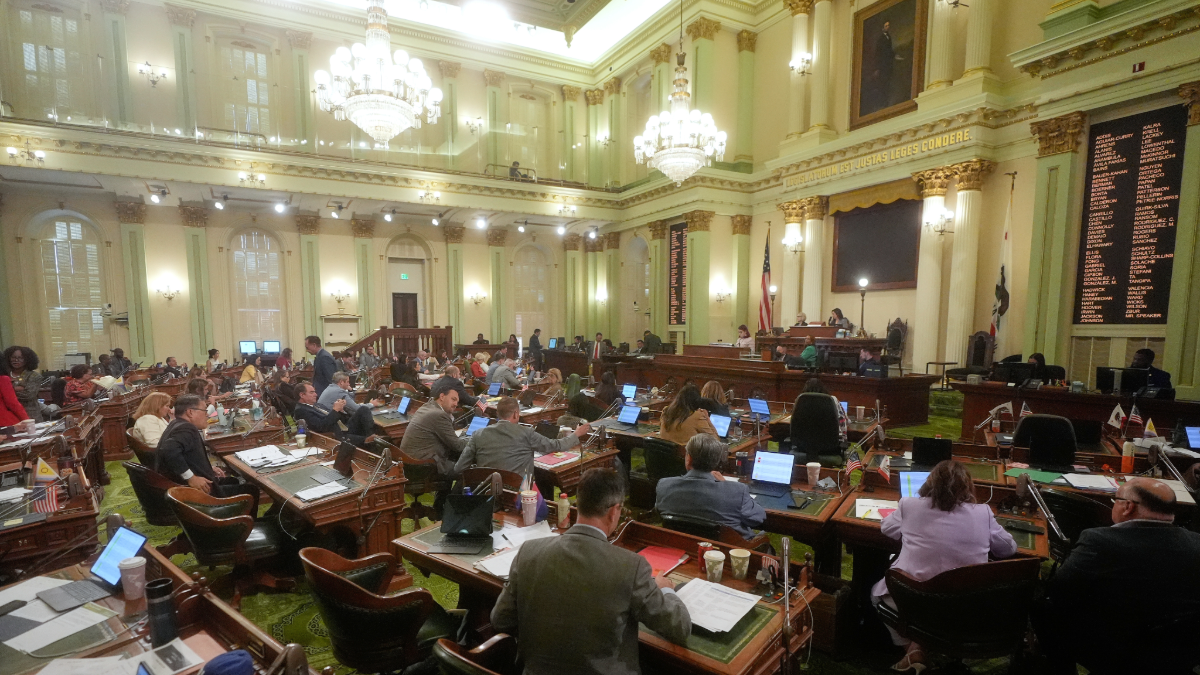
California Assemblymembers meet during an Assembly session at the state capitol, Monday, Aug. 31, 2026, in Sacramento, Calif. (AP Photo/Jeff Chiu)
Repeating its performance from last fall, the California legislature has once again passed a slate of AI-related bills. Governor Gavin Newsom has already signed several bills relating to chatbots and independent audits, and the rest await his signature or veto. These remaining bills apply variously to employers, advertisers, large online platforms, healthcare providers, AI developers, chatbot providers, and attorneys, among others. Even if not all of them become law, their sheer number, along with some strong and unique provisions, keep the state at the forefront of AI regulation in the United States.
In this article, we summarize thematically the key AI bills passed in this California legislative session, indicating which ones the Governor has signed into law.
AI in employment
The “No Robo Bosses Act of 2026,” SB 947, would prohibit employers from relying solely on an automated decision system (ADS) when making disciplinary or termination decisions. No other US state has such a ban. Like some state laws and rules, however, the bill would impose obligations on employers when they rely primarily on an ADS to make such a decision. Employers would have to have a human “corroborate” the ADS output. If so corroborated, an employer must provide a “postuse notice” when informing the employee of the decision and, if requested, describe the employee data used to make the decision.
The bill would also ban employer retaliation against employees exercising rights under its provisions. Further, it has a unique, broadly worded provision forbidding employer use of an ADS to “[p]redict and take adverse action against a worker for exercising their legal rights,” including but not limited to rights under employment and labor laws.
Governor Newsom vetoed a different version of this bill last year.
The legislature also passed two bills involving the use of workplace surveillance tools. AB 1883 would forbid such a tool when it “uses artificial intelligence on employees” either to (1) recognize, or to make inferences or predictions about, an individual’s emotional state, or (2) collect neural data, unless the tool is used “to ensure safety.” The other bill, AB 1331, would restrict use of workplace surveillance tools (even if they don’t use AI) in workplace bathrooms. Other states have workplace surveillance laws, but California’s specific references to emotion detection and neural data collection are distinguishing features.
AI in healthcare
The legislature passed three bills focusing on AI use in clinical settings. AB 1979 applies to providers that use “a tool, system, or device that includes artificial intelligence” in connection with clinical functions that state law requires a professional licensee to perform. Such providers could not use those items either to “[i]ndependently perform” such functions or to advise unlicensed personnel to perform them.
The bill would also require licensed providers to retain “the ability to exercise independent professional judgment in patient care” when considering the output of a clinical decision support system (CDSS), which is defined essentially as an AI system that aids clinical decisions about diagnosis and treatment.
The other two clinically focused bills also focus on CDSS. SB 503 would require developers to make reasonable efforts to identify and mitigate reasonably foreseeable risks that a CDSS has biased impacts. AB 2575 would (1) protect worker choice on whether to override CDSS output and (2) prevent developers and deployers from pointing to such choices as a defense in lawsuits alleging harm from CDSS output.
The final healthcare-related bill is the Wellness for Oversight and Psychological Resources Act, SB 903, which bears the same title as a similar law passed last year in Illinois. It would forbid offering psychotherapy services “through the use of companion chatbots,” including via claims that the chatbot “is a therapist or provides therapy.” The bill would also require review and approval by licensed professionals when using AI for certain purposes, such as making therapeutic decisions, detecting mental states, or performing triage or screening.
AI in advertising and media
The legislature passed two bills dealing with the use of synthetic or digital characters. SB 1050 requires a clear and conspicuous disclosure in an advertisement that “prominently includes” a “synthetic performer,” defined as a digital representation of a human, created at least in part with generative AI, and “not recognizable as any identifiable natural person.” If signed, California would be the second state to address the advertising use of synthetic performers, following a New York law passed last year. The two regulations differ from each other in several ways, such as the California bill applying to audio-only advertisements, which are excluded from the New York law’s coverage.
Whereas the synthetic performer bill addresses characters that are not recognizable as a particular person, the second bill, SB 1111, focuses on the opposite. It would amend two state laws that restrict unauthorized impersonations of real people in advertising and other specified contexts, ensuring that “digital replicas” are included in the scope of those laws. The amendments would extend other consumer protections that California already has in place for unauthorized use of digital replicas. Several other states have similar laws.
Companion and customer service chatbots
On September 10, Governor Newsom signed two of three bills that impose obligations on operators of certain types of chatbots, adding to existing California law on chatbots used for companionship. A third bill on customer service chatbots remains on his desk.
The two new laws amend SB 243, the state’s companion bot law. The most substantial revisions are in SB 1119, called “Adam’s Law,” which is the only law in the US requiring operators of such products to (1) perform and document a “comprehensive risk assessment” with respect to child users, and (2) submit to “independent child safety audits” of their compliance with the law. It also adds age verification and robust provisions – some of which resemble those in other states’ laws – requiring operators to mitigate child safety risks. These provisions include unique requirements such as default limits on how much time a child can chat with a covered chatbot, as well as limits on advertising and selling a child’s personal information. The law allows for both public and private enforcement and becomes effective on July 1, 2027, though the audit requirements do not kick in until January 1, 2029.
The second law is SB 867, which imposes a 5-year ban on the offer or sale of “any toy that includes a companion chatbot,” where “toys” are limited to physical products designed or marketed for play by children under 16. This law will go into effect on January 1, 2027, and the ban will remain in effect until January 1, 2031. No other state law has prohibitions specific to AI-powered physical toys.
The remaining chatbot bill, AB 1609, would also be a first-of-its-kind in state AI regulation, if signed. Most state chatbot laws do not extend to chatbots used merely for customer service, whereas this bill centers on them. For example, California has a law that restricts intentionally misleading chatbot use to incentivize a purchase or sale. The new bill would prohibit representations that a customer service chatbot is a human and require disclosure if reasonable people would likely believe, even absent such representations, that the chatbot is a human. Coverage is limited to businesses that have over $500 million in gross annual revenue and provide goods and services to customers.
Amendments to the California AI Transparency Act
The California AI Transparency Act took effect on August 2, 2026. Among other things, the law imposes disclosure obligations on covered providers, defined mainly to include generative AI developers that make their systems publicly available and have over 1 million monthly visitors. Such providers must ensure that content created using their tools includes provenance data that can be readily accessed through free AI detection tools. Specifically, they must provide a latent disclosure and an option for users to include a manifest disclosure for such content.
The legislature passed two bills to modify these requirements. SB 1000 would delete the monthly visitor threshold and the requirement to provide the manifest disclosure option, thus expanding coverage while also reducing developer burden. AB 2713 would modify the separate obligation of large online platforms to let users inspect provenance data, clarifying that they are not required to take actions “not compliant or interoperable with widely adopted specifications issued by an established standards-setting body.”
AI in legal practice
The legislature also passed the nation’s first law to regulate attorney use of generative AI. This bill, SB 574, states that attorneys shall not "delegate the practice of law” to generative AI, a phrase that could lead to interpretive challenges given that delegation is not defined. It is thus unclear whether the prohibition applies or expands existing attorney ethics rules.
The bill also contains several prohibitions on using generative AI merely to assist in the practice of law. Attorneys may not enter “confidential, personal identifying, and other nonpublic information” into a generative AI system unless access is “restricted to the attorney” and others whom the attorney authorizes and who are obliged to maintain confidentiality of the information. For California attorneys, this provision would make it especially important to consider enterprise versions of AI tools that offer technical measures and contractual obligations to maintain privilege and confidentiality.
Attorneys would also have to “take reasonable steps” to: (1) verify the accuracy of generative AI outputs, including case and statutory citations; and (2) correct any “erroneous or hallucinated output in any material used by the attorney.” While attorneys would be obliged to take these steps in the course of all their work, the bill also imposes obligations as to court filings. Attorneys would have to: (1) disclose to the court any use of generative AI for a submitted document; and (2) not submit a document without having “personally verified” the citations therein (regardless of AI use).
AI auditor capacity-building
Finally, the legislature passed, and Governor Newsom signed, two bills, SB 813 and AB 1405, designed to build capacity in California for “independent verification organizations” (IVOs) and third-party auditors with the expertise to assess risks of AI systems and models. In its digest for both bills, the legislature referred to the Transparency in Frontier Artificial Intelligence Act, which imposes obligations on developers of frontier AI models. While that law has no IVO or audit requirements, a similar Illinois law does require independent audits, and, as explored in a DLA Piper client alert, IVOs have appeared in at least one federal bill and a Virginia law.
Takeaways
While California remains a major hotbed for AI regulation, many other state legislatures continue to debate and pass AI-related laws on a wide range of subjects. Regardless of which of the remaining bills discussed here become law, state AI laws will be coming into effect across the country over the next several months. The rapid pace of legal change, the intense public focus on AI issues, and recent results in social media cases all suggest that states will be preparing to use their new authorities for enforcement efforts.
Authors