Brazil's 2026 Elections Are Its First Real Stress Test for AI Regulation
Tatiana Dias / May 14, 2026Tatiana Dias is a fellow at Tech Policy Press.
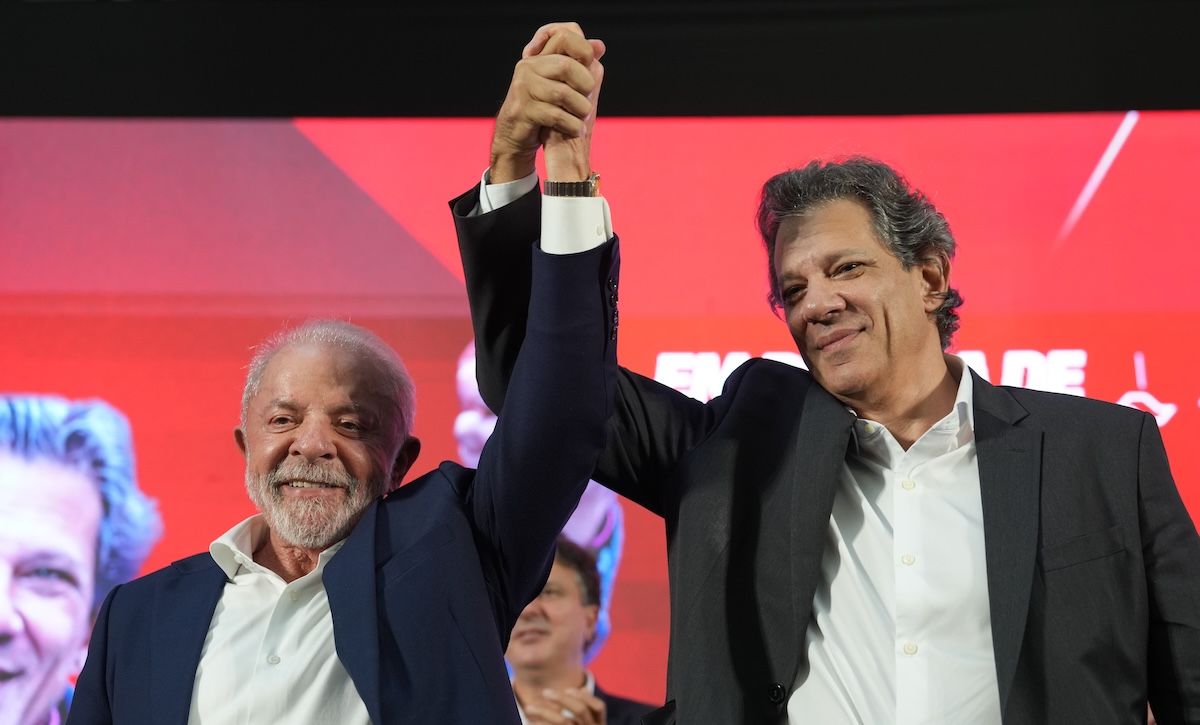
Brazilian President Luiz Inacio Lula da Silva, left, and outgoing Finance Minister Fernando Haddad raise their arms during a ceremony announcing Haddad's candidacy for governor of Sao Paulo state in the October elections, in Sao Bernardo do Campo, Brazil, Thursday, March 19, 2026. (AP Photo/Andre Penner)
Dona Maria has strong opinions about politics. A Black, elderly woman, she is a popular voice on social media in Brazil, critical of the left-wing government of Luís Inácio Lula da Silva. A few months before the presidential election, in which Lula will face Flávio Bolsonaro, the son and political successor of far-right former president Jair Bolsonaro, Dona Maria gets as much engagement on Instagram as popular politicians.
But Dona Maria doesn't exist. She is a character created by a 37-year-old Uber driver from the countryside of Rio de Janeiro. Daniel Cristiano dos Santos uses Google Gemini and Flow to bring the character to life, as revealed by BBC Brasil. For $4 per video, he has "Dona Maria" comment in an outraged tone on topics such as rising food prices, the arrest of Venezuela President Nicolás Maduro, and tariffs imposed by President Donald Trump, blaming Lula.
"I'm already fed up with this s**t, Brazil. And the slug [a reference to President Lula] is silent. Now that people are getting f**ked by foreign tariffs, he's quiet as a clam," the character says in one of the videos, which reached over 8 million views and more than 20,000 comments. The reactions to the video suggest that most people seem to believe the character is real.
Black, elderly, and female, "Dona Maria" strategically represents a demographic that is expected to play a decisive role in the next elections and one that today overwhelmingly supports Lula.
"She is a figure that generates an artificially created sense of recognition and belonging, and that connects with a large share of the current government's voters," says Fernanda Rodrigues, a researcher at the Institute of Reference in Internet and Society (IRIS).
At least 12 videos on the page have surpassed 1 million views. "Topics that spark social outrage, the algorithm delivers," Santos told the BBC. "If you make a video that's too truthful but without that spicy edge, it doesn't deliver." The profile is estimated to have reached 100 million people. Its creator, however, denies having created it for electoral purposes.
This will be the first Brazilian election in which generative AI tools, like those used by Santos, are cheap, widely accessible and used at a massive scale by ordinary people — while also sophisticated enough to blur the line between synthetic content and reality.
Dona Maria is a symbol of the enormous challenge Brazilian authorities face ahead of the October 2026 election in a deeply polarized country.
The definition of deepfake and the limits of free speech
Brazil’s Senate approved an AI regulatory framework in late 2024, heavily inspired by the European Union's AI Act. The bill, however, still needs to be considered by the Chamber of Deputies.
"The Dona Maria case exemplifies the impact of the absence of specific AI regulation in Brazil," says Rodrigues. The current version of the bill, for example, requires visible watermarks in synthetic content.
For elections, Brazil's Superior Electoral Court, known as the TSE, has had resolutions in place since 2024 regulating the use of AI, including prohibitions on chatbots and deepfakes. "That's where a conceptual difficulty arises: is Dona Maria a deepfake?" asks Paulo Rená da Silva Santarém, also from IRIS.
Brazil's Electoral Court has not yet established a clear definition of what constitutes a deepfake – whether any realistic AI-generated creation qualifies, or whether the content must be intended to mislead voters. Dona Maria, in this case, does not attempt to impersonate a real person.
For Santarém, the rules should make this answer clear. "If there is room for divergence, there will be divergent rulings," he says.
In a technical brief, his organization, in partnership with others such as Artigo 19, argues that while Brazilian regulations have advanced, they remain unclear. Without clear criteria, the brief states, the regulation "may lead to excessive litigation against legitimate expression by individuals."
For electoral lawyer Fernando Neisser, a law professor at FGV, the illegality of "Dona Maria" is "evident." "The prohibition is not exclusively directed at candidates and parties. No one may use deepfakes in the political-electoral environment."
Neisser also sees a regulatory gap between Brazilian authorities and AI companies. "The TSE missed the opportunity to bring these platforms to the table."
Privately, TSE justices have also acknowledged that the current rules on AI are insufficient for the 2026 elections. One of the reasons cited was the ease with which profiles like "Dona Maria" can be produced and spread by ordinary users.
Another key issue is the court's leadership.
In 2022, the president of the TSE was Alexandre de Moraes, known for his hard-line approach toward Big Tech and, specifically, X, which earned him accusations of censorship from Elon Musk and the Trump administration.
This year, the electoral court will be led by Kassio Nunes Marques, who was appointed by Bolsonaro. Last year, Marques was part of the minority bloc of justices that voted to maintain legal protections shielding digital platforms from liability over user-posted content. For this reason, Nunes Marques is expected to adopt a more free speech oriented approach, which may signal greater tolerance for the rhetoric and communication tactics of Brazil’s far right that Alexandre de Moraes confronted.
Deepfake school
In late April, three parties in Lula's coalition filed a lawsuit seeking the suspension of the “Dona Maria” profile on Instagram, TikTok, Facebook, and X for alleged early campaigning.
The suit argues that the profile does not clearly disclose the use of AI and presents false, distorted, and decontextualized information. "It is clearly a tool of political propaganda, used consciously and deliberately," the filing states. The parties also highlighted the financial gains of the profile's creator, who has admitted to earning around $200 per month from Instagram monetization. He has also reportedly received advertising proposals from betting companies.
A report by the fact-checking agency Lupa found that Santos is selling courses on an online platform called Kiwify, teaching people how to create AI videos for $20. In one class, he creates another elderly character, wearing a Brazil jersey and attending a typical pro-Bolsonaro rally – the prompt used to create the character is offered to students. Santos teaches students how to use ChatGPT for scripts and Google's Veo 3 for "ultra-realistic" images. He also shows how to remove the watermarks that identify the video as AI-generated, demonstrating that safeguards built by one platform can be circumvented by features on another platform.
"This market has developed precisely because of the absence of specific regulation," says Rodrigues. For her, it is essential to discuss the platforms' accountability in the viralization of this type of content.
Outlets linked to the Brazilian far right are accusing the government of “censorship” over the lawsuit, even publishing an “exclusive interview” with the AI character that has “been persecuted on social media”. The case is pending before the TSE and will be reviewed by Justice Estela Aranha, a lawyer specializing in digital law and a former advisor to the Ministry of Justice, who served on the UN's High-Level Advisory Body on Artificial Intelligence.
Aranha faces a difficult dilemma: It is not so simple to situate Dona Maria under existing law. Banning the character raises legitimate freedom of expression concerns. Doing nothing means normalizing a massive volume of synthetic content production with the potential to influence and confuse voters while shaping future rulings and the Brazilian electoral court's own understanding of deepfakes.
So far, the evidence already shows that AI tools have had an impact on the disinformation landscape in Brazil. According to the Panorama da Desinformação no Brasil study, false content has already tripled from 2024 to 2025. In 2024, AI was used predominantly for creating scams; by 2025, the majority of false content carries an ideological bias.
The political battle in AI
While the courts deliberate, large pro-Lula pages have created their own version of Dona Maria. In those videos, the recreated character says she "was deceived," that she "believed in Bolsonaro" and "thought the Workers' Party would destroy Brazil," and now defends the current president. But in the war between AI Dona Marias, the left-wing version is losing. So far, one video has only managed around 2,000 likes.
"This shows the logic of political dispute in the field of AI. It is very dangerous because it can normalize these synthetic characters as a legitimate tool for political persuasion," says Clarissa Lima, who holds a PhD in education and coordinates the AqualtuneLab collective, which works on law and race. The organization described the use of AI to manipulate public opinion by exploiting Black identities as a façade of legitimacy and a form of "violence."
"The question shouldn't be which narrative the AI is defending. We need to think about what ethical limits Brazilian society will establish for the use of these technologies," says Lima, who believes that democracy is at stake.
Neisser argues that countries also need to think about transnational regulatory solutions for AI tools, which he said "pose a risk to democracies around the world." In Brazil, however, he is pessimistic. "There is not much that can be done at this moment. We are going to have a very complicated electoral process."
Authors