At Netroots Nation, Progressives Divided on AI
Dean Jackson / Jun 10, 2026Dean Jackson is a contributing editor at Tech Policy Press.
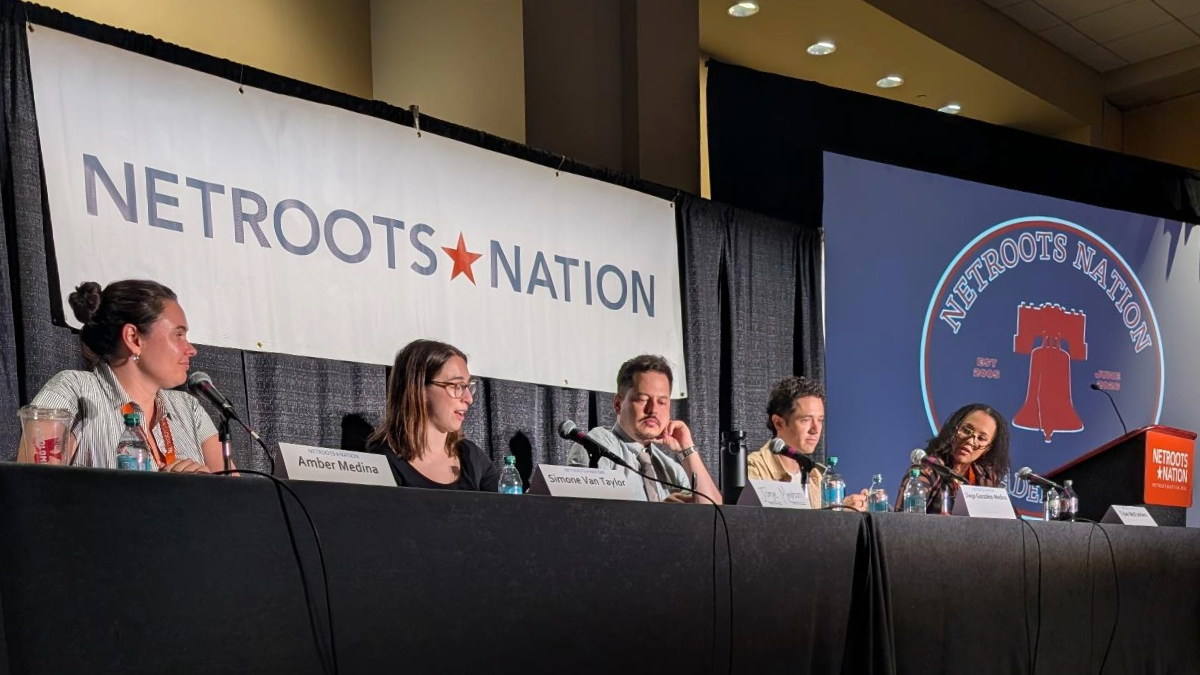
Panelists at a session titled “Does AI Change How Change Happens?” at Netroots Nation in Philadelphia on June 6, 2026. Dean Jackson/Tech Policy Press.
In February, a widely read piece in the newsletter Transformer asked if the left was “missing out” on AI—setting off a cascade of reactions about how progressives feel and think about AI and how to govern it. These issues surfaced again in April at a debate hosted during Take Back Tech—a conference held in Atlanta for organizers who are generally opposed to the tech oligarchy. Some participants in the debate made the case for a “people’s AI” outside the control of Silicon Valley; others contended that the technology is irredeemably imperial.
Similar tensions are apparent when contrasting progressive policy proposals: some see AI as an engine for prosperity and treat its risks as matters of governance and distribution. Others consider it inherently extractive, arguing in essence that a tree grown in toxic soil bears only poisoned fruit.
But the divide is not just cultural and political; it appears to be affecting how candidates run their campaigns. In March, a study commissioned by the American Association of Political Consultants found that while use of AI in campaign and organizing work is growing, Republicans lead Democrats in adoption and enthusiasm.
These disagreements are coming to a head as the 2026 midterm elections approach, and could potentially have some impact on outcomes. While some high-profile Democratic operatives have built new AI tools, they remain controversial. Do Democrats face an existential imperative to adopt AI to stay competitive in the perpetual technological arms race of American politics? Or should political ideals compel rejection and opposition? Is there any in between?
A view from Netroots Nation
These and other unresolved questions were under discussion last week at the Pennsylvania Convention Center in Philadelphia at Netroots Nation, which calls itself “the largest annual conference for progressives.” Founded in 2006, each year the nonprofit draws thousands of participants to discuss trends in digital political organizing.
AI was a topic of discussion not only on the mainstage but also on the showroom floor, where dozens of organizations advertised tools and services to attendees. Only a handful of vendors offered proprietary or fully customized LLMs with a full suite of campaign capabilities; more said they were experimenting with generative AI for specific but limited tools or features, such as customer support bots, social media listening, or memo-writing. Such internal use cases were more common than the creation of public-facing content. Some tools on display used custom LLMs while others were based on wrappers for Anthropic’s Claude or other general-purpose LLMs. Old fashioned machine learning appeared to be alive and well, especially among vendors doing audience segmentation for fundraising or outreach. Some vendors said they felt no need to integrate AI into their product offerings at all. Very few used jargon like “agentic” or “MCP.”
AI training sessions at Netroots Nation featured both participants who confessed a desire to upskill and others who resented organizational pressure to use AI. In a show of hands during one workshop, about half of the participants said they used AI regularly; roughly that many also said they worked for an organization with a written AI policy, and that they thought AI caused more problems than it solved.
One speaker warned explicitly that the influx of AI tools into their work is inevitable because funders and clients will soon expect certain tasks to be AI-assisted or fully automated. The sense of inevitability also crept in implicitly: for instance, common advice about “mitigating risks” like data vulnerabilities and algorithmic bias assumes that AI risk cannot be avoided by forgoing use entirely.
In some ways, the risks and fears raised by participants reflect the state of generative AI a few years ago, when text and image generation were the prevailing use cases and political technologists were considering using AI for content creation. But the vendors and training workshops were more representative of the shift toward AI for data management and analysis, reflecting the so-called vibe shift in AI use and adoption.
Other attendees went beyond risk mitigation, professing strongly held convictions regarding intellectual property rights, environmental costs, labor issues, and Silicon Valley’s rightward turn—all issues they said indicated against AI use. There were also practical concerns about cognitive surrender and the atrophy of human skills and institutional knowledge. When one panelist asked if there were tasks AI should never handle, one audience member cheekily shouted “everything,” and a showcase of new AI tools was disrupted by protesters who held up signs with slogans like “AI don’t vote.”
Is there a middle way?
A few participants suggested that progressives should move toward smaller, bespoke, open-source AI models. This would follow projections in the private sector, where enterprise clients are expected to shift from expensive, general-purpose frontier models to custom LLMs trained on limited datasets. This may be especially appealing to progressives if those models can be run locally with renewable power sources. This approach would offer several advantages: a smaller environmental footprint, more direct control over model alignment with progressive values, better data security, and escape from Big Tech’s AI stack. It could prove to be a middle way between complete rejection of Silicon Valley and acquiescence to its power; but political-economic questions about big tech and the Democratic Party platform will not be resolved by a compromise on tool use.
These questions also appeared at Netroots Nation. With data center development roiling communities across the US, attendees vented about the Democratic party’s lukewarm response; during one panel, local activists excoriated elected officials over a rumored data center project near a predominantly Black neighborhood in South Philadelphia. Foreign policy also featured, with attendees showing transatlantic solidarity between progressives during a discussion on “fighting fascism” between US and EU legislators.
As understanding and use of generative artificial intelligence mature, some of the left’s divisions around AI use may fade. Questions about how to best confront tech oligarchy and what technology tools to do so with will remain.
Authors