Assessing the Landmark Meta Settlement
Justin Hendrix / Aug 27, 2026Audio of this conversation is available via your favorite podcast service.
Days into a bellwether trial brought by four states, Meta reached a settlement with a bipartisan coalition of state attorneys general to resolve their claims, agreeing to pay up to ~$17 billion and to make a series of teen-safety changes to Instagram and Facebook.
The day after the settlement was announced, Tech Policy Press convened a live podcasting recording to assess the settlement and its implications.
Expert guests included:
- Alissa Cooper, Executive Director of the Knight-Georgetown Institute (KGI)
- Meetali Jain, Executive Director of Tech Justice Law (TJL)
- Matthew B. Lawrence, Professor of Law at Emory University School of Law
What follows is a lightly edited transcript of the discussion.
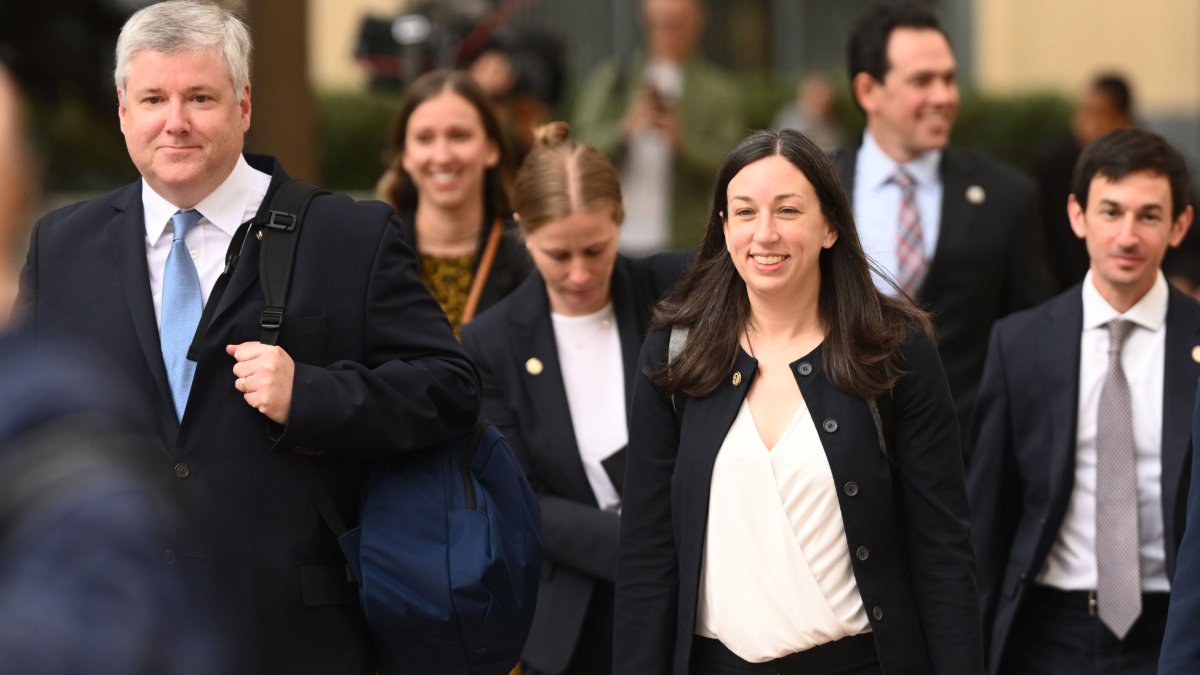
Nicklas Akers, California Senior Assistant Attorney General, left, and Deputy Attorney General Megan O'Neill exit court after tech giant Meta reached a settlement to end a landmark trial over teen social media addiction in Oakland, Calif., Wednesday, Aug. 26, 2026. (AP Photo/Noah Berger)
Justin Hendrix:
Just quickly to catch anybody up who's not followed the news, although I doubt that is the case given the nature of Tech Policy Press's listenership, readership, if you're on this call, you probably know what happened, but just basics, last 24 hours we learned of this settlement that just days into this bellwether trial brought by four states effectively reached a settlement with attorneys general to resolve their claims, agreeing to pay up to something north of $17 billion and to make a series of safety changes to Instagram and Facebook, including things like time limits, nighttime access blocks, age assurance framework, feed and parental controls, agreeing to an independent auditor, various other kind of stipulations and considerations that are baked into the settlement, which runs to something like 130 pages, although we might take all those signature pages out and say the meat of it is something less than that.
Important to say Meta denied the allegations, admitted no wrongdoing in the settlement. And I believe the case of course settled before a verdict. We're still waiting for the court to accept the settlement, I believe technically. And one thing just to note, I think important to say that we'll get into a little bit, that about five billion of the total that you're seeing in the headlines is kind of contingent on Meta's rivals adopting comparable obligations. And so we'll get into that. I think that's an interesting point and one that deserves some kind of special consideration. But I'm going to go around to each of my guests just for opening reactions given that we are responding to the news. Just their one line read. And I guess the question is, and maybe the discourse is sort of turning on, is this a genuine sort of turning point?
Is this a kind of "Big Tobacco moment" as some headlines have referred to it? Or is it something different? How would you characterize this? And Alissa Cooper, I think I'll start with you on that question.
Alissa Cooper:
Yeah. Again, thanks so much for bringing this together. It's all coming together in real time since the settlement was announced yesterday. I think the way that I think about this one day later is really as yet another brick in the path towards true accountability and harm mitigation, but that path continues on. I think the thing about tobacco, and I think Matt can probably describe this better than I can, it wasn't actually a moment, it was a movement. It took four decades of litigation to reach the master settlement agreement with the tobacco companies in the 90s, but there was a very long journey to get there. And I think this particular settlement, while it's notable for a variety of reasons on its own, should really be viewed as one more step towards eventually building the kind of accountability infrastructure that's needed in order to mitigate harm both to youth and adults online.
So there's definitely a lot to unpack about what's novel, what's new here, and the dollar figure exceeds some prior settlements, but in other ways feels small when you look at Meta's revenue. But I think it's certainly not the end of the story. It's more like towards the beginning of the story.
Justin Hendrix:
Meetali, how about you? Your one line read on this moment.
Meetali Jain:
I think it's undoubtable that this is a historic step. Again, though I agree with Alissa towards justice and accountability in the full meanings of those words. I think this settlement also needs to be viewed in the context of being part of a movement, a movement that has been very active now. For years, many of the audience here are part of that movement, whether it's parent survivors, it's advocates, it's lawyers, et cetera. It's been a movement in the US that has actually taken less time to get to this point than I think it did for tobacco. But yes, it is another significant step along the way. And I think we can't get hung up on the monetary amount because for the reasons Alissa mentioned, I mean, it's really a rounding error for Meta and the injunctive relief is significant, although I still think that one of the things I'll get into later that I'm sure we all will get into later is that ultimately it doesn't really disrupt the main driver of Meta's business model, which in this case really is personalization.
Justin Hendrix:
And Matthew.
Matthew Lawrence:
So I might take a bit of a more pessimistic tone. I think a lot of us have seen The Odyssey recently and there's this great conflict and then there's this horse gift left by Matt Damon, Odysseus, and they take it into the city, they think they've won. And then of course that's the Trojan horse and it's actually the seed of their undoing and the whole movie's. Well, sorry for the spoiler, but I do think of this as a Trojan horse. I think that we knew we were on the road towards regulation and I've been telling people, reporters that I talked to that once industry knows we're on the road to regulation, it's going to try to seize the reins of that regulation and steer it to protect its interest. And we have here a very strong effort to steer regulation towards an industry self-regulation model, which is notoriously vulnerable to capture.
And this is an industry self-regulation model that has no real disclosure of harm. So there's measures on the outside, but there's no actual monitoring of internal data that I can see. But I've had one hour, this is all early reactions, but there's also no duty of care or anything else like that. And then finally, there's an effort to set up barriers to entry that would prevent the emergence of social media platforms that weren't built on the engagement model, but other ones. So for all those reasons, I'm worried this is a Trojan horse.
Justin Hendrix:
So I want to just pick up on that point and maybe on reactions. I mean, one of the things that's kind of clear is that Meta immediately responded by publishing a statement, what it called an open letter to TikTok and YouTube to join us in supporting teens. It kind of refers to the relationship with the bipartisan attorneys general, of course, as an agreement, but talks about effectively partnering. It positions this very much as Meta taking the lead, as being the leader here. So in some ways, this is the first attempt to spin this arrangement to Meta's advantage, and I think everybody would anticipate that. Certainly we've seen many other examples of that over the course of the years. But I don't know, how do each of you react, and maybe going back to you, Meetali, Alissa, to Meta's attempt to position itself on the back of this settlement?
Meetali Jain:
Happy to start. I mean, I think it's disingenuous characterization of this settlement as an agreement itself speaks volumes. This wasn't an agreement that was come to in the context of voluntary conversation between two parties. This was effectively a way to avert Mark Zuckerberg having to testify and going through a very lengthy trial, the preview of which had already been forthcoming in other cases that had already been going to trial. So I think that it's clear that that was a spin effort of Meta's part to not lose competitive edge vis-a-vis its competitors. But I will say that I think it's also within the AG's interest to have this provision in the agreement because this case was notably brought only against Meta. And that's not to say that the harm wasn't forthcoming from these other companies, Snap, TikTok, and YouTube, but the AGs felt that their strongest case was against Meta.
Now of course, the private lawsuits have been against all of those companies. And so this is a way I think that the AGs were able to have that kind of external benefit of the agreement to the extent that there is benefit from those provisions extend potentially in the future to those other companies.
Alissa Cooper:
Yeah. I mean, I think anyone who buys into the sort of corporate spin around this particular latest instance of it really hasn't been paying attention. So we all have to read between the lines on that. But I think actually there's part of that spin that sort of gives the lie to the central concern of the plaintiffs here, which is about the way in which the design of these products draws young users onto the platforms and keeps them there to their detriment. Meta's messaging here is like, we all know that once there's usage limits on our platform, they're just going to go to yours. What does that tell you about how compelled young users, older users, adults as well feel like they literally, once they put one down, they must go to the other.
I think that's a really interesting implicit omission that's embedded in some of the ways that this has been characterized. And unfortunately, I think as Matt says, that a lot of the provisions don't go far enough to actually mitigate that harm and certainly not beyond the five-year period in which the settlement applies. On the flip side, on the plaintiff side, I do think there's an interesting dynamic here now with the legislative landscape. I don't like making predictions, but it seems to me unlikely that the other three companies that need to collectively buy into the prisoner's dilemma here are going to do that either voluntarily, possibly through the courts. But both of those avenues seem sort of unlikely to me. But there's a real incentive for even if a single state legislates the set of protections embedded in the prisoner's dilemma, then they get additional financial relief and we get industry-wide compliance across the entire nation, not just in that state.
So I think that's a very creative way if that idea came from the plaintiffs to try to put more pressure on legislatures to act in a way that creates accountability across the board, not just for Meta.
Justin Hendrix:
So I want to press more into what you're describing there, Alissa, in this kind of phase two industry adoption kind of concept, but I want to put that off just for a moment and maybe dig a little more into what you feel is missing with regard to some of the features and the various other kind of remedies that are around Meta's products. And Matthew, bring you in here as well to maybe address questions over whether this really gets at the addictive qualities of the platforms as I know you're concerned with. But maybe Alissa, just to stick with you for a moment, your post on the Knight-Georgetown Institute's website this morning says the settlement targets harmful product design, but leaves much on the table. What's left on the table?
Alissa Cooper:
So the real central miss here is around the algorithms that power these products. This settlement requires Meta to notify teens every 90 days that they could optionally decide to use a chronological feed instead of the engagement maximized feed that is the default. There's a lot of downsides to chronological feeds, and we know from a lot of existing information that came out through discovery in this case and other cases, that unless these changes are made by default, a very vanishingly small fraction of users actually take them up and go through the process of changing their settings in order to change the feed. And it's that design that is there so that people remain on the platform and keep their attention as long as possible in order to maximize ad revenue, which is upstream of a lot of the different harms that have led to all of this litigation, to the sort of outrage baiting content, to the suicidality, to the eating disorder exacerbation and on and on.
And so that's sort of the engine that drives the product. We've, with the settlement, kind of gone around the edge and said, "Well, we're going to limit the amount of time that you get exposed, but when you get there, you're going to be exposed to it all." And that I think is just a huge miss in terms of what the opportunity was that could have been achieved with stronger provisions around the algorithms.
Justin Hendrix:
Meetali, I'll come to you. Just your comment to us yesterday was around also parental control and supervision and the extent to which the settlement reinforces that as a kind of key element of what is putting the onus on parents effectively to make lots of decisions about the extent to which they're going to get involved in managing certain aspects of these remedies or the product features. Can you say more about that?
Meetali Jain:
Sure. I mean, it's just more of the same. We've seen the same talking points, assume different adaptations over the years, but it's always been in the company's best interest to put the onus on parents to police their kids' online safety. And it's no different in this agreement where you have an entire section that talks about improving parental controls. And what we've seen in practice and has been borne out for years now is that those parental controls really just don't work. And so I think again, it's yet another opportunity for the companies to continue to put that onus there. I'll just say, if I might, that a couple of other things that are really notably missing from this agreement, in addition to really attacking the central personalization and the driver of Meta's products, I think are the fact that though we have an independent audit requirement, which I'm pleased about, it doesn't go far enough.
I mean, it's not public. And so there's no way for consumers at large, parents to really understand what the safety of these platforms is, nor is there any sort of formula or guidance about how auditors should be measuring harm. And so if it's again going to be Meta determining how harm is established, that really doesn't seem to take us very much further than where we have been. And finally, I'd say infinite scroll, auto play on by default. I mean, these are things that the EU has found that were notably absent, I think, from this agreement. Sorry, settlement.
Justin Hendrix:
And Matthew, perhaps I'll come to you next. And maybe a kind of double question since Meetali's just brought up, of course, the accountability, the auditing piece of it. What's left on the table when it comes to addressing really the addictive qualities of these platforms? And then maybe we can tip over into the question around auditing, go a little bit more into detail about that.
Matthew Lawrence:
Well, first shoehorn in from a public health perspective, when you think about tobacco or opioids, it's always so important how the money's going to be spent. And so as great as this is, I do think this is a momentous step, but something I was disappointed to see is that where states can spend the money however they legally authorize to spend the money. There's recommendations about putting it towards good use, but that's more akin to the tobacco settlements where we saw money going to police gymnasiums and things like that. But more to your core question, what I'm seeing is that there's an auditor who has, this is pages 30 to 31, is assess the Meta's implementation of the relief terms, including asking for data. And as I'm reading that, but maybe this will be disputed, the auditor is looking at whether Meta's doing the things that it's promised to do, the age gating, the time limits and so on, but they're not looking at the core thing we're worried about, which is compulsive use harms.
Who's monitoring that? Who's watching that? As I'm reading this, maybe it's that the states and Meta w take different views on this. Maybe we'll hear more about this in the coming years. Maybe I'm completely misinterpreting it, but it seems like we're setting up auditing around taking these certain steps, but not getting at the kind of core what's going on behind it. And then I'll just say, it reminds me of the insurance industry where with health insurance, one of the reasons it's so terrible is there's no duty of care due to ERISA preemption for normal health plan coverage determinations. There's all this stuff on the outside, but when it comes down to it in the moment, nobody really knows what's going on and the insurer always has this interest through their business model to deny care. And we have the same thing here with an engagement-based business model and kind of a black box of what's happening in the moment.
So that data thing is something I'm very interested in going to this core issue of compulsive user.
Justin Hendrix:
Well, let's stick with this and just invite conversation even amongst you about this because a key part of this case was what did Meta know and when did it know it? And what did it keep from its users and from the courts, et cetera? And I think a lot of people are looking at this and wondering, does this kind of auditor and accountability stipulation really give us more insight? Is it really going to give us more insight? I think Arturo Béjar, who testified in the trial last week, made some comments to us yesterday that I think get similar kind of concern to yours, Matthew, which are along the lines of, is this really kind of measuring whether Meta is able to comply with whatever these remedies are, but still we don't know, are children safer? Do we have a bigger read on the underlying issue and problem?
Are we going to get at that? Alissa, you have spent enormous amount of effort at KGI on trying to get to the bottom of how to do independent technology research and what are the various mechanisms for that? I don't know, what do you make of this piece of it?
Alissa Cooper:
Yeah, I mean, I think the first spot to really shine the light is on the metrics. What are we going to be measuring? Let's assume that we do end up with a qualified auditor who has the skills and capabilities and resources and access to internal data and personnel in order to actually be able to conduct the measurement. What are they going to be measuring? I mean, Matthew basically already explained this, but there's a lot of language in the settlement for some of the provisions, which essentially just falls back to Meta's definitions and their community standards and what they consider to be harmful, et cetera. This is not sufficient. We want to know whether after the settlement is in place, after Meta has claimed compliance six months later, a year later, five years later, has the harm actually been mitigated? And you need a particular set of metrics for that.
You need to understand from users themselves whether they feel like their wellbeing has been impacted, whether they can sleep better, whether they can focus better, whether all of the concerns and harms that brought state AGs together to bring this case have actually been reversed, not whether the tool was deployed. Did we show the notification to the right users?
I mean, that's important to know too. That's such the minimal bar. So we need a set of metrics and measurements that relate to actual harm and not just compliance with the functional terms of this settlement. We're one day out looking at the way that the auditing provisions are crafted. I do think we have more to learn. It's the first thing that's going to happen 90 days, this state committee is going to get together with the auditor and they're going to decide what the work plan is. That is going to be a very important period because if that work plan does include all of this, which I don't think the settlement precludes having actual harm metrics and measurement, it just doesn't affirmatively state that those are the things that will happen, then there's a lot of possibility here. There is a real lack of transparency as Meetali says.
We won't know as the public the results of a lot of these measurements, nor will researchers be able to access the data. Although Meta and its public messaging has talked about setting up a social media research foundation and donating data to that. I would love for Meta to go all in on that and be held accountable to it. I don't see the provision leading to that in the settlement itself, but Meta is talking about it. So that might be an additional vector by which we can get some more transparency around the actual effects of this settlement.
Justin Hendrix:
And Meetali, Matthew, I'll bring either of you in to add to this or generally engage with what Alissa's just said. But one thing that I did want to bring up is this state committee that Alissa has referenced. We understand it'll be made up of six offices from the attorneys general. And I think the agreement states that Meta will be part of the committee as well. It doesn't exactly explain how this mechanism will work. I don't know. Anything else we can add there on what you understand about that? And I'll put that to anyone who's looked at those provisions in particular.
Meetali Jain:
I think all that needs to be worked out. It does talk about the six AGs offices being on a rotating basis, so there will be some ability. I mean, that could be both good and bad because it does feel that there's going to need to be some institutional knowledge built up over time. So I would hope that it's not rotating so frequently that we lose that. But what I will say just as a plug for AGs is that the AGs offices we know that have been involved have just been fantastic. And so I hope that they continue to really use this platform to exert that leadership and to be though leaders as Alissa said, and to take the opportunity for the potential that this creates if they so choose.
Matthew Lawrence:
You can tell I agree with all of this and I worry a lot as a defense attorney, so I focus on the negative and I hope that it's all much more positive. I have the Administrative Conference of the United States 1994 recommendation on self-regulation by industry. This is a common issue all over cross. Industry always wants to self-regulate in this way and then have something like we have here, the six attorney general committee that oversees it. And what ACUS says is be very careful because this model often leads to capture of the regulators by the regulated industry and barriers to entry of competition. In light of that concern, it says only do this if the agency itself has sufficient expertise to audit the self-regulatory activity itself. And what I'm getting at is that this committee does not look like it's set up. I would want a big agency that's super well funded and has a hundred people on staff that can have the expertise to ask the right questions and make sure the work plan's good enough.
I would like to see a lot more to have any confidence that the trend we see in industry after industry of self-regulation going the way the industry wants it to will be avoided in this case. I think it's possible. Maybe the investment will be put in that committee, but it's not required by this. And if it doesn't happen, then that's reason for concern.
Justin Hendrix:
And Alissa, maybe I'll just put to you as well these considerations around additional research and oversight. I mean, there's at least some provision that's being mentioned here for effectively funding more independent research into scene wellbeing. I don't know, what do you understand about that? What do you make of it?
Alissa Cooper:
I have searched far and wide to try to find the source in the actual settlement for this provision. I have not found it yet. I don't see the AGs speaking about it in their press releases either, but I will be delighted to learn that it actually is a commitment that is binding on Meta. I mean, any structure with sort of reasonable accountability that facilitates actual pathways for researchers to be able to conduct additional research on actual data about what's happening to people on these platforms and as a result of their engagement with these platforms I think would be welcome, but we're really, I think, needing more details on that. One thing just in response to what Matthew was saying about the relative small size of this committee compared to the task that it is given. I mean, this is a situation we find ourselves in often with tech litigation in the United States because there is no real regulatory authority that spans across the states that has the kind of technocratic resourcing and expertise to enable the kind of investigations and accountability that Matt was describing.
It's a bit in contrast to some other jurisdictions, and I know maybe we'll talk about other jurisdictions later, but when we think about regulators in other jurisdictions, the European Commission that have dedicated teams, that this is all they're doing now because they have legislation that granted them authority to do that kind of thing. It really shows you the incredible asymmetry and power between the regulated and the regulator. We have in some ways the most acute version of that here with a very small committee doing oversight, but there are other models in other parts of the world that we can look to.
Justin Hendrix:
And I'll just, for anybody who may have missed this, Alissa's referring to the fact that in my question, at least I was referring to this idea of an independent social media research foundation, which is mentioned in Meta's blog post about this, but isn't exactly described anywhere in the actual settlement document. So that's an interesting discrepancy and unclear exactly how that works or where that will come from. And we'll just have to see how that all sort of plays out over time. But let's turn to this question around industry-wide adoption because Alissa kind of pointed to this at the beginning, and I do think the minute you start reading this thing, everything seems normal right up until you get to this idea of industry-wide adoption. At least that's the way I read it yesterday. This is really interesting stuff on some level, and it appears to be something that Meta is quite enthusiastic about, the ability to use this agreement as an opportunity to call on what it sees as its prime rivals, TikTok and YouTube to make changes as well.
But let's talk about this. How should we understand this thing? And maybe Matthew, I'll come to you first. How novel is this to see something like this in a settlement, something that reaches beyond the accused and would cover off other players in the industry in this way?
Matthew Lawrence:
Justin, I haven't had the chance to go dig back for novelty of this. I've not seen something like this before. It did strike me, but I can't tell you it's not novel. I haven't dug through Westlaw for every. I will say I really separate here, and this goes to the Trojan horse piece a little bit, the effort to regulate TikTok and snap on the one hand with the effort to regulate newcomers to the industry on the other, because the settlement is very clear that this is not just about these other big players that are built on the engagement model, but also all of these requirements would apply to any startups, any newcomers. And that's just a big difference because the implications are different and that leans directly into what I mentioned from the ACUS report about how self-regulation is often a tool to create barriers to entry to lock in market share for entrenched players.
And here you have out there social media apps that are trying to build a different kind of model, community building, engagement, family-wide, and this is potentially imposing on them all of these requirements which can make it more costly to us.
Justin Hendrix:
Yeah, and I'll just maybe a little more detail on that on the new entrants. It's almost like the agreement kind of contemplates a sort of equilibrium that has to be achieved where any new entrant that I guess ends up with, what is it, more than five million users and half an hour daily spent for at least a period of four months or something like that, if I remember the details correctly, would effectively trigger a kind of reassessment of that equilibrium? Are we maintaining industry-wide adoption? Is everyone kind of on board? And the minute everyone's not on board, then things kind of fall apart again. Is that the way you read it?
Alissa Cooper:
Yes. Yeah. And I think that sort of universal commitment, that's sort of what caused me to arrive at the place where I though, oh, okay, for Meta, this is useful from a PR perspective because as they have already done from the outset, they can use it to attempt to get a little bit of a leg up on their peers in the press by saying, "Oh, well, we've committed to these. How come you guys don't do it too? We all know that our products are bad for teens." They're already doing that. They know that if not every single one of them commits, then it never comes into fruition. On the flip side, the thing that the plaintiffs and the whole community of advocates and parents and other interested parties who's been leading this charge for so long, what they actually want is compliance across the board.
They don't want just Meta to have to impose some usage limits. They want this industry to reform the way their products are designed so that youth can be better served. Having a sort of universal commitment or something that leads more towards a legislative approach that would impose requirements across the industry for companies of some size makes a lot of sense for them too.
I haven't spent a lot of time about the actual mechanics of when there's a new entrant or not, because I can't imagine even that all three of the parties that are named Snap, TikTok and YouTube will all agree to this. It doesn't really seem to be in their interest.
Meetali Jain:
Well, and I think this is another place where there's a failing of our competition laws. I mean, that's really what our competition laws historically have been set up to do. I think the new entrance problem is not that it shouldn't be addressed here, but that it's difficult to address it whilst also not imposing any sort of antitrust laws to remedy the market capture of these companies in the American economy. One thing I do just want to say though is that as much as I absolutely share Matt and Alissa's cynicism about the shortcomings of the agreement, and I might even add some more, I do think that this was far more than what we could have gotten through a state legislature because of First Amendment concerns and because we haven't seen those legal findings just yet because of the settlements that have been taking place. But I do think that it's important to recognize that what the AGs were able to secure here, however imperfect, was greater than what the legislatures would've been able to obtain through the adoption of laws because of the positioning of those laws vis-a-vis our First Amendment.
Justin Hendrix:
Can we just press into that? Can you explain that a little more? I think that's a question that many people have at the end of the day, why did the state settle? Why would they choose to do that? What is the broader rationale for that? Can you help us just understand that calculus, how it fits into the legislative battles as well and what governments are seeking more generally?
Meetali Jain:
Yeah, I mean I'm happy to start. There's been multiple First Amendment fights with laws that have actually managed to be passed and adopted in states that seek to regulate kids' online safety. It's of two flavors. It's the one which is the paradigmatic First Amendment violation that what is being regulated is content. Of course, these companies very strenuously will argue that whether it's likes or beauty filters or it's algorithms that all of this touches upon content which is protected under the First Amendment. That's one flavor of First Amendment, I think, challenge that we've seen, but the other of course is a compelled speech First Amendment argument. To the extent that states are requiring companies to be transparent about third party assessments, about any sort of training data in the AI context, what have you, that's seen as a compulsion on the companies to speak when they otherwise would not.
I think obviously we as civil society, as lawyers have very strenuously opposed such arguments, but they are in the ether and they're very much, I think, a facet of our American legal fraternity. It is something that we have to contend with, I think more uniquely than in other jurisdictions.
Alissa Cooper:
If I can just jump in here potentially at my own peril with two incredible legal minds on the call who can correct me if I'm wrong, but I agree there's many, many provisions in this settlement that you could not imagine legislating in any realistic way without an immediate First Amendment challenge and that would prevail. I do think it shows you a little bit where some of the gaps are here, where there's potential for legislative solutions to address some of those things. Again, the one being near and dear to my heart around algorithms. At the Knight-Georgetown Institute, we have worked on a model bill, it's called Better Feeds, which attempts to, in its crafting, evade some of these pointiest edges where we've seen prior challenges on First Amendment grounds while still creating a framework under which providers will be obligated to change the way that they optimize their algorithms so that they actually serve the user's long-term interest, but giving them a lot of flexibility to do that so we deal with the compulsion piece, focusing really on the metrics that they use to optimize those algorithms.
I do think one possibility here is that the settlement in place for one company, state legislators go back and look and say, "Okay, well where are these gaps that we can fill in that we can push on the individual pieces that we didn't get?" Of course, a lot of them also very focused on AI and chatbots, which are completely out of scope of this settlement, even Meta's own AI chatbots. There's lots of other places to go back and say, "Okay, maybe this settlement dealt with one piece for this one company, but maybe there's other pieces to pick off now."
Matthew Lawrence:
I'm torn on this because I totally agree with what Natalia was getting at, but the reason we have a guinea pig generation is because Section 230 insulated from liability for negligent or reckless acts, seemingly social media companies this mine. If you build a car or a printer or whatever it might be and you hurt somebody, you don't take careful steps and you hurt them, you could be sued, but Section 230 was insulating social media companies, insulating them, and there's also the First Amendment at play. These lawsuits got where they got by shift in discussion to the design and to public health concerns around this. They were able to get Judge Rogers to allow many of the claims into trial, and they were also able to keep it out of the appellate courts as an interlocutory matter, which is why Mark testified all that. The Supreme Court has not blessed that theory yet.
I think there's good arguments for it, but it has not blessed that theory. So hanging over everything has been the possibility that Meta could just go up to the Supreme Court and get a total win all of this. I am very sympathetic to the idea if you're a lawyer on this case and they know much more than I do or any of us, I think, you're one of the attorneys general, this could very well be the best you could get because you get this, you get the settlement, and now there's not going to be appeal after the Supreme Court that takes it all away. On the flip side, the most content-y, the most First Amendment, the Section 230-y pieces of the settlement are places where Meta says Meta represents, this is a page 24, Meta represents that we're currently protecting teens in these content-y ways and we promise to continue to do so as effectively.
Why did you get there? What did you get there? Now they did get really meaningful pauses, timing limits, but those are time, place, manner that wouldn't have been Section 230 or First Amendment anyways for boring reasons we could put in the chat or something like this. I'm torn about this. Is this the best you could get, or not?
Justin Hendrix:
Well, Alissa, you were worried about being out over your skis on that last question. Maybe I'll force you into a slightly speculative area as well just around how this does change the state legislative and the federal legislative picture. A little more detail on that, like what you see. I mean, clearly there's still child on land safety legislation coursing through both the House and the Senate. There's a lot going on, of course, across the states. Things are in different places. I don't know. Can you see this really tilting the chessboard?
Alissa Cooper:
You've seen a variety of different reactions on this question already in the first day. Certainly Attorney General Skrmetti in Tennessee, who was one of the leads here, linked it directly to this is a great step, but it also shows you why we need KOSA at the federal level. So that's one position that's out there. I think certainly all of the parties that have been working on and advocating for that duty of care style legislation at the federal level will continue to do so, whether this settlement changes the game. I think it gives new information about what is and isn't possible on the litigation track, but TBD, I'm definitely not going to predict what Congress might do since it does so little on tech. I think, again, the sort of prisoner's dilemma piece that is baked in there, if a single state manages to pass a law that creates the requirements on Snapchat and YouTube and TikTok in addition to Meta, only around the usage limits, the age assurance and the auditing, it's just those three provisions that are part of that piece, then there's an additional $5 billion that's going to get distributed all across the land, including to their own state.
It does feel like there's a bit of an incentive there for somebody to give it a go, to try. Such a law would run into all the challenges that Meetali and Matthew have been describing, but every law about kids online safety runs into those challenges and the risk of being challenged is not necessarily always a reason not to try. I could definitely see this potentially incentivizing legislators at the state level to give those kinds of approaches another go, or as I said earlier, to look at narrower pieces that this agreement just left on the table, and not that AI is narrow, but the AI piece, the algorithms piece, potentially more meaningful oversight. These are things that this settlement didn't get to.
Meetali Jain:
I should just say too, that despite our cynicism about our recognition that this may have been the AG's calculation vis-a-vis the First Amendment and Section 230, there have been some excellent decisions in recent years around First Amendment that Matt and I have actually collaborated on by way of amicus briefs supporting these kinds of arguments that a design-based approach in fact does not trigger the First Amendment and its application. There's been some good cases coming out from California, but frankly from around the country. I do think that if the AGs wanted to be more visionary in thinking about the implications, the future implications of this settlement, they could look to those decisions to see that courts are starting to separate the wheat from the chaff and disagree with the company's characterization of what is content and what is not.
Justin Hendrix:
I want to ask also about implications beyond the United States and the extent to which we feel like this settlement might trip across borders. Obviously there's a lot going on in Europe. There's the Digital Services Act, there's the UK's Online Safety Act. There's efforts to introduce age restrictions or even bans for teens on social media in dozens of countries around the world, which we've been tracking at tech policy press very closely. I don't know, anybody that would like to take that one on, what do we see happening abroad as a result of this? How does this change the experience for teens in Canada or in Cambodia?
Alissa Cooper:
I'm happy to take a shot at that. It's maybe the most scattered of all the thoughts because I think it takes a little longer to process, but I guess a couple of thoughts. One is just that yes, clearly the enforcers, litigators, regulators in other jurisdictions are paying very, very close attention to the details here, especially those, again, that have the capacity to actually do the investigatory and enforcement work that is required given the complexity of these products. Focusing on the European Union, there are multiple open investigations under the Digital Services Act against Meta. There are also some against TikTok and others that are squarely about these exact same product designs and courses of conduct about the addictiveness of the platforms, about the impact on youth mental and physical health and wellbeing, and already preliminary findings that the European Commission has been public about wherein they found that the platforms were not adequately mitigating those risks and where they talk about the need for the platforms to change their product designs, including around things like notifications, infinite scroll, auto play, algorithm design in order to actually mitigate the risks that the DSA requires them to mitigate.
I think in some ways the specifics of the injunctive relief here show, sometimes people like to say show what's possible. Oh, if it's required in the US, then Meta must be able to do it. I think the universe of what's possible is actually much larger than that, but it certainly shows the floor. If they're going to commit to this here, then clearly they could commit to something similar elsewhere. There's a funny part for me because I'm so focused on algorithms that even the option to offer people a chronological feed under this settlement, Meta is given four months to comply with that. They deployed that in the European Union two years ago. I don't know why they need four months. They could turn it on today. There's some of this sort of cross-jurisdictional learning where you say, how do we get to the super set of all of the most meaningful protections and make that the recipe for the next case and continue building and building?
I hope that's something that comes out of this, that this is viewed as the floor, it's viewed as a starting point, and that in other jurisdictions where the enforcers and the regulators have the capacity and the legal authority that they can continue to build and learn also, back to the metrics conversation, what's actually working, not just do it because 47 state AGs though it was a good idea, but do it because we get data that shows that it's actually working.
Justin Hendrix:
Yeah, I think we've had comment to Tech Policy Press from Haley Hinkle at Fairplay, underscored a couple of your points there, this idea that on some level this represents a sort of concession that platform design can be regulated. That is something that concerns some, and we've seen commentary already, a piece that folks should read from Mike Masnick at Techdirt on that consideration as well. But I might ask maybe Matthew and Meetali just to press a little bit more into what this might mean for other litigation that's out there, what it might mean for other considerations around issues like Section 230 or First Amendment, anything that you might like to share there, knowing that it's first thought 24 hours later, how we think this is going to change the legal picture, knowing that there's a lot of litigation still ahead. I mean this resolved the state concerns, but there are a bunch of individual plaintiffs, there are a bunch of school districts, there's many others in the MDL, and on some level, some argue this may have handed a blueprint to other plaintiffs that might want to come forward, et cetera.
I don't know, what do you think? Meetali, I see you first.
Meetali Jain:
Yeah, I think that is also an interesting difference between the tobacco settlement and what we have here that all this future litigation for the most part has not been prohibited. So we do have the thousands of cases in both the MDL and the JCCP that are going to be moving forward. What I can say about what I know as part of a global network of tech accountability litigators is that currently there are many litigators across the world preparing their litigation around addictive design, and that's true not just in Europe and Canada and Australia, but also in Latin America and Africa and Asia. I think, and as evidenced by the participants to this webinar, I think that there's great interest across the world. People are very closely following these cases and settlements and are thinking about how the laws in their own jurisdictions can support an approach that's really design-based, which I think is incredibly valuable because it's both language that the companies understand internally how they develop their products, but it's also language that we understand from a legal standpoint in terms of what to do.
So that's something that I think is very much currently underway.
Matthew Lawrence:
I would just add to that first, I think there's three ways this really will be helpful for litigators in other cases that I'd disaggregate. The first is in the New Mexico case when New Mexico was asking for structural kind of relief, the argument was that would harm competition, so you can't do that. So then the New Mexico judge, even when finding all of these harms and issue a big monetary judgment, declined to order structural relief for fear of messaging of the market. It would be a lot harder for Meta or social media company to make the same kinds of arguments to a judge now because that judge would say, "Well, I see what's happening here." You see what I'm saying? So that's one. Second is a feasibility point. Often whether it's the First Amendment or just in general, companies will say, "We can't do this.
We can't age-gate in this way or honor these requirements." If you're actually doing it, you can't make that kind of argument to a judge anymore, it becomes harder. Then third is just the overall feel of it. On the flip side though, I think in five years or 10 years, when somebody says that Meta created a public nuisance or something, Meta will say, "Well, we had duties under the settlement and we satisfied them." So they'll begin to use it as a shield and say that the minimum set up by this is actually the maximum and they don't have to do any more in a settlement like this requires. Legally, I don't think that would be binding, but there'll be a kind of a feel to it and it could be effective in these particulars.
Justin Hendrix:
I want to just maybe point forward and ask one question of each of you about what this might mean beyond social media. We had a couple of comments to Tech Policy Press around what this might mean for AI firms in particular who are also now facing concerns around child online safety. Meetali, of course, you are actively litigating around those issues, but I don't know, what does this mean for potentially other digital media or technology firms that are serving products to children? Can you see implications for them?
Meetali Jain:
Absolutely. I think there too, with all of our AI cases, we have taken a design-based approach. So to the extent that there's important findings of law or settlement provisions that pertain to design provisions, I do think AI companies are taking close note. I personally don't think that there's a coincidence that in recent weeks, both Google and OpenAI have talked about their products for students and for teens. I suspect that there's some kind of correlation between what's going on in the courts and how they see their products being used by children. They're using the same language of age appropriateness and privacy and safety guardrails. I do think that these companies are taking note as they should, because again, the approach that whether it's regulators or litigators are taking is one of trying to attack the very design of these products. They're different products for sure, but I think we can point to the upstream designs of these products as being the bottom line of these companies and their similar business objective to maximize engagement and profitability.
Alissa Cooper:
Reading through line by line yesterday, I don't know how you could also avoid the question of just why do only minors get these protections? Some of these are fairly straightforward, and I think we all either experience ourselves or we know in our own social circles, those who struggle with their ability to put the phone down, to maintain their attention, to not be sucked into these horrible loops of FOMO and social comparison driven by likes and reactions, et cetera. I mean, imagine social media without likes. Just imagine it. Imagine the downstream implication for the influencer economy, the notion of raising teenagers who become adults, who their entire world has been shaped by the need to appear a certain way online. To me, I felt this way in the past. As Meetali said, the companies have started to produce these teen accounts and teen offerings and safer settings on YouTube.
I was like, "How come we can't get those?" I think on a personal level, that's something to think about, but it's also from a policy perspective. Can we not expand this conversation to adults? Can we turn towards the broader population and say, "Shouldn't we be demanding better of our online experiences for everyone? Shouldn't we all not be subject to endless outrage bait and attacks on our attention?" I would love to see the conversation expand in that direction, both on the social media side as well as on the AI side with manipulative interfaces. As Meetali says, there's design to it. It doesn't manifest in the same way, doesn't function the same way, but it's meant to draw us in and it's meant to have a particular psychological effect on us as adults and as youth, and would love to see more work towards applying what we learn here towards the broader population.
Meetali Jain:
Justin, if I might say, just to Alissa's point, we know that there's been bipartisan consensus, generally speaking, around kids. This is why for us, it's been very important with our AI litigation to ever so gently start to hopefully move public empathy for adults too. We've brought a number of cases involving adults who have been victim to AI-induced delusional disorder, which is becoming more and more recognized as a phenomenon among psychiatrists. So my hope, and it is a hope at this point because it is early days, is that we can move our society and move the public, the needle, so to speak, to have that kind of empathy for vulnerability writ large, and that can be defined in a number of ways, not just by age.
Justin Hendrix:
We've got two minutes left, and I'm going to invite you just to address our audience, Tech Policy Press listeners, the folks who have participated in this live are folks who themselves are going to work on these issues. They're going to go and look more closely at this settlement. They're going to research these questions. They're going to think about the applicability in a variety of jurisdictions across the world. What would you point them at? 30 seconds from each of you on what you think are the open questions from today going forward that you think they need to pay attention to. Maybe Alissa, I'll start with you.
Alissa Cooper:
I think part of how we got here is really an incredible multidisciplinary effort between researchers, parents, families, litigators, school districts, so many different vantage points on this issue, and we need more of that joint investigatory power. So it's not just researchers sitting in an ivory tower, but it's that coalition building where we can both identify what's the data that we could collect in order to really show this new lens on this harm or to prove some causal effect. I think the best version of that comes through working across these different vantage points in the ecosystem to try to really sharpen those questions and find some answers.
Justin Hendrix:
Meetali.
Meetali Jain:
I would echo Alissa's comments and just add, I also think we need to be working across jurisdictions and paying more attention to one another. These companies have a transnational footprint, and so too should we. I think there is some of that, but I think we can actually do much more to create those transnational conversations so we can learn from one another and learn about better paths towards trying to get to the digital spaces that we believe are safe for everyone.
Justin Hendrix:
Last word to Matthew Lawrence, on the ground in the airport.
Matthew Lawrence:
I would just say that observing the transformation here, this is unimaginable where we are today from where we thought we might be five years ago, and it's really individual people and groups of people, parents who've been advocating so passionately. It's youth who've been getting engaged. So what I would say in this particular, I would call it a battle in this larger fight, is I would look to them and I'd say, "Great work. Keep going. How can we help?"
Justin Hendrix:
Well, we've stuck the landing. It is noon here. The hour is up. I'm very grateful to Meetali, to Alissa, to Matthew for joining us at the last minute, and so many of you from across the world for joining us for this conversation. Thanks to my guests, thanks to everyone who participated live. You can find the podcast probably a little later this evening in our various podcast feeds or at Tech Policy Press. I invite those of you who intend to write about these things, look at them closely, be in touch, grateful to all of you, and I wish you a good day.
Authors