As Google Scrubs ICE Detention Reviews, Platform Power Serves State Interests
Muira McCammon / Aug 3, 2026Muira McCammon is an assistant professor at Tulane University.

June 6, 2026: Protesters and officers with the Department of Homeland Security clashed outside the Metropolitan Detention Center in Los Angeles on the first anniversary of increased US Immigration and Customs Enforcement (ICE) raids across Los Angeles County. (Photo by Ted Soqui/Sipa via AP Images)
In June, United States Immigration and Customs Enforcement (ICE) agents tracked down Paigelynne Gonyea to the Syracuse Central Library, where she was working as a poll worker. They handed her a written warning and told her that her Instagram account had made threats against an ICE agent and was in violation of federal law. On January 8, Gonyea had posted the following message online:
BREAKING: The ICE agent who shot and killed Renee Good in broad daylight has been identified as Jonathan Ross by the Minnesota Star Tribune. I think today is a good day for Jonathan to be indicted!
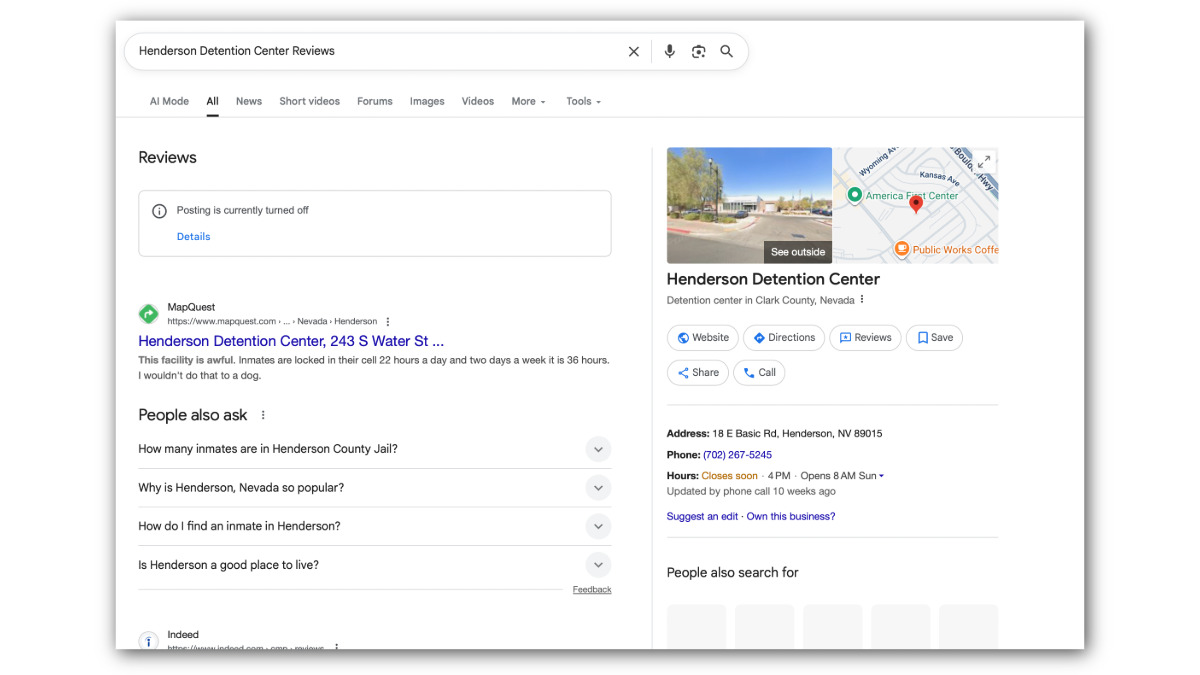
Under the Trump administration, ICE agents have been on a campaign to erase such critical statements, and lately, they’ve been getting help from Big Tech. Last year, I noticed that Google was turning off access to reviews and ratings of ICE detention facilities and many other federal components. By August 2025, the tech company had removed reviews for over 90 facilities, forbidding people from further commenting on them and eliminating access to previous comments. Last month, of that original group of detention facilities, only four still allowed reviewing and rating: the Farmville Detention Center, the Chase County Detention Center, the CNMI Department of Corrections, and the Grayson Center Detention Center. Previous comments, now gone from the internet, discussed conditions inside the camps and represented ongoing efforts to hold ICE accountable. I wrote about this in a research article published last month in the journal New Media & Society.
In its recent statement to The San Francisco Standard, Google said that turning off access to reviews and ratings for ICE facilities was “unrelated to a government request,” and separately, in a statement to The Intercept a Department of Homeland Security spokesperson said that ICE had not requested any reviews of detention facilities be removed. After my work received international media coverage, Google turned off reviews for the four detention facilities, prompting concern from people like Tania Choto, whose husband Fernando remains detained at ICE’s Farmville Detention Center.
However, there’s a bigger issue at play here. Many of the communication channels where people are going to speak up against the US federal government are now managed by private technology companies. Google’s content moderation policies and how they may relate to knowledge panels and reviews of individual US federal agencies are not being clearly disclosed to the public.
Google, for its part, has not announced any specific policy on the moderation of federal listings in Maps and only recently acknowledged—after my article was published—that it was moderating comments related to ICE detention facilities. It is not yet known how aware federal agencies are of the knowledge panels that relate to their work and mission. How or if government workers are involved elsewhere in the US administrative state in the maintenance and editing of individual knowledge panels, which can be “claimed” by organizations, is unclear. If they are suggesting edits to these panels, it could make such efforts subject to the US Federal Records Act and other records management laws.
Google makes leaving reviews relatively easy, and at surface level, it might seem less risky to write on an ICE knowledge panel than to email ICE or tag its account on Twitter. But, the Trump administration has made it clear that it is coming after critics of the US carceral state, filing subpoenas to uncover the identities of posters who call out its inhumane behavior online and tracking them down. In this moment of democratic backsliding, it’s possible that anyone leaving a Google review critical of ICE, or other federal agencies housed outside the Department of Homeland Security, could face repercussions.
Google reviews: A medium for contesting institutional abuses and ICE
While online reviews may seem trivial, they are sometimes a key source of information. As journalists have struggled to see firsthand what’s happening within detention facilities, they’ve looked online for narratives of life inside the camps. In 2025, reporters at The Financial Times published a detailed forensic analysis, attempting to map the scope of the US immigration industrial complex. Their investigation drew on satellite images of facilities from Google Earth and excerpts of Google reviews. Other journalists have turned to Google reviews of ICE facilities, including Stephanie Koithan with The San Antonio Current, who documented conditions at the South Texas Processing Center in Pearsall.
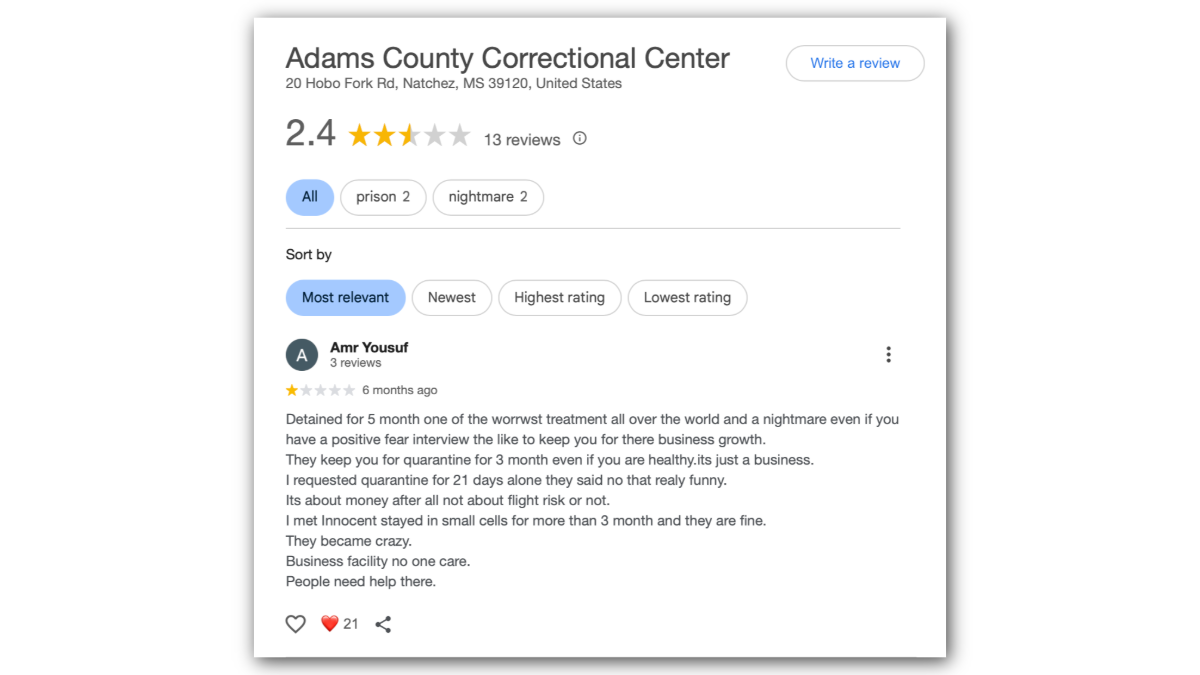
Last year, in August 2025, I collected over a thousand Google reviews of 26 individual detention facilities that were still accessible. By then, Google had already begun turning off reviews for most of the facilities listed on the Department of Homeland Security’s official index of active ICE facilities. Today, only four of those facilities still allow for reviews to be posted. When my own scholarly article reporting my findings was published in June, the number of publicly available Google reviews had fallen from four digits to a mere 55. (Recently, The Mississippi Indy interviewed a formerly detained person who gave the Adams County Correctional Center outside Natchez, Mississippi one star.)
This does not come as a total surprise. In 2023, Google, via one of its project managers hinted at the company’s practice of moderating reviews of prisons:
… longer-term protections for places where we have found user contributions to be consistently unhelpful, harmful, or off-topic. This includes places that people go to without choice or places only accessible to people stationed or assigned there — such as police stations and prisons.
Google has demonstrated a willingness to suppress the speech of people who seek to question the US administrative state. If the company is willing to quietly remove critical reviews of ICE detention facilities, what other types of expression might it be willing to erase? What about taxpayers who want to criticize the work of the Internal Revenue Service? Or Americans and others around the world who might yearn to reminisce on the legacy and global impact of the now gutted United States Agency for International Development? And what of those who might want to reflect on their interactions with the US Department of Justice’s Office of the Pardon Attorney? At the moment, reviews for all of these entities are still up, but it is uncertain how the tech company might interpret its own commercial and political prerogatives in the coming years.
A screenshot provided by the author.
What the erased reviews reveal
What are reviewers of ICE detention facilities saying? Of the hundreds upon hundreds of reviews that I read, only a few bore obvious traces of internet ‘review bombing’ campaigns, such as where people chimed in to say “#abolishice.” In many instances, self-identified family members of detained people wrote Google reviews to attest to the communication struggles they faced while attempting to contact their loved ones. As one person explained, “This place does not know what it’s doing [sic] you called ask questions and you get transferred to phone numbers that don’t even exist.” Others explicitly expressed a desire to access contact information for detention facilities and their officials: “Can someone give me information about the email address of the officer in charge?” Some reviewers put their complaints more succinctly: “Learn to answer your damn phones!”
A screenshot provided by the author.
For others, the challenge was not making calls but rather receiving them. As one self-identified former girlfriend of a detainee lamented, “I keep getting calls from this place and I’m not sure if my ex is trying to contact me.” One reviewer describing herself as the wife of a detained man similarly lamented, “If I could give 0 zeros I would I’ve called them over 1,000 times to know about my husband and no one answers.” Many of the comments criticized ICE communication practices fraught with uncertainty and disrespect.
What the comments reveal collectively is an institution that apparently doesn’t want to listen or dialogue with people, from the formerly detained to civically-engaged Americans.
What kind of democracy does Google want for the US?
Today, it would appear that Google’s commitments to free expression are not calibrated to the interests of people questing for accountability or federal oversight, but rather to the very institutions doing the Trump administration’s bidding. If the company, through its content moderation practices, is helping to protect ICE’s institutional reputation through erasure and archival annihilation, what, if any, commitment does it have to people leaving reviews on other government institutions’ knowledge panels?
Historically having an informed citizenry has been seen by many as a prerequisite for a democracy, but the matter of where people can go online to hold the US federal government accountable has involved an increasingly complicated set of sociotechnical choices. Under the US Administrative Procedures Act, people can submit comments and provide feedback to new regulations proposed by individual US federal agencies (notably in 2018, over 100,000 individuals left public comment for ICE, when it was proposing a rule change to how it treated unaccompanied children), but there is no requirement that government officials maintain—or listen—to other forums online.
These circumstances leave a number of questions open:
- As formerly detained people reflect on their experiences, where will they be able to go in the future online to share their stories and try to hold the US federal government accountable, and who will control those channels?
- Were a federal sub-agency to claim a Google Business Profile, the case could be made that a Google Knowledge Panel constitutes a public forum for purposes of the First Amendment and individuals whose reviews have been erased could have a potential case against the US federal government. How might an American court respond to a complaint from someone whose speech has been erased?
- While a Knowledge Panel will generally fall outside the scope of the US Federal Records Act, editing the panel through Google's tools or responding to reviews might make its metadata qualify as a government record under the same logic that the National Archives and Records Act applies to agency use of social media and other third-party platforms. Might legislators in Congress consider amending the US Federal Records Act to make it more inclusive of accounts of conditions at these fraught sites?
- Tech companies have proven that if the right political moment comes around, they are willing to unearth the archive, as Twitter did in the restoration of President Donald Trump’s Twitter account. If a new president or political environment were to arise, could Google be pressured to turn back on reviewing and resurfacing past comments? Might Republicans and Democrats be united in this initiative, given the ideological diversity of narratives that have been posted on ICE facilities’ Google Knowledge Panels?
- Could other countries’ governments regulate this practice and open up the potential for reviewers outside the US to contribute to these forums without the same threat of erasure?
Ultimately, Google reviews remain one of the main public-facing portals where people can complain, protest, and recount the intolerable conditions faced within many ICE detention facilities. Google’s content moderation choices threaten to render these narratives invisible.

Authors