AI Detection Was Built for Faces. Climate Deception Targets Environments.
shirin anlen, Zuzanna Wojciak / May 18, 2026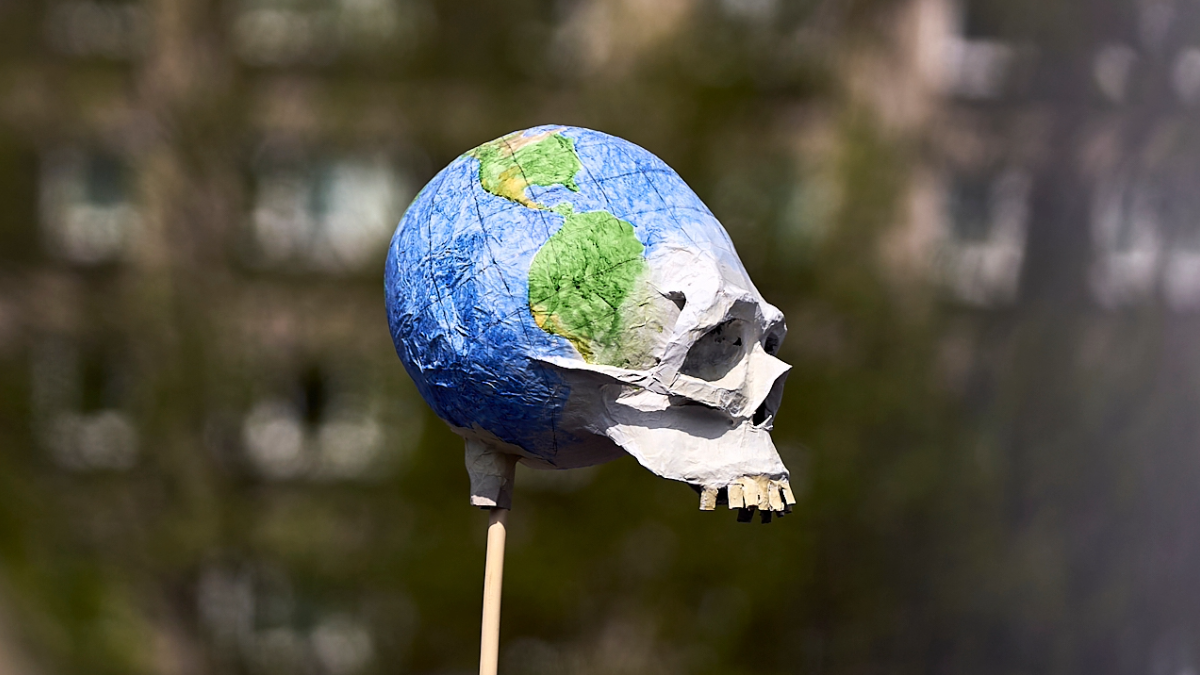
Berlin: A sign with a skull and crossbones designed as a globe is held by participants in a climate demonstration on April 18, 2026. Photo by: Michael Ukas/picture-alliance/dpa/AP Images
Much of the public debate around generative AI has focused on human-centered content: political deepfakes, manipulated speeches, fabricated celebrity videos, and non-consensual intimate imagery. This focus is justified given the scale, severity, and increasingly tangible real-world consequences of these harms, which continue to dominate online abuse. But recent investigations into synthetic conflict footage reveal a deeper structural problem: today’s AI detection ecosystem is heavily optimized to identify manipulated humans, not fully synthetic environments, disasters, infrastructure, or atmospheric events. As generative AI increasingly permeates climate-related misinformation, this limitation will become not only more visible but far more dangerous.
In 2024, we published a report on AI and conflict that projected a 2–3 year horizon before AI would fundamentally reshape the landscape of conflict. Yet within a year, it became clear that we had underestimated the speed of technological acceleration. AI was already industrializing propaganda, manipulation, and information warfare in active conflict zones.
We have since witnessed the profound impact of synthetic media on fragile information ecosystems and high-stakes environments. The weaponization of AI content in Iran, alongside the violence enabled by AI-generated nonconsensual intimate imagery (NCII), demonstrates that the harms of deceptive AI do not remain confined to the digital sphere; they materialize in the real world with devastating consequences. In the context of climate disinformation, the implications extend far beyond false viral content or online confusion. During climate emergencies, misinformation can directly shape life-or-death decisions. Confusion costs time. Time costs lives.
Recent conflict investigations already offer a warning of what is coming. In June 2025, a viral AI-manipulated video depicting the bombing of Tehran’s Evin prison spread widely online. During an investigation conducted by WITNESS’ Deepfake Rapid Response Force, multiple AI forensic teams identified a recurring limitation across current detection systems: many of the most advanced detectors rely on the presence of humans in a video and are primarily trained to identify facial or biometric manipulations rather than synthetic environmental scenes.
The problem resurfaced repeatedly. In July 2025, investigators examining another suspected AI-manipulated video depicting an explosion on Borhan Street in Iran encountered nearly identical caveats from AI detection systems regarding their reliance on facial and human-centered manipulation analysis. Days later, analysis of suspected fabricated protest footage from Georgia triggered similar warnings once again. And this challenge becomes even more pronounced in layered compositions, as seen in cases such as the alleged Haifa Port explosion footage, where authentic video is blended with synthetic smoke, explosions, crowds, weather effects, or environmental destruction. These hybrid constructions increasingly evade systems trained primarily to detect portrait-style deepfakes or biometric inconsistencies.
Taken together, these cases point to a deeper structural problem within the AI detection ecosystem: many tools are not actually detecting “AI-generated content” in a generalized sense. Instead, they are optimized to identify a narrow set of artifacts associated with manipulated human features: synthetic skin textures, blinking irregularities, lighting inconsistencies on faces, or biometric mismatches. When those human-centered signals disappear, detection confidence often collapses.
This is not simply a technical gap. It reflects the historical evolution of the AI detection industry itself. Most modern detection systems emerged in response to facial deepfakes. Their datasets, benchmarks, and training architectures overwhelmingly prioritize human faces because those were the earliest and most visible harms. But similar to what we are now seeing in conflict environments, climate misinformation rarely centers on faces.
Climate misinformation does not primarily manipulate identities, but environments. It operates through deceptive landscapes, infrastructure, atmosphere, destruction, scale, and chaos: floods, fires, storm surges, satellite imagery, collapsed bridges, smoke plumes, crowded evacuations, burning forests, ocean waves, and failing power grids. These are fundamentally different visual domains from the human-centered content on which most deepfake detection systems were built. A detector trained to identify manipulated lip movements, synthetic skin textures, or biometric inconsistencies cannot reliably determine whether floodwaters move in physically plausible ways, whether smoke disperses according to atmospheric conditions, or whether a satellite image reflects a realistic storm system. These are not simply different aesthetics; they are fundamentally different forensic challenges requiring an understanding of environmental dynamics, physics, and spatiotemporal behavior.
Researchers have increasingly pointed to the limitations of general-purpose deepfake detectors in these contexts. University of Washington-led research demonstrated early on the capabilities of generative AI to fabricate satellite imagery. Their proposed detection method, while a pioneering effort at the time, focused on identifying significant landscape transformations and classifying images as real/fake–making it unfit to detect smaller manipulations on authentic images. Subsequent efforts advanced other solutions, such as dividing an image into small patches to analyze terrain inconsistencies or adapting existing image segmentation methods to detect AI manipulations in satellite imagery, voicing the need for further research, benchmarks, and evaluation datasets to respond to this emerging field.
In more recent work examining conflict-zone explosion footage, University of California, Berkeley researchers Sarah Barrington and Hany Farid found that even high-performing forensic systems struggled to reliably distinguish authentic from AI-generated explosion videos. They hypothesized that this failure stemmed from the unique spatiotemporal dynamics of explosions, which differ significantly from the human-centered content used to train most forensic classifiers. Their research showed that combining domain-specific classifiers that are trained exclusively on explosion imagery with physics-based modeling could dramatically improve detection performance.
The findings point toward an important shift in the future of forensic analysis: effective detection may increasingly require specialized systems capable of analyzing the physical behavior, motion patterns, and environmental dynamics unique to particular forms of synthetic content. But even these approaches face serious scale limitations. We cannot realistically build bespoke detectors for every possible scenario: hurricanes, earthquakes, floods, wildfires, aerial footage, satellite imagery, protest crowds, collapsing bridges, or smoke simulations. The visual universe of climate disasters is simply too vast, varied, and fast-moving. And unlike political deepfakes, climate misinformation often spreads during unfolding emergencies where verification windows are measured in minutes.
The risks are not hypothetical
The consequences of these detection failures are no longer theoretical. We are already seeing synthetic environmental media disrupt emergency response systems, distort public understanding during disasters, and redirect critical resources in moments where minutes matter. Here, the imperative must be to “prepare, don’t panic.”
We have already seen how deceptive AI-generated imagery can disrupt real-world systems far beyond conflict zones. Following the 2025 earthquake in the North West of England, Network Rail received a photo of a collapsed bridge in the area and subsequently canceled the rail services. The image was AI-generated, but before it had been identified, 32 services were affected. In another example from the United States, teenagers used generative AI to create fabricated images and videos depicting homeless people inside their homes. They then sent the content to their parents, prompting calls to the police. The trend dehumanized unhoused individuals, manufactured panic, and diverted emergency resources toward incidents that never occurred, potentially delaying assistance to people facing genuine emergencies.
Fabricated visuals of a hospital allegedly destroyed in Jamaica by a hurricane, AI-generated earthquake footage falsely linked to disasters in Indonesia and Myanmar, and synthetic hurricane imagery in the United States have all circulated online as if they were authentic disaster footage. Across recent climate-related events, AI-generated disaster content has increasingly outperformed authentic footage in reach, engagement, and emotional impact. During severe snowstorms in Russia, synthetic clips spread so effectively that genuine footage struggled to compete for public attention. In another case, AI-generated videos falsely depicting floods in Indonesia circulated widely across social media platforms, with debunking not coming from AI detection systems but from contextual verification and open-source investigation. The same pattern emerged during the Los Angeles wildfires, where AI content contributed to widespread public confusion over what was real and what was not.
This confusion is not merely informational. It directly shapes human behavior, movement, and decision-making during crises. The 2026 World Disasters Report documents how misinformation during conflict and displacement crises in Lebanon and Sudan caused civilians to delay evacuations, return to unsafe territories, or make irreversible decisions based on manipulated narratives circulating online. In the aftermath of Hurricane Helene, misinformation targeting FEMA and aid workers became so severe that emergency response activities were temporarily paused amid rumors of armed threats against responders.
Now we can easily imagine similar dynamics playing out in the climate context. Layering highly realistic synthetic disaster imagery alongside false claims into these already volatile information environments will have a great impact on operations on the ground. A fabricated flood video spreads faster than official emergency alerts. A fake satellite image falsely suggests evacuation routes remain open. An AI-generated clip appears to show aid being distributed in one neighborhood while real survivors elsewhere are ignored. Emergency responders lose critical time verifying viral footage instead of coordinating rescues and delivering assistance. This is not speculative fiction. The early warning signs are already here.
These risks are no longer viewed solely as a platform moderation or media literacy problem. In November 2025, the COP30 Belém Declaration on Information Integrity and Climate Change marked the first time information integrity was formally embedded within international climate governance. Signed initially by 20 countries and later backed by the European Union, the declaration recognized that misinformation and deceptive AI content can directly undermine climate response, public trust, and disaster resilience. Parallel efforts by the World Meteorological Organization (WMO) to provide authoritative weather, water, and climate data as verification baselines point toward an emerging model in which trusted scientific infrastructure becomes central to authenticating environmental reality in the age of generative AI.
One recent example involved AI-generated “eye of the storm” footage allegedly depicting Hurricane Melissa approaching Jamaica in late October 2025. The video spread widely online, with tools like Grok describing it as authentic on X despite community notes flagging it as synthetic. Ultimately, the debunking came not from automated AI detectors but from contextual analysis showing the scenario was physically impossible. Investigators later traced the clip back to a TikTok account that openly described it as an AI-generated “what if” simulation. But this kind of human-led verification is slow, resource-intensive, and fundamentally unscalable in the face of rapidly proliferating synthetic media.
In another sign of the shifting media environment, authentic disaster footage increasingly requires proactive verification. Following viral AI-generated storm imagery, journalists and eyewitnesses have begun explicitly labeling genuine footage as “not AI” before audiences will trust it. That inversion may be one of the most significant consequences of the generative AI era: authenticity itself becomes suspect. It also poses a question as to who has the power and resources to establish authenticity. Commercial satellite imagery providers can access the most up-to-date visuals of the scene and easily debunk fabricated AI satellite images. However, they can just as easily restrict access to these images, hindering humanitarian operations as well as the ability of journalists, human rights defenders, and online users to establish authenticity.
The lessons from recent conflict investigations should therefore serve as an urgent warning for climate response systems. If current detectors struggle to analyze synthetic explosions, crowds, smoke, and urban destruction in war footage, they will struggle even more with hurricanes, floods, fires, and satellite imagery. The problem is not simply that detectors are imperfect. It is that many were never designed for these environments in the first place. And by the time detection systems catch up, the informational conditions surrounding climate disasters may already have changed irreversibly.
We are navigating a reality in which synthetic environmental media can spread globally within minutes, while verification remains slow, contextual, and deeply labor-intensive. No detection model alone will solve this problem. The emergence of initiatives such as the COP30 Belém Declaration suggests that international institutions are beginning to recognize information integrity as a core component of climate resilience. But governance frameworks alone will not solve the problem. As researchers and journalists have already begun warning, we are entering an era of “deepfake weather events,” where authentic documentation competes with synthetic simulations, fabricated eyewitness accounts, and algorithmically amplified panic in real time.
The future of climate resilience will depend not only on improving AI detection capabilities but on building stronger verification ecosystems and demanding greater platform accountability. This includes broader adoption of provenance standards such as C2PA, more consistent and meaningful labeling practices, and greater scrutiny of coordinated influence networks, cross-platform amplification dynamics, and the known limitations of current detection tools, particularly in rapidly evolving crisis environments. At the same time, we must invest in the frontline actors already doing the difficult work of verification: contextual journalists, open-source investigators, emergency responders, scientific institutions, and civil society organizations, alongside broader public literacy around synthetic media and climate misinformation.
If trust in environmental reality collapses during crises, the consequences will extend far beyond misinformation. They will shape who evacuates, who receives aid, and ultimately, who survives.
Authors