Age Verification Is Locking Trans People Out of the Internet
Dia Kayyali, Jasmine Mithani / Dec 8, 2025Dia Kayyali and Jasmine Mithani are fellows at Tech Policy Press.
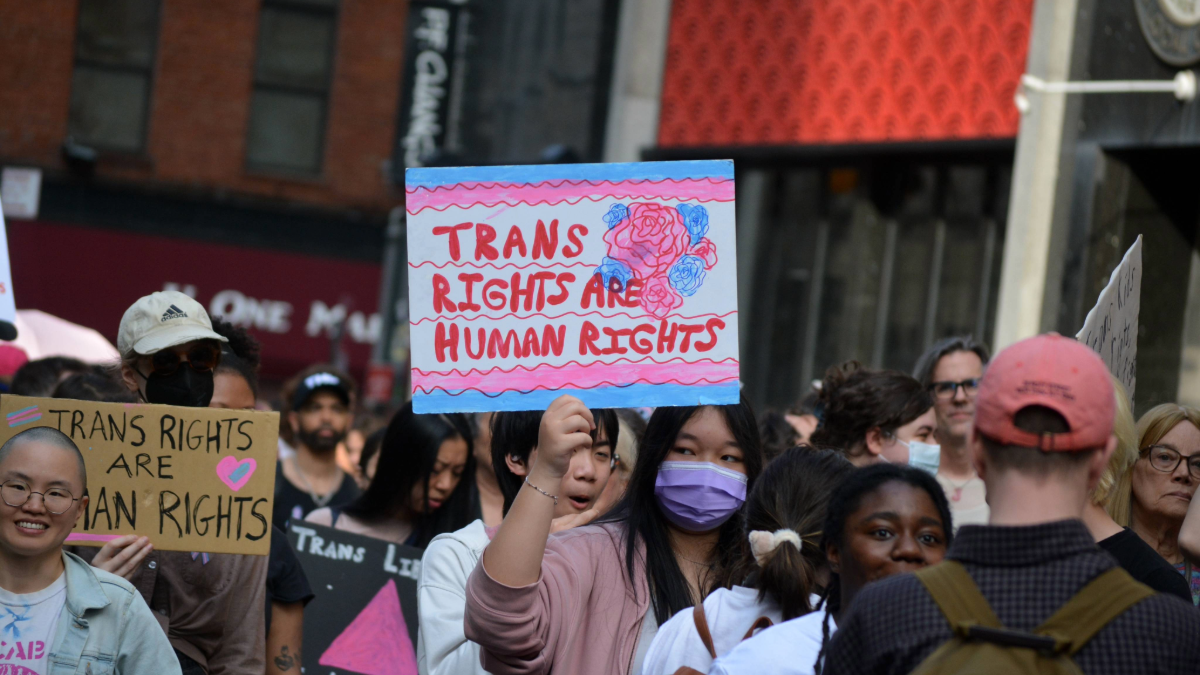
NEW YORK, NEW YORK—March 31, 2025: Person with a sign at an event on International Trans Day of Visibility in Manhattan. Shutterstock
Last month, the United States Supreme Court blocked trans people from obtaining passports consistent with their gender identity, overturning a stay that allowed proper documents to be issued. Since President Donald Trump signed an executive order declaring the federal government will only recognize an “individual’s immutable biological classification as either male or female,” the plaintiffs in the case before the Court have been interrogated for having documents with a different gender marker than their presentation. Like many trans people, the plaintiffs were “accused of presenting fake identity documents, and were forced to out themselves as transgender and nonbinary to TSA agents.”
Now imagine this identity verification process is automated via a black box algorithm, with no humans available to hear an appeal. Under laws mandating rigorous age checks to access certain content online that are sweeping across the globe, this is now a reality. Advocates, legal experts and computer science researchers told Tech Policy Press that current methods of online age verification are likely biased against trans people, cutting them off from swathes of the internet.
Lawmakers from India to the US have responded to various digital phenomena affecting youth mental health and the serious problem of increasing child sexual exploitation with policies barricading parts of the internet in exchange for a picture of a passport or selfie. These “age verification” solutions build on technology and systems that have been shown to be biased against trans people in other contexts, even as they require the processing of sensitive biometric information and other personal documents in a leaky data ecosystem.
“Lawmakers pushing legislation that encourages companies to age-gate their sites are actively putting people in danger and are using ‘protecting kids’ as a crutch to obfuscate from the fact that they refuse to truly hold companies that are profiting off our information accountable,” said Sara Philips, campaigner at Fight for the Future, a US digital rights nonprofit. “Online ID checks may seem like a common-sense solution, but that facade hides a much darker truth: lawmakers are pressuring companies to implement surveillance and censorship tactics, and it's putting all of us in danger," she said.
Age verification and trans rights
LGBTQI+ people are seeing their rights violently stripped away globally, but in a particularly regressive way in many of the “Global North” countries where age-verification is being implemented or proposed as a policy. LGBTQI+ content—particularly in education and libraries—is explicitly being targeted by local and state policies in the US, and at risk in the UK and some places in the EU.
In the US, many of the same states passing age verification laws are targeting transgender students for expulsion from appropriate bathrooms, banning their participation in sports, and allowing discredited “conversion therapy” that seeks to change sexual or gender identities. The second Trump administration has sought to ban essential medical care for trans people, ban trans members of the military from serving due to their identity “conflict[ing] with a soldier’s commitment to an honorable, truthful, and disciplined lifestyle.”
The UK is also increasingly hostile to trans people. The April 2025 UK Supreme Court ruling holding that sex means “biological sex” has led to the exclusion of transgender people from public spaces, to the degree that the European Commissioner for Human Rights sent a letter to the UK government expressing concern about the rights of trans people after the ruling.
Despite the public focus on “porn,” a wide range of content has been impacted since the rollout of the UK’s Online Safety Act age verification requirements in July of this year. Jim Killock, executive director of the UK organization Open Rights Group, pointed out that Reddit forums related to health and advice were restricted.
“There has been an impact on health and advice Reddit forums being restricted, for example, although Ofcom has tried to dissuade Reddit from restricting access in some cases. Political content was always going to be vulnerable, because it often contains images of violence," he said. A BBC investigation conducted a few days after the rollout of age verification requirements in the UK found that Reddit and X were blocking posts about the wars in Gaza and Ukraine.
Why trans users are hit hardest
Many advocates have emphasized how LGBTQI+ content and online communities can be disproportionately impacted by age verification requirements. Trans users in particular face logistical and technical challenges, as they are especially likely to have problems with out-of-date government-issued identification or access to consistent banking and credit card information. Biometrics like facial recognition technology have been shown to have a persistent, measurable bias against trans people, frequently misgendering them.
Os Keyes, a postdoctoral fellow at the University of Massachusetts Lowell, said that while no specific research has examined the efficacy of age-verification technology on trans people, there are “very good technical reasons to believe that such biases exist.” Keyes’s own research found that automated image-recognition systems were likely to misclassify trans people. They said age verification systems build off of existing infrastructure, which often has gender coded as a factor.
There are other non-technical reasons why biometric age assurance may not work for trans people. “Hormone replacement therapy — which many trans people take — has effects on the soft tissues of the face that age verification systems tend to build on,” Keyes said. Feminizing therapy can make transfeminine people appear younger, and masculinizing therapy can make transmasculine people look more youthful in practice, they said.
“When these systems are built, as they are, with a minimum age threshold, the result is likely to be trans people disproportionately being blocked from access to services,” Keyes concluded.
All of this means even trans people who are over 18 may find their access to sites as diverse as surgery photo galleries or LGBTQI+ nonprofits cut off, and it is unclear what remedies are available when this happens. A spokesperson for Yoti, for example, told Tech Policy Press that they encourage customers to provide a variety of verification methods to users. Yoti’s online support directs users to email about any complaints. The company spokesperson did not mention any other methods for appeal.
Surveillance and security risks
In addition to facing technical difficulties, trans users are also particularly at risk from the collection of private information, from both government misuse and potential data breaches– especially in the US. While the UK has data protection laws that theoretically will minimize the amount of data processed and retained under the Online Safety Act, the US has no such federal mandate, and the legislation being passed by states will have little agency oversight.
Paige Collings, a senior speech and privacy activist at Electronic Frontier Foundation, points out that, even in the UK, the rollout has been chaotic, and OfCom has not required sufficient due diligence from companies. “What we are really doing is building surveillance infrastructure around accessing information online,” said Collings.
Over the last several months, several concerning examples of how data breaches could manifest have emerged, including a recent hack of Discord’s verification data and the breach of sensitive data from the app Tea. The Tea breach is particularly concerning. Tea was meant to provide a place for women to share their experiences with men and stay safe. Users from 4chan, a popular anonymous message board known for fomenting extremism and misogyny, discovered an exposed Tea server that contained data used to verify users were women.
They quickly collaborated to download and disseminate the sensitive data, including selfies and drivers licenses, which Tea said were over two years old and “stored in compliance with law enforcement requirements related to cyber-bullying prevention.” Multiple maps reportedly used address information from the leak to pinpoint home locations of Tea users, exposing them to harassment and underscoring the unique risks marginalized users, such as trans people, can face from data leaks.
The consequences of such data leaks are significant. The National Partnership for Women and Families points out that “Sensitive personal records have already been used to prosecute reproductive health activities and adverse pregnancy outcomes like stillbirths and miscarriages.” The US government has long depended on data brokers to assist in law enforcement activity, including Immigration and Customs Enforcement detentions. The Tea app leak also included images from direct messages, which, when tied to the data needed for age verification, could enable dangerous abuses, including offline violence.
What’s at stake
There have been many high-profile cases of children experiencing harm online, whether it’s social media impacting eating disorders in teen girls, chatbots seemingly encouraging kids to act on suicidal urges, or facilitating contact between sexual predators and youth.
These are real problems related to children using the Internet, and some people believe age verification can be a magic bullet solution. But experts say age verification is being sold as a simple solution to a complex problem, while in reality, it is expanding surveillance, entrenching discrimination, and cutting marginalized people off from essential parts of the internet.
Reporting so far hasn’t shown whether age verification has resulted in a dramatic decrease in minors viewing pornography — a statistic that was hard to measure in the first place. Digital ID checks have been a deterrent to adults, some of whom choose not to watch pornography anymore. Major online porn platforms have shared significant drops in traffic, while at the same time, sites that are not complying with age verification laws are enjoying rising traffic. There has also been a surge of interest in VPNs as a way to get around location-based age verification checks.
“Age verification is being implemented in the name of safety, but giving more and more personal information to tech companies is not safe,” Philips, from Fight for the Future, said.
These safety problems with technology are not limited to those under 18. A conversation with a flirty chatbot led to the death of a cognitively impaired senior when he attempted to visit her in another state.
In many cases, the companies creating products targeted for age verification have not only amplified dangerous content but have actually knowingly allowed these harms to flourish. For example, Meta guidelines allow its chatbot to “flirt and have romantic roleplay” with children. Age verification will not fix the structural issues that allow influential men to go unpunished for human trafficking, or that allow companies to develop powerful technologies in the name of profit with insufficient safeguards.
Authors