Across the US, School Districts Wrestle With Classroom AI Policy
Justin Hendrix, Chris Mills Rodrigo, Laura Karpas / Sep 8, 2026Audio of this conversation is available via your favorite podcast service.
Just ahead of the start of the new school year, districts across the United States are issuing new policies on the use of artificial intelligence applications in classrooms. Last Wednesday, New York City effectively banned most student-facing AI in all K-8th grade classes while allowing a limited set of approved tools to be used for high schoolers for the upcoming school year. And on the same day, Los Angeles school officials announced the district was placing a one-year moratorium on generative AI for all of its estimated 378,000 students.
To learn more about these announcements and the politics driving them, I spoke to two individuals who've been covering these matters for Tech Policy Press this summer.
Chris Mills Rodrigo:
Chris Mills Rodrigo, and I'm a fellow at Tech Policy Press.
Laura Karpas:
I'm Laura Karpas, and this summer I was an audio reporter at Tech Policy Press, and I'm also a current graduate student at the Craig Newmark School of Journalism at CUNY.
Justin Hendrix:
Chris and Laura, thank you so much for joining me. We're going to talk a little bit about AI policy in schools and some news this week. I'm going to start with you, Chris. For Tech Policy Press this week, you did a survey, effectively, of what it's looking like across the country in different school districts. We've been tracking the news on how various jurisdictions have been trying to impose policies to lesser and greater effect, the extent to which states are getting involved in setting some baselines, making some guardrails. What did you learn looking across the country?
Chris Mills Rodrigo:
Thanks, Justin. I'll caveat this by saying that a lot changed this week and we're going to get into that later. But for the most part, going into this school year, the 2026 school year, the majority of school districts that I looked at, which were some of the biggest, probably top 25 school districts, the approach was largely cautionary. I think a lot of districts are not exactly sure what they want their policy to be yet, so are more so putting guardrails in place on impermissible uses of technology, but not establishing clear rules around when it can be used. So when students can use chatbots in class, when they can use it for homework or for classwork, and on the other side of the equation, when teachers can use it too, whether they can use it to create curriculum, where they can use it to build in-class presentations.
So a lot of the districts that I surveyed were focusing on AI literacy, essentially making the case that artificial intelligence to some extent is inevitable for people to come into close encounters with, whether that be in their personal lives, in schoolwork, or in the workplace after finishing school. So a lot of the focus was on making sure that students could understand how AI works. It's a probabilistic model. It's not thinking for you, but it is giving you a summation of answers that the corpus of text that it scraped points toward.
So this was pretty evident in the Chicago Public School District, for example, which had some AI limits, but for the most part was focused on setting guardrails and setting up courses for teachers and students to learn more about how AI works. And then there were a lot of school districts that had confusing policies on AI. So this is like the Los Angeles School District, which changed its policies this week, but before that had really inconsistently, they had banned ChatGPT, but then brought it back. They had launched their own chatbot, but then shut it down, and they had put out guidelines, but never officially, only through reporting. So not a lot of clarity.
At the same time, there have been bubbling reports about the possibility of some AI moratoriums going in place. There's been national campaigns calling for a suspension of generative AI technology use in schools, and there were a few school districts. Katy Independent School District outside of Houston put in place a restriction on K through six use of generative AI and Haddonfield District in New Jersey barred AI for K through two students.
And just a last note on this national survey that I did, as you mentioned, there are other players in the space. So states have adopted official guidance and policies on AI, roughly about 35 of them. However, for the most part, those kind of look like the, I don't know if I want to say wishy-washy, but sort of soft policies that I was describing earlier. So setting guardrails, focusing on technological literacy, but often kicking the can down the road for teachers to decide what students can use in class and what they can't use.
Justin Hendrix:
Do you see much difference in the policies that schools are deploying across grades and age ranges? Are there different rules for K-5th grade or middle school or high school students?
Chris Mills Rodrigo:
For the most part, it's been a sliding scale of restrictiveness from K-12. So a lot of the policies, for example, will have only monitored use of AI systems for students up till sixth grade, but then after that they can use pre-approved AI tools on their own time in the classroom without somebody looking directly over their shoulder. And then in the places where there were more ban-like restrictions put in place, those were also limited through certain age ranges.
Justin Hendrix:
Well, let's talk about the news this week. You mentioned already things have changed here in New York City where all three of us are, as well as Los Angeles. What happened this week? What's the news?
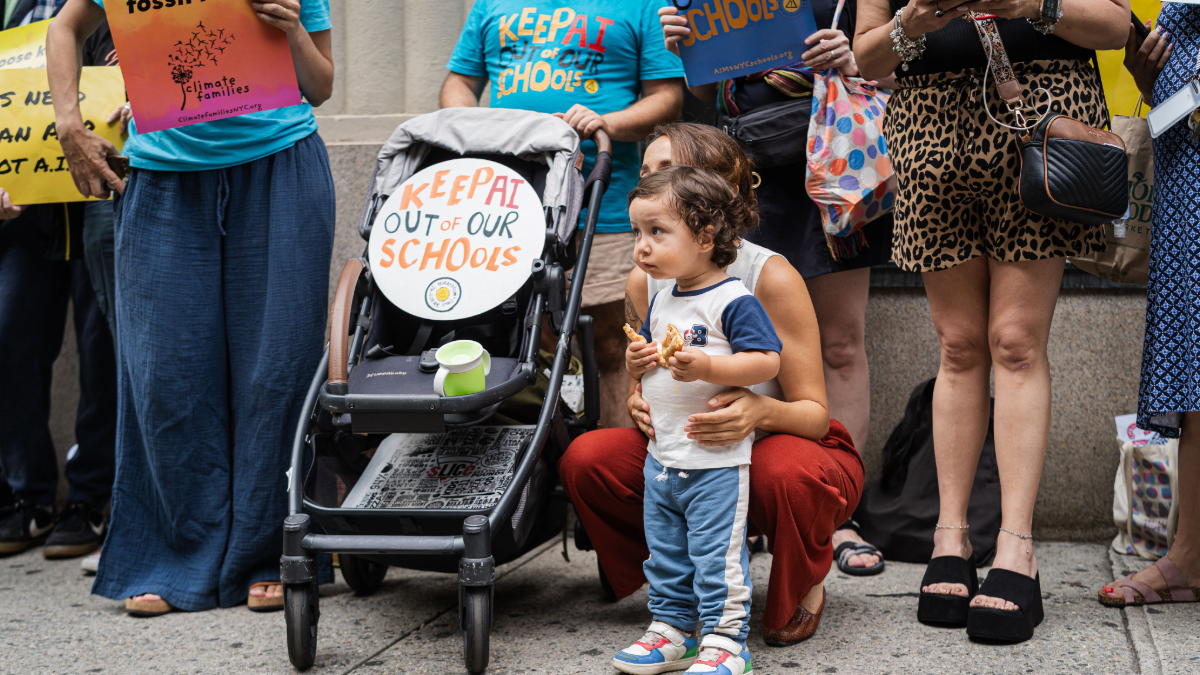
Parents and teachers held a rally calling on Mayor Mamdani and NYC School Chancellor Kamar Samuels to have a two year moratorium on AI in public schools in New York City, NY. July 29, 2026 (Photo by Steve Sanchez/Sipa via AP Images)
Chris Mills Rodrigo:
Yes, so the news is that on Wednesday, New York City Mayor Zohran Mamdani and schools' Chancellor Kamar Samuels announced that they would be banning student-facing AI in all K through eight grade classrooms and allowing limited approved tools to be used for high schoolers during this upcoming year, which essentially is an AI moratorium for one year for the majority of students, and then for high schoolers limited access.
Audio clip—Mayor Zohran Mamdani:
So beginning this school year, we will implement a one-year moratorium on generative AI for students in two K through eighth grade. This moratorium is a commitment to getting the future right.
Chris Mills Rodrigo:
This is a pretty big change in New York City policy. This administration in March had released draft guidance that put forward a stoplight system for AI where different kinds of AI use were put into categories based on how risky they were. And in this policy, almost all student use of AI was put into the yellow light category. Essentially use caution, but decisions should be made by individual teachers. This resulted in a lot of backlash from teachers that get very difficult for them if a kid comes in from a class in the morning where they're allowed to use all AI chatbots and then in their class they're more limited or vice versa. Teachers were frustrated after seeing some of the reporting and results of studies out there about how AI can negatively affect students. And students were also angry, feeling that this was an abdication of the responsibility of the school district to set clear policies around when they can and can't use it.
It's difficult if a student, as I said earlier, has differing rules from class to class if they're submitting an assignment and then they're being graded on a different methodology of how much AI can and can't be used. So over the summer, Chancellor Kamar Samuels admitted that the draft missed the mark and also paused purchases of new software. And then this week, just days before the new school year kicked off, they instituted this AI moratorium.
Justin Hendrix:
Laura, you were reporting on some of the deliberations over the summer. You attended at least one deliberation directly related to these questions. You encountered some of the protestors, concerned parents, I think some students as well. What did you see and hear on the streets in New York this summer?
Laura Karpas:
Right. So like Chris said, things have really been heating up. And since March, as a teacher described it sort of felt like the Wild West.
Audio clip:
We need an AI moratorium now and we need clear guidance because it is the Wild West.
Laura Karpas:
They're in the state of limbo, but in that state of limbo, a lot of people came out to the Panel for Educational Policy, which is the voting board that oversees all the public schools in New York City, and they came out to make their voices heard. And one of the biggest groups is called the AI Moratorium Coalition. It's made up of teachers, parents, activists, educators, students who were pushing for a two-year moratorium in schools. So I attended the meeting of the panel back in late July, and people gathered outside to make their voices heard, and there was really a range of topics that people were really concerned about. Everything from data privacy to the demise of critical thinking skills to the corporatization of public education, to even things about the environment, climate change.
Audio clips—various speakers:
We are against the corporate takeover of our public education.
I don't want my kid depending on some bot to tell him what he can or cannot do.
Our children are essentially being guinea pigs for unregulated AI technology in our school.
The unchecked expansion of tech and of data centers that are destroying the air we breathe, the water we drink, and the earth we call home.
Laura Karpas:
What I really felt and heard was that the backlash against ed tech and artificial intelligence was really as much about education as it was about their hopes and their fears for the future, which is no more embodied than in the children who will inhabit it. So yeah, the Panel for Educational Policy, it was ran for nearly five hours, lots of public comment, really putting the pressure on the voting members to put a complete pause on AI and ed tech in schools. And one of their major concerns as well was not just artificial intelligence, but screen time, which was addressed in the recent guidelines that the city came out with.
Justin Hendrix:
It seems like the parents, the activists, the advocates got most of what they wanted in this case. It's sort of being seen as a victory for those who were advocating for a more strict moratorium or even a ban.
Chris Mills Rodrigo:
The folks in the AI Moratorium Coalition that I was able to talk to after the release of this policy are calling it a step in the right direction. They still have a few issues that they would like to see addressed, including restrictions on staff use of AI and clearer metrics for how to evaluate new tools, if they are to be introduced in the process in the future. But generally, they're happy about the results and are hopeful that after this year, there'll be a more democratic process that engages parents, teachers, and students alike to determine a longer term policy.
Justin Hendrix:
And Laura, from your perspective, you were listening to folks adamantly plea for more deliberation on this front. Do you get the sense that this will adequately answer the concerns that you heard raised this summer?
Laura Karpas:
I think like Chris said, I'm sure they're happy to step in the right direction. I don't want to assume what anyone's thinking, but I'm sure they're concerned. The guidelines for the high schoolers are not as strict as they are for the younger ages. And I will say what Chris said about that they are hoping for a more democratic process. That is something I really heard at that meeting, was a real frustration around how these meetings go and how these decisions are made and the transparency that's involved in them.
Justin Hendrix:
One parent told me that they were so frustrated because their entire news about the original guidelines in March consisted of a piece of paper that was sent home in their kids' backpack.
Laura Karpas:
Completely. People are very frustrated. There's not enough communication, not enough transparent communication. People were also very frustrated these meetings cannot be held online. There's also not much accessibility in the actual meetings. It's funny, a few people pointed out that they're pushing, at the time, all of this educational technology and screens, but there's actually no screen in the panel for educational policy while the meeting is going on. A five-hour meeting with lots of contracts and votes. And that was a major point that came up.
Back in July at the Panel for Educational Policy, that was actually the first meeting with the new members that were appointed by Mayor Mamdani. This was really a real opportunity for people to come in and express their concerns to the new members as well as for the new members to express how they're feeling to the public. And actually, the new members were quite frustrated as well with the sort of democratic process of it all. They were frustrated that they didn't have enough opportunity to read through contracts before voting on them, and they were frustrated that they didn't have enough opportunity to take in mind what the public was saying before voting as well.
Audio clip—various speakers:
You cannot ask us to evaluate and vote on something in this moment when we haven't had enough time to digest it.
And some of us, we're cerebral up here this year, just want to say that. We read, we research, and so it is very, very unfair to us to vote right after we hear what the public has to say about something.
Laura Karpas:
There was also a lot of confusion around if AI functionality, while at the time it was paused, if it could be implemented in the future. You have a contract that says it has no AI functionality, can that company slowly introduce it? That was a major concern, and I'm not sure if that was addressed in the official guidelines that came out recently.
Audio clip:
Now you asked a question about whether or not there's a capability for the vendors to provide functionality, AI functionality in the future. That's not a question that I can answer at the moment because it's not a question that we ask the vendors.
Justin Hendrix:
So that's interesting. So the idea is that other ed tech tools, which may right now fall below the threshold for being considered AI tools, could become AI tools as new features are released or perhaps they're hooked up to the APIs of the frontier model developers for different reasons. So that's interesting just in terms of what we think of as AI in schools that literally could change based on product development.
And I think the thing I'm hearing from you both is just this sense of everything moving very, very quickly. There being very little information, very little research, very little to base decisions on, an incredibly complex matrix of considerations, and just simply not enough time, resources, and in some cases it sounds like almost patience to deal with it.
Laura Karpas:
That's the exact impression that I got. I mean, one activist described it as a Pandora's box that was about to burst wide open, and there was a real sense of urgency to close it. I think what we've seen with the new guidelines that came out, I don't know if the box is closed. I'd say though it's a little more closed than it was.
Chris Mills Rodrigo:
I think that's exactly right, that there is this sense of confusion. At the same time, New York City, they put out this draft guidelines in March. They announced that they were going to be amending it before the coming school year. Folks were generally aware that there would be something like a moratorium. It could not be more different in Los Angeles where the Los Angeles Unified School District announced on Wednesday that they were implementing a moratorium on AI for all students, K through 12, in a meeting where school board members that were attending did not know that policy was being introduced. I would recommend reading some reporting from that event because there were several funny times where members of the public had to amend their speeches in real time, starting off by saying, "We urge our institutions," and then stopping themselves and saying, "We thank our institutions for taking action." So that's a case where there's even less transparency about what the policy is and how the policy was developed.
Justin Hendrix:
Chris, looking forward, when you think about the survey you did looking across the country, what do you think the next six months look like, the next eight months, the next year?
Chris Mills Rodrigo:
Where my focus will be is actually what happens in New York and LA, because these are the nation's two largest school districts, and very notably, were the first school districts to ban ChatGPT in late 2022 and early 2023, which set precedent for a lot of other schools across the country. However, just months later, they reversed those bans and in fact talked about embracing AI technologies in the classroom. And I think that that kind of bait and switch set a lot of the sort of uncertainty and lack of clarity that we now have with AI and education rolling. So I'm very curious to see how these schools implement these moratoriums, and I think a lot of other districts will be in wait and see mode to see how that process goes. I don't think that they want to get caught in a situation like ChatGPT again where they have to walk back their steps and apologize for approaching technology in the wrong way.
Justin Hendrix:
Chris, what about federal policy here? We've had these Trump administration pushing AI, executive order related to it. Does that appear to be showing up at all in these local discourses around AI in education?
Chris Mills Rodrigo:
It's really hard to tell what the impact of national guidance on AI in education has been so far. One district that I talked to in South Carolina talked about the lack of state guidance and how that was influencing how they implemented policy, but didn't have much to say about the federal executive order. I would say that what has happened on a federal scale is massive commitments from AI companies to invest in education. And I think this is kind of the sub-current, the story that's happening in the background of this is that we have a relatively poor public education system and we have extremely rich education technology companies that have a lot of money and they want to capitalize on the interest in AI. So I think we're going to see a lot of interesting relations between the federal government and its close ties with AI industry and schools.
Justin Hendrix:
I get the sense as well that one of the things that is playing into these debates about AI in the classroom is people's experience of technology more generally in the classroom over the last 20 years. Is that sort of consistent with what you've seen?
Laura Karpas:
That is absolutely what I saw. It seemed like artificial intelligence was really just the peak of a very slow creep, and people were not just concerned about artificial intelligence, they were concerned about all technology merging its way into classrooms. And there was a lot of discussion about getting rid of it all together. People talked about wanting paintbrushes, wanting art, wanting pencils, wanting books, and I think there is a real yearning to reverse this slow creep of ed tech in classrooms.
Chris Mills Rodrigo:
I think Laura has it absolutely right. One teacher in Harlem that I spoke with talked about coming into education in 2016 in a very optimistic time for education technology. A lot of exciting thoughts about how technology amplify education, how it could help in the classroom, how it could make things more personalized, more engaging. And 10 years later, the feeling is much more that what these technologies, be they AI powered or not, have shown is that the fundamental thing is the relationship between the student and the teacher and that everything else is kind of secondary. And in fact, introducing more elements that can take away from that relationship can be damaging for students.
Justin Hendrix:
Laura and Chris, thank you very much for your reporting across the summer.
Laura Karpas:
Thank you so much, Justin.
Chris Mills Rodrigo:
Thank you, Justin.
Authors