A Roadmap for Confronting the Chilling Effects of Censorship, Surveillance and New Technology
Justin Hendrix / Jul 26, 2026Audio of this conversation is available via your favorite podcast service.
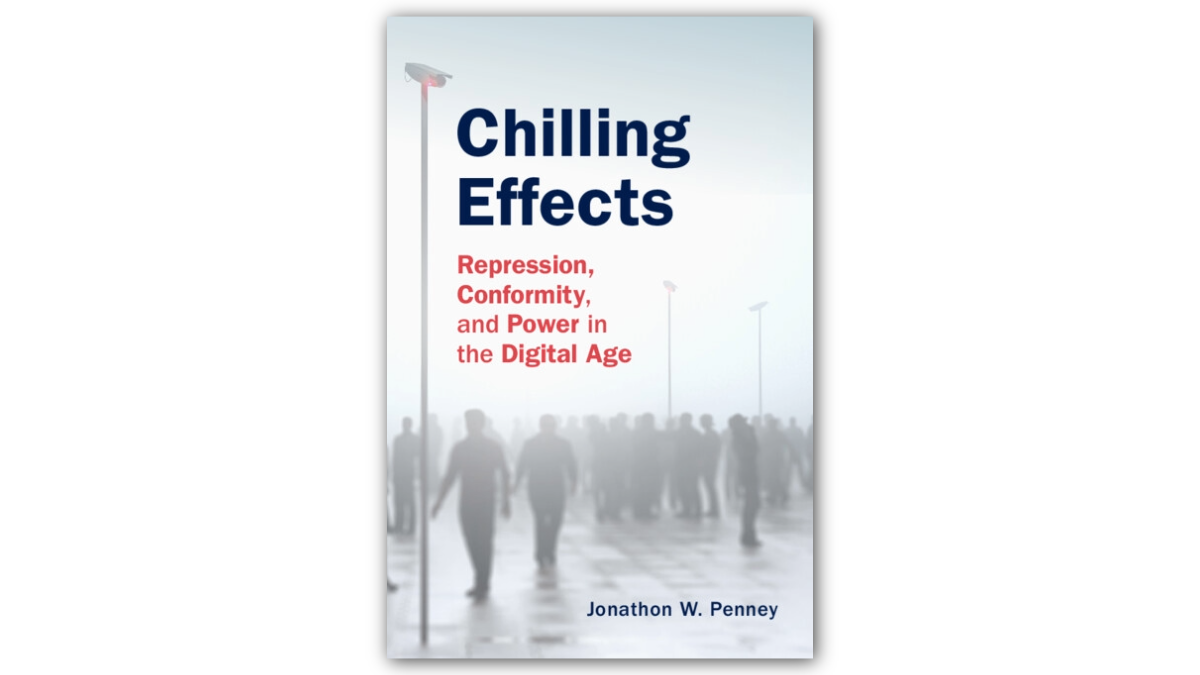
Across the world, despots and and wannabe dictators are deploying new tools, both legal and technological, to stifle dissent and oppress. Today’s guest is Jonathon W. Penney, the author of Chilling Effects: Repression, Conformity, and Power in the Digital Age, a book from Cambridge University Press that explores the weaponization of surveillance, censorship, and technologies of control and offers a roadmap for the reforms necessary to push back.
What follows is a lightly edited transcript of the discussion.
Jonathon W. Penney:
I'm Jon Penney. I'm the author of the new book, Chilling Effects: Repression, Conformity, and Power in the Digital Age, published with Cambridge University Press. I'm associate professor and York Research Chair in Artificial Intelligence, Data Governance and the Law at Osgoode Law School, York University in Canada. But also, a longtime research fellow at the University of Toronto Citizen Lab, and faculty associate at Harvard's Berkman Klein Center for Internet & Society.
Justin Hendrix:
All of those credentials make you the perfect person to talk about what we're going to talk about today, the subject of your book, this idea of the chilling effect, the legal context around it, the social behavioral context around it, what we need to do perhaps to break out of the trajectory we're on at the moment. You start with some maybe obvious points in this book that Tech Policy Press readers and listeners are very attuned to: the idea that surveillance and censorship is on the rise everywhere. We are living in a chilling new era, that technology is playing a role in this in very important ways, but it's not just tech.
I don't know. Where do you start when you tell people about this book at a cocktail party? How do you describe your ambition with it?
Jonathon W. Penney:
Yeah, that's a great question. Part of what I try to do with the book is to get people to understand, on an intuitive level, this concept of a chilling effect, which has a bit of a dual character. On the one hand, it's a legal concept that comes to us from American law and a series of US Supreme Court decisions in the post-war period, where the Court invokes it to strike down different overreaching anti-Communist statutes during the McCarthy era. But underlying that concept is a understanding or a theory of human behavior. That in the face of certain threats, a legal threat, privacy threat, even a personal threat of violence, we have this tendency to self-censor and self-restrain our behavior for self-protective reasons. And the technological context of the world in which we're living, yes, we live in an era, as you mentioned, of unprecedented technology, unprecedented data.
I think what's different about what I make, or my angle in the book, in the point I would make at a cocktail party, it's not just the tech. It's not just that there's a lot of data, and this has an impact if you're concerned about privacy, if you're concerned about rights and freedoms. Is that, on an intuitive level, we've always been concerned about this concept of chilling effects. So, the idea that if you knew someone was watching what you were reading over your shoulder on the airplane, someone was peering over what you're reading, you move to like an... Maybe I'll move seats or shift how I'm sitting, so it's not as easy for someone to be spying on what I'm seeing, what I'm doing. Or maybe in a more modern context where you're aware that the government might be tracking what you are doing, or tracking and reading online, that maybe you might avoid some more sensitive content.
Just not because you think you're going to get arrested or get caught up, but just the awareness that maybe that could get you caught up in maybe a list or a dragnet, or that data might be leaked or disclosed and misappropriated in some way. So, all of these are examples where I think, on an intuitive level, we always have this ingrained concern about certain kinds of privacy threats, other kinds of personal threats, which shape our behavior, that we protect ourselves from the watcher. In the face of a threat, we self-censored to not offend, but also to avoid risks and harms.
What's different in the book and different in the context that we're living is that, I think, these threats with this technology is now being increasingly weaponized in sophisticated ways that are really unprecedented at any other point in time in our modern history, or even stretching back further. And the way we think about the concept that we think about the public policy challenge is deeply flawed. We need a new way of thinking about it and we need a robust public policy response.
Justin Hendrix:
The first part of the book, you try to lay out the conventional understanding and theories of chilling effects. You refer to multiple academics, including Daniel Solove, who's been on this podcast in the past. You talk about a person named Frederick Schauer, who you say is considered the leading theory, the definitive treatment of chilling effects. What does the listener need to know about the kind of, I suppose, intellectual basis for thinking about chilling effects within the law in order to understand your point of view?
Jonathon W. Penney:
I mentioned earlier the modern origins of the chilling effect concept, or at least how it came to prominence in the post-war period, being invoked by the US Supreme Court in the context of different lawsuits that challenged overreaching anti-Communist statutes during the McCarthy era of the 1950s. And then as those statutes, in many cases, were repurposed during the Civil Rights era to repress the civil rights movement, you have cases invoking the concept of chilling effects continuing. To understand that very legalistic concept actually has really defined the concept itself, and traveled with this notion of chilling effects wherever it's traveled, and wherever it's really popped up and had influence. So it's... And I call this in the book conventional understanding. It's individualistic, which is not surprising because it emerges in First Amendment law, which is about individual legal rights to protect its speech under the US Constitution. It's highly legalistic as it's concerned about, first and foremost, statutes, regulations, and traditional laws, and how those laws might have a chilling or discouraging effect on people's speech and related activities.
And thirdly, itself underlying the concept, it has a theory of human behavior that's really hangs its hat on what, in the scholarship, we call a deterrence theory. That is people are aware of laws and statutes, are aware of their requirements. And when they're made aware of a vague or overreaching law, it make a conscious decision to avoid speaking or engaging in other kinds of activities to avoid the legal harm or the legal penalty or the legal risk in that context. So, this is a conventional understanding that I take as the target of my book, and it starts with the US Supreme Court. It's shaped by First Amendment scholars like Fred Schauer, Dan Solove, who himself has done really groundbreaking important work in privacy, makes important contributions to build out the theory to make it make more sense in the context of privacy threats.
I want to be clear here, while I critique conventional understanding, in doing so, I'm standing on the shoulders of giants. I mean, Fred's work, Dan's work are so critically important to chilling effects in that key foundation. What I aim to do is to say those were important for their times and their era. We need a new understanding that's better informed by empirical research to better respond to the threats and the related public policy challenges today.
Justin Hendrix:
I want to ask you a little bit about the way that you go about assessing some of this empirically. You referenced different research that has been important to your understanding and work that you've done in past that others have done, looking at internet platforms like Wikimedia, Google Search.
I don't know. How do you see some of these issues playing out at a macro scale in observable data that we can see in, literally, internet behavior?
Jonathon W. Penney:
Absolutely. And that's really what's really changed over the last, say, 10 years that I've been doing work in the space. And part of my critique of conventional understanding in the book is that the deterrence theory that underlines the conventional understanding has been largely weakened, not fully discredited. But the research shows that you need very specific conditions for deterrence theory to hold that, often, in the real world, don't. And then as I conducted my own empirical studies, including on Google Search and on Wikipedia, and found really compelling evidence of chilling effects in, not legal context but, say, in the context of people's awareness of surveillance or even kinds of online... The chill that stems from forms of law, like harassment and abuse in different on and off foreign contexts. That that conventional understanding, not only has it been shown to have a weak empirical basis, it simply cannot explain the research findings that myself and other researchers have been doing new and innovative work in documenting chilling effects in a wide variety of, often, tech contexts, online and technologically-related contexts.
And what's really become different of which, I think, it really advanced the field, is that the research that's now made possible by big data and data availability. So, there's a little bit of irony here in the sense that what's helped compound at the capacity for chill, and threats, and other kinds of shaping of behavior at scale that I talk about in the book as being a concern for the health of democracies, the availability of data and platforms like Wikipedia, like Google Search, other kinds of digital platforms that make their data available to researchers, we've been able to document chilling effects in ways that we could not in the past. In the past, you'd have to maybe ask someone in a survey, you'd have to try to prove a counterfactual. What would you have said or done but for this threat or this privacy of this trend of law?
And what I was able to have done, for example, with my Wikipedia study, was that look at Wikipedia traffic before and after the Snowden revelations. Another set of MIT researchers who reproduced my Wikipedia surveillance chill findings looked at Google Search for sensitive terms before and after the Snowden revelation's chains of Google Search. And then more recently, I was able to conduct a study with my colleague and friend Danielle Citron, who's a leading expert on online abuse. We were actually able to demonstrate a chilling effect associated with the Dobbs decision in the United States, which overturned Roe v. Wade, and led to an expansion of policing, criminalization, and restrictions on abortion access, but also new privacy threats online. We were able to demonstrate, again, with Google Search data and Wikipedia article traffic data, a slow effect that I was able to show with my Wikipedia study.
The idea here is that the data allows us to see and document, not just individual-level effects, which you could document through anecdotal actions. You could ask somebody to report how they're affected by targeted surveillance. And of course, there's important insights that are still being done in that kind of work. What's different with this kind of data that you can document the scale of the shaping of behavior, of the chilling effect, that not just documents it so it ends skepticism, but also lets us better understand the scale of the problem and our response.
Justin Hendrix:
You also point out that there are a bunch of different fields, social psychology, sociology, behavioral economics, communications, that are bringing different insights into this issue, often using different language than maybe lawyers or us journalists are talking about. One thing I remember underlining in the book is this idea that we all like to think of ourselves as rational, independent individuals, maybe not subject to chilling effects. I'm going to speak truth to power no matter what. I'm not going to follow the herd. But in fact, the science seems to suggest that we're, to some extent, deluding ourselves.
Jonathon W. Penney:
That's absolutely... That's really well put. I mean, one of the key points that I make in the book, and I critique conventional understanding, which I think has an assumption of precisely that you've just described. That we are rational actors, that we are aware of threats around us, we're aware of a legal threat or a privacy threat, and we make a rational decision to self-censor or to change our behavior deliberately in the face of these risks. What I think the research shows, and in the theory that's in the book, which I call a conformity theory, you can really call it conformity compliance and obedience theory. It draws on social psychology, it draws on surveillance studies and all these other fields that, I think, lawyers and even privacy scholars don't often necessarily engage with, is that there's a deeper psychological foundation for this behavioral response. That is we are essentially wired to be chilled in the face of these threats.
And if you speak with, for example, an evolutionary psychologist, they would describe it this way. They would say that this behavioral response in the face of different kinds of threats, privacy threats equals with other kinds of threats, we have this ingrained behavioral tendency to self-censor and self-restrain a behavior is we do it for self-protective reasons and we conform, at the same time, with the group. And the reason we do it is our ancestors in the past, those in the face of a threat that didn't self-censor and engage in group conformity were simply less likely to survive. They're more likely to be alienated, more likely to be ostracized, and therefore you'd be on your own, less likely to survive and less safe. And so, one of the outcomes of that reality is that chilling effects are not just a product of a rational decision-making process. It's often assumed by policymakers, and journalists, and also researchers, and those who assume the conventional understanding. But that there's also a subconscious behavioral tendency that we have where we are chilled, we self-censor, engage in conformity in ways when we're not even aware of it.
We are wired to be chilled in the face of these threats, and we've done so for survival reasons. But in the world in which we're living with new scales of threats, different audiences, new scales of data being collected about us, the impact is less isolated and, I think, more profound and corrosive within a democratic society.
Justin Hendrix:
So, I always like a good framework or rubric or taxonomy, which helps me thinks about these things. You suggest four chilling effect factors: observation, uncertainty, personalization or personal threats, and power and authority.
Just quickly, can we hit the highlights on those?
Jonathon W. Penney:
Absolutely. So, these four factors are essentially the factors as I got into a lot of the key social and behavioral science research. As I looked at my Wikipedia findings, a similar chilling effects findings that conventional understanding could not explain, research in social psychology in these other adjacent fields could explain these findings. And as I got into the research and did broader literature review, it was these key factors that caused or contributed to chilling and conforming effects. So, I ended up calling them the chilling effect factors.
The first one being observation, but you might also call it surveillance. And this is established in different kinds of social psychological research, communication scholarship in different contexts. It's been widely documented that observation has a impact on people's behavior. When people are aware that they know they're being watched, they engage in forms of group conformity. They comply with the perceived norm of the group that they better identify with. So, you have observation.
You have a second factor, which is uncertainty. Uncertainty is another key factor where if we're uncertain about a law, uncertain about data collection about us, uncertain about other elements of our environment, this too can cause and contributed to chilling and conforming effects of the different threats, be it surveillance, be it legal, uncertain laws and processes, uncertain corporate practices, all over the like.
The third factor, we might call personalization and personal threats. And I talk about this also in Chapter 8 in the book, and relate to something called the chilling effects crew, where I plot some data from some of my own findings, where the more personalized and targeted the threat itself, the greater the impact. That is the greater the chill. So, the way you can understand this factor is as the threat that we might be talking about, the data collection, the algorithmic profiling, the legal threat, the more targeted it is, the more personalized it instead is, the more it's tailored to the specific person who might be impacted, the greater the impact that it has on the person.
So, the way you might understand that is mass surveillance awareness, that there's mass government surveillance, does have a shaping effect on people's behavior. And that's, I think, that's been... I pick up in, for example, in Wikipedia study. But where people have good reason to believe, like a reason basis to believe, that they or a group that they're associated with might be targeted by the government or by a company or by police or some security agency, that increases or ratchets up the chill and impact of that threat. So the greater the personalization, the greater the chill.
And thirdly, the fourth chilling effect factor I call power and authority. And again, this comes directly from research on obedience, but also has been picked up in compliance and conformity research as well. And evolutionary psychologists say this behavioral response is all the same. When a figure, or an entity, or an actor which is engaged in the threatening activity, the more power and authority that they have over the victim, over society, over the particular victim or the group that might be targeted, again, the greater the chilling effect. All of this research is well documented in the context of social influence, research, and social psychology. And what I found in my own research, it really, in an almost comprehensive way, helps us understand and document the impact of the kinds of traditional threats that activists, policymakers, rights scholars, privacy scholars, lawyers, often raise concerns about chilling effects. Surveillance on certain laws, personalized targeted threats, targeted prosecution, targeted threats to do so, targeted surveillance. And then, of course, we're talking powerful entities: big tech and big government. Those are the key factors that can really help us explain a lot of the threats that I talk about.
Justin Hendrix:
So, you lay out various flavors of chills. Everything from the data breach chill to the data processing profiling and prediction chill, what you call a statutory and regulatory chill, targeted law enforcement chill, system and institutional chill. I want to just tunnel into a couple of these. In particular, the system institutional chill and what you call the chill of disinformation. I was reading this part on the system and institutional chill, and I was thinking about some of my students. I teach graduate students. And I always ask them about their behaviors online, their political behaviors online. We talk about polling around political participation online, and social media, and that sort of thing. And over the years, I would say responses from my students mirror what I think we see in polling data, which is a lot of people have effectively been chilled out of participating in political discourse of any sort online for fear of potential repercussions to them in their careers or in their personal life.
But how is that, I don't know, an institutional kind of a situation, or how do you see institutional systems reinforcing the context in which people are making those types of decisions?
Jonathon W. Penney:
Yeah, that's a great question. And I can tell you that I wrestled a bit about... I mean, in this taxonomy more broadly, the different categories. But this one in particular, what would be the most fitting kind of nomenclature to understand what the research that I think falls under this categorization? That I called, in the end, I went with a kind of institutional chill. Because the research that I used to shape and inform my thinking about it focused on different institutions in society. So I would be remiss not to mention, for example, the excellent work of a Stanford social psychologist, Sarah Brayne, who's done really interesting work in understanding surveillance in the criminal justice context. And often, the work that's been done is focused on how people who view themselves as being labeled or tied into a kind of institutional labeling or stigmatization, as people who are through the criminal justice process and therefore forever they're going to be labeled as miscreants or convicted felons, and that has a profound chilling effect on how they live their lives and how they engage with other social services in society.
And so, due to their experience within one institution in society, they feel the surveillance, data collection, data labeling, profiling processes that they undergo are carried with and they follow them wherever they go elsewhere in society, and therefore have a profound impact on how willing they are to engage in other institutions, whether it's going to social services for help or going to see a counselor. They fear that counselors are going to have access to data that was processed within the criminal justice institutions. And surveillance study scholars would call this... They call it the surveillance assemblage, which I think captures some of it. I think the institutional label captures some of it, but I think the example that you've given, I think, is a great illustration of why even these terms are a bit too limited.
Instead, I think exactly the idea behind this kind of chilling effect is how these surveillance, data collection, and profiling travels with us, not just in relation to institutions, but everything that we do in our lives today. So we are politically-engaged students who have opinions on politics, but they also know... And they want to express those opinions, but they also know that there's a lot of uncertainty, there's a lot of permanence to what they say, and they know that there's entities out there with both power and authority use the differentially effect factors. All factor into the choices that your students, but also some of the people that are picked up in Sarah's work and others, make important decisions about how they live their lives. So, they're willing to self-censor on politics, self-censor on other kinds of social opinions to protect their future economic opportunities, to protect their future personal relationships so they're not labeled or stigmatized by their opinions.
And I think that's not necessarily just an institutional chill. It's a kind of data valence where we now feel labeled, or stigmatized, or we fear the risk of being profiled, and that travels with us forever. It's kind of having like a concrete criminal record that is a digital persona to something that Dan Solove has used in the past that just travels with you. And there's a risk of that that has a profound chill in how people are willing... How they live their lives. So, it's gone beyond just simply self-censoring for one purpose, or not speaking in one context, but shaping, I think, the baseline of how we live. And I think that's really, really worrying for a healthy democratic society.
Justin Hendrix:
Absolutely. And of course, in this context that we're in the United States at the moment, this is literal real-world consequences. You might utter something in support of Palestinians and find someone literally knocking at your door to take away your rights or your visa. So, I feel like these things have really become quite clear over the last couple of years here in the United States, if they weren't prior.
But I want to ask about another chill, which is the chill of disinformation. And I feel like we've talked a lot on this podcast about ideas around mis and disinformation, and the extent to which maybe ideas like the marketplace of ideas, that the answer to disinformation is more speech. Maybe some of these things are, I don't know, not so easily understood. But how does disinformation speech chill political participation?
Jonathon W. Penney:
Yeah, it's a great question. And just let me say very quickly to your prior comment, I think, absolutely. And one of the interesting things about the Trump administration is they actually have a very sophisticated understanding of chilling effects and their different factors. Even where there may not be a mass database, it's clear that they're using the threat of that. So, ICE agents on the front lines mentioning a protest. "Oh, by the way, you're in a mass protestor database. Good luck with that."
Justin Hendrix:
Or “you will be in this database,” right?
Jonathon W. Penney:
Exactly. And that creates immediately a surveillance effect, an uncertainty. "What does that mean for me?" It's coming from an entity with power and authority, not just a frontline worker. But how the database is therefore, the assumption is tied to every part of the US government, and how that's now being weaponized in profound ways. You can see how these actors understand the four factors of chilling effects in a sophisticated way, or using and weaponizing it.
But let me come back to your question on the chill of disinformation. And this is one of those things where, again, using those different chilling effect factors, those four factors can really provide a powerful way of explaining chilling and related behavioral phenomena in a wide variety of contexts. And not just like I talk about in the taxonomy, not just algorithm, profiling, not just surveillance and data collection of those traditional contexts, but also strategies by which governments and other bad actors who want to chill and discourage political participation, speech, political opposition, all of that, that we want to normally encourage in a free and democratic society. If you understand how chilling effects work and you understand those four factors, you know that often, the aim when it comes to disinformation is not to persuade and change people's minds. I mean, sometimes that can be the case.
A bad actor sends out disinformation, sends out false information, and maybe that can convince some people of that this is a false story and they promote it, and the false information and disinformation spreads, and it persuades people of a different political point of view or shifts them in some direction. But often, the aim, and maybe the easier goal, is not persuasion when it comes to disinformation a lot of context. And part of my thinking on this was really shaped by work by a sociologist named Zeynep Tufekci, who's wrote a book Twitter and Tear Gas. I believe it came out in... It would've been post-Gezi protests, so it would've been maybe 2015. I think about 10 years ago now. Can't believe it's been that long. But Zeynep is Turkish, although she's a sociologist working in the United States, and her book was basically documenting some of the role of social media in protests within Turkey.
And one of the strategies that she documented in that book is what she called flooding the zone, where the government wasn't aiming to convince the protestors of anything, or even Turkish citizens. Instead, was to flood the zone with false information such that activists, but broader citizens who the activists would want to persuade and gain public support for their campaign in Turkey. Instead, the government flood the zone with all sorts of different false information such that your average citizen couldn't make head nor tails of what's true and what's false. And when you increase the uncertainty, it creates a situation where your average citizen just says, "You know what? I don't know if what the protestors saying is true. I can't tell what the government's saying is true. I don't know what's true, I don't know what's false, so I'm just going to disengage." So by flooding the zone with false information, disinformation, which now at a scale with AI slop and deepfakes, it can be done at a capacity of a scale is unheard of when Professor Tufekci was writing this book.
I mean, the capacity for governments to do this and batteries do this now has now increased by exponentially since then. So you just create uncertainty in the information environment, and that leads to a chill. The chill being there might be people who want to engage, speak, they want to protest, but they're discouraged or chilled from doing so through an information environment that is utterly confused and uncertain. If you can't tell what's true and what's false, you don't know which side of a public policy issue to fall down on. And so you disengage, you don't speak, and you just tune it out. And that's good for authoritarian regimes who don't want citizen grassroots uprisings like you had in Turkey, but also democratic governments that have authoritarian impulses like some that we're seeing today.
Justin Hendrix:
So, another place where you offer us a good framework is how to think about, and predict, and evaluate chilling effects. And you talk about some things that I think my listeners will find straightforward: the implications for human rights, autonomy, identity, democracy. Of course, our main concern is implications for democratic participation here. But you also talk about a couple of other potential implications of chilling effects around fomenting polarization and extremism also reproducing, entrenching inequality. I wanted to ask you about those two in particular.
Jonathon W. Penney:
So part of what I aim to do in the book by advancing this new understanding of chilling effects, one that I think moves us beyond conventional understanding and advances theory, I call it a conformed theory of chilling effects. But the aim is this, is one of the insights of this new understanding is that chilling effects and the threats that cause and contribute to them have both a repressive dimension, but also a productive dimension. The repressive dimension speaks to self-censorship, and how speech and activities that we've been talking about can be repressed due to certain kinds of threats. And that's a very straightforward, traditional way of thinking about chilling effects and the threats that cause them. But what I think conventional understanding is often neglected, and research is often neglected, it's a productive side that these threats also lead to more conforming speech and behavior. And what that means for individuals, what that means on a societal scale.
Now, one of the assumptions people say, of course, people say, "Yeah, surveillance, people watching, that leads to more conforming behavior." And often, baked into that assumption or baked into that understanding is an assumption that conforming behavior means more polite, civilized, appropriate behavior. That is, when in the face of these threats, when under surveillance, you will conform with more mainstream societal norms. You'll be more polite, more civilized, more conformist in your thinking and in your speech. And then in many cases, that's true. I make the point on a society level, I think you end up with a lot of more groupthink. Less innovation, less dynamism on a societal scale or a community scale. But that's also an incorrect assumption in all cases because conformity and conforming behavior can lead to other kinds of more abusive, less mainstream behavior. It depends on which group you identify with.
If the group that you identify best with is one where the norms and the values of that group is more hateful, abusive, polarized, tribalist, engaged in forms of trolling and harassment online and offline, then it's going to be those group norms that you're going to conform with in the face of these chilling effect threats. And what that means on a societal scale is that you probably end up with what we see in society today. You see at a broader society level, more groupthink, more conformity to conformist norms, and maybe less creativity and dynamism in some ways, but also pockets of more polarized extremist subpopulations. When the face of these threats, you have more tribalism, extremism. And then maybe in some democratic societies, including the United States, greater polarization, more divisions. All of that is a natural outcome. The same conformity, compliance, and obedience, which are all behavioral responses to these threats, we just assume that it leads to more polite, conformist, proper behavior. But that's often increasingly not the case, and can lead to really problematic extremist polarized behavior too. And that's one of the more complicated outcomes of this kind of an understanding.
Justin Hendrix:
One of the other things I found interesting was this idea that when people are chilled, they may not engage in activities they might otherwise pursue. And you talk about how this is perfect for effectively leaving folks, I suppose, exposed to various kind of other efforts to hijack their attention, or to prey on them from a capitalist perspective.
Jonathon W. Penney:
Yeah, absolutely. I mean, there are different dimensions of the broader public policy challenge posed by chilling effects as a public policy challenge, and its impact on people's behavior on an individual level in a community and then in a societal level. There's, of course, governments who are concerned about national security threats and the impact that national security surveillance has, but there's also surveillance capitalism and the attention economy, and how these companies are competing for attention in an increasingly complicated role where there's new platforms, new services all aiming to persuade us. Get our attentions, get our eyeballs, get our engagement, and keep our engagement. And the way that I think about this new reality and world that we're living in where these kinds of threats are increasingly being weaponized. Some are for clearly, anti-democratic and authoritarian reasons. I think the Trump administration is an example of that, and you can see that Zeynep's work in Turkey is another example of that during the Gezi protests in, I believe, it was in 2013.
But for companies and commercial reasons, it's a way that you can shape people's behavior at scale. So if you can use and weaponize these threats, especially when you know, as I make the point in the book, that there's a deeper psychological foundation for our behavioral response to these kinds of threats, they can be easily exploited by bad actors. And by bad actors, I mean malicious governments, but also companies that want to exploit us to profit off our behavior and to shape it. And so increasingly, the technology, and the data, and these platforms can absolutely use this new sophisticated understanding of chilling effects. To chill us from keeping ourselves informed, from accessing information that can keep us informed, and reduces our trust in mainstream institutions such that we, in the case of disinformation, we simply disengage. We don't give ourselves a boom. We don't participate in traditional civil society and traditional politics that leaves us less informed and exactly more vulnerable to being manipulated.
And that makes us more easy victims of all the other kinds of behavioral manipulations that are constantly targeting us at scale. And those are, often, not just, of course, to get us to self-censor and get us to be misinformed or to disengage from politics, but simply to capture our attention and to monetize our behavior. And chilling is just another tool, another weapon in their broader toolbox that they can use to victimize us and to shape our behavior at scale in ways that hurts us and hurts our communities, but also hurts the broader society as well.
Justin Hendrix:
You talk about this idea of the chilling effects doctrine, what needs to change in the law. And obviously, you're writing this from Canada. A lot of the observations in the book are about the US. But how do you think about this, maybe, across legal systems? What needs to be in place for people to be able to preserve their rights?
Jonathon W. Penney:
Yeah, great question. And part of the way I think about this, and at least the doctrinal changes that have to be made, really come back to a kind of skepticism that has afflicted chilling effects for decades. And even though a lot of the examples that I talk about in the book are US examples, and a lot of the law and even the concept emerges within US law, wherever this concept has traveled, in my home country of Canada, the UK, Europe, Asia, and beyond, the American understanding, this legalistic understanding has really traveled with the concept. This conventional understanding is really predominant in all of these jurisdictions. And so, a lot of the problems that I diagnose in the US context hold true in the Canadian, the UK, Europe, Asia, and beyond. And because of the weakness empirically and theoretically, and its narrow focus and legalistic focus of conventional understanding, I think it's fomented a lot of skepticism about chilling effects, and the public policy challenge and horrors that they cause.
Judges, lawyers, policymakers have all been pretty skeptical of whether chilling effects even exist. And if they do, is the threat maybe just transient and passing? I think we've arrived at a time where the research is really compelling, that we move long past the conversation as to whether chilling effects exist. And we now are doing research in an emerging and growing field where we are understanding the different factors that shape chilling effects and magnify them, which is what I'm trying to do that I discuss in the book. But the law and public policy needs to catch up, and the doctrine needs to catch up. Because still, the doctrine today is still stuck on the conventional understanding where legal threats, legal injuries quickly get you into court, but other kinds of chilling effects, a chill of surveillance, a chill of forms of online stalking and harassment, courts remain deeply skeptical and ignorant of these kinds of impacts.
My argument in the doctrine is that has to change. The skepticism has to end. Courts have to open their eyes to the new empirical and research reality, and they need to shape doctrine accordingly. Courts have been largely skeptical of non-legal forms of chilling effects. They welcome, and it's very easy or, at least, a well-recognized First Amendment injury to go into US court to get standing, to sue for a statute that might have a chilling effect on speech. The argument that I make in the book is that easy allowance for standing and to make those claims needs to be extended to other kinds of chilling effects. Privileging of the legalistic understanding of the concept needs to end, it needs to be expanded, and reasonable claims need to be much easier to be made out in court. And that's an argument that I make holds, not just for the US, but Canada and everywhere where the concept really has popped up.
That's where, I think, the doctrine has to change on a doctrinal level. But of course, there's also public policy reforms that need to be in place, too.
Justin Hendrix:
I think that's where you finish the book, is in various recommendations there, you talk about why we need to restrict and regulate surveillance, reduce uncertainty about what surveillance is going on, curtail personal threats, personalized chilling effects. And then you say we must constrain power and authority. You talk about the power of the state, the power of corporations. I find myself looking at that list. It's neat, 1, 2, 3, 4, but wondering if it's a bit chicken and egg. Can we ever do 1, 2, and 3 if we don't do 4 first?
Jonathon W. Penney:
Oh. So yeah, that's a great point and a great question, and I think it's largely right. I think often, when I've had conversations about the book, people come in skeptical. They're persuaded by the new understanding of the book. But like you said, I think really, the outset of our conversation, people are often more pessimistic about our ability as a society within law and reforms to properly respond to this public policy challenge. And I think it's very easy to get pessimistic in light of the scale and scope of the challenges, and the threats, and how they're now being increasingly weaponized all around us every single day. At the same time, with this new understanding, I think I want to push back against the pessimism. That's pretty common. And that there's already existing tools, and existing laws, and existing public policy responses to forms of chilling threats that have really worked in the past, that simply need to be modernized and updated for the era that we're living in.
For example, anti-SLAPP laws, which were statutes that were put in place to protect against threatening lawsuits of another era, that were used to chill public participation, to chill critics with legal threats. So, anti-SLAPP laws were enacted to make it easier to get those kinds of chilling legal threats and lawsuits knocked out of the court system. I make the point in the book that these kinds of laws could be expanded to make it more easily to make out claims against bad actors who are engaged in targeted surveillance and other kinds of online and offline harassment, threats and abuse, and to make it easier to make out those claims and have a statute as a basis for it. But you're quite right to come all the way back to the point you're making. Those are, again, piecemeal statues. What we really need to begin with is the power imbalances within society.
In order to get all of the four forms that I talk about, and I make the point that those four factors provide a great roadmap for reforms, you're absolutely right. That we have to start with big tech. We have to start with big government. And we need to really, first and foremost, cut both down the sides. We need to reduce the power of government to be able to influence and shape our behavior without transparency through all of these different processes. And we need structural reforms to break up the power of big tech that is just constantly consolidating. It's happening in the AI sector. It's already happened in social media. It's happening in the mainstream broadcast media sector. As we speak, consolidation is happening. Big tech is getting bigger, more powerful, more influential. And the more we let it continue without putting a break, or putting a stop, or intervening with a public policy response, the harder it's going to get to get any of these reforms in.
So, you're quite right. One of the points that I make in the book is while I think that the personalization factor, the greater the personalization, the greater the chilling effect, when it comes to the policy response, and I come to this in the convening chapter where I speak to it really is a broader struggle of norms and discourse and power within society. That's what it really comes down to. In the same way privacy is about power, in the end, chilling effects and our ability to effectively respond to them, and the threats that cause them, is also a struggle over power, information, and broader structural power relationships in society.
So you're quite right, that's where we need to begin. Anti-competition law, structural reforms, breaking up large technology companies, all of this has to be done. And then I think it's going to be easier to get some of the more piecemeal reforms done along the way, too.
Justin Hendrix:
I would recommend this book to any of my listeners who are keen to sign on to that agenda. It's called Chilling Effects: Repression, Conformity, and Power in the Digital Age by Jonathon W. Penney. Find it at your local bookseller.
Jon, thank you so much for joining me.
Jonathon W. Penney:
Thank you so much for the invitation, Justin. It's been great talking to you, and great talking to your listeners.
Authors